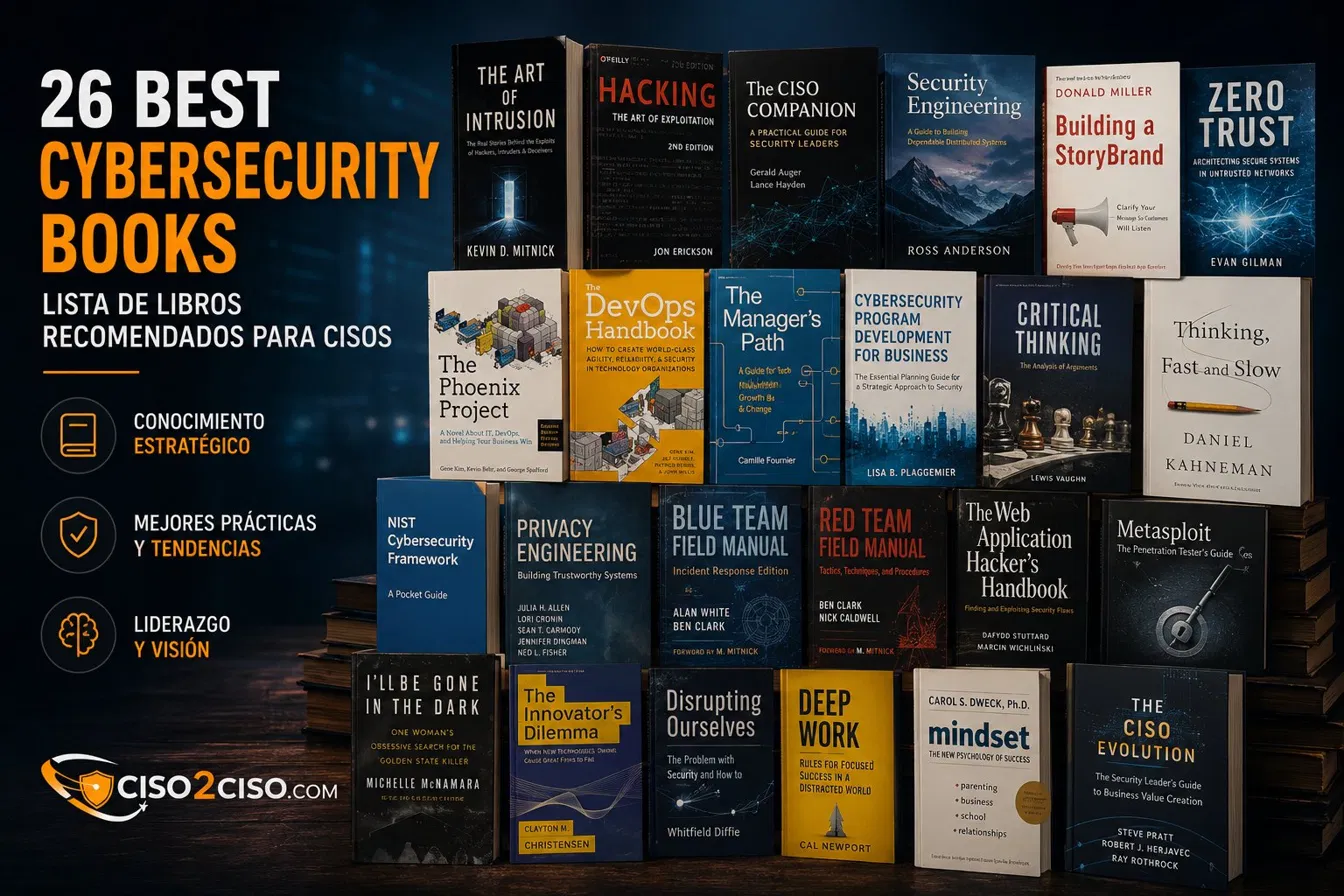
The 26 Best Cybersecurity Books Every CISO Should Read
A Personal Reading List
Books remain one of the most underused resources in cybersecurity professional development. While the field moves quickly and much of the current threat intelligence comes from blogs, advisories and conference talks, books provide something different: depth, context and frameworks that survive the churn of the news cycle.
This is my personal reading list — books I have read, recommended and returned to over the years. It is not exhaustive. The global market has many excellent titles not represented here. If you have books to add, I welcome them in the discussion.
The list spans technical depth, leadership and strategy, risk governance, and the human dimensions of security — because a complete CISO needs all of those perspectives.
The best security professionals I know are voracious readers. Not because reading replaces doing, but because the frameworks and mental models from good books shape how you think about problems you have never encountered before.
The List
1. Practical Internet of Things Security — Brian Russell, Drew Van Duren
The definitive guide to securing IoT environments, covering architecture, identity management and the unique challenges of constrained devices. Essential as OT and IoT continue to converge with enterprise security.
2. Mobile Application Security
A comprehensive treatment of mobile security architecture, vulnerability assessment and secure development for iOS and Android platforms — increasingly relevant as mobile devices become primary enterprise endpoints.
3. Ransomware: Defending Against Digital Extortion — Timothy Gallo
One of the clearest practical guides to understanding ransomware as an operational threat — covering attack anatomy, defensive architecture and recovery planning. Written before the ransomware-as-a-service era but foundational to understanding it.
4. Enterprise Cybersecurity
A framework-oriented approach to building and managing enterprise security programs at scale — covering governance, architecture, operations and the organizational dynamics of security leadership.
5. DDoS Attacks
A technical and strategic treatment of distributed denial of service — from attack methodology to defensive architecture and crisis management. More relevant than ever as DDoS is increasingly used as a component of broader attack campaigns.
6. The Art of Invisibility — Kevin Mitnick
Mitnick's accessible guide to privacy and digital self-protection. Valuable not for its technical prescriptions but for the mindset it develops around how much information adversaries can gather from open sources — critical for understanding social engineering and reconnaissance.
7. Cyber Security on Azure
A practical guide to security architecture and implementation on Microsoft Azure — covering identity, network security, threat detection and compliance in cloud-native environments.
8. Why CISOs Fail
An honest examination of the organizational, political and strategic reasons that CISO tenures end — and what successful security leaders do differently. One of the most useful books for understanding the non-technical dimensions of the role.
9. Security Information and Event Management (SIEM)
A comprehensive guide to SIEM architecture, deployment and operations — covering use case development, log management, correlation rules and the integration of threat intelligence.
10. Effective Cybersecurity
A practitioner-oriented guide to building security programs that work in the real world — balancing technical controls, organizational dynamics and resource constraints.
11. CISO COMPASS — Todd Fitzgerald
One of the most comprehensive references for the CISO role — covering strategy, governance, program management, board communication and the leadership dimensions of security. A reference book more than a cover-to-cover read.
12. Cybersecurity and Cyberwar — P.W. Singer, Allan Friedman
An accessible introduction to the geopolitical dimensions of cybersecurity — nation-state actors, cyber conflict, policy frameworks and the intersection of technology and international relations. Essential context for CISOs operating in critical infrastructure or multinational environments.
13. The Frugal CISO
A practical guide to achieving security objectives under resource constraints — prioritization frameworks, ROI analysis and the art of doing more with less. Relevant to virtually every CISO regardless of budget.
14. Human Dimensions of Cybersecurity
A research-grounded examination of the human factors in security — behavior, psychology, organizational dynamics and the role of culture in security program effectiveness. Often overlooked but critical to understanding why technical controls alone are insufficient.
15. PRAGMATIC Security Metrics — W. Krag Brotby, Gary Hinson
A rigorous treatment of security metrics — what to measure, how to measure it, and how to present security data to audiences with different needs. One of the few books that addresses the measurement problem in security seriously.
16. Malware Analyst's Cookbook
A hands-on technical reference for malware analysis — covering static and dynamic analysis techniques, sandbox environments and the practical skills of understanding what malicious code actually does.
17. Advanced Persistent Threat Hacking
A deep examination of APT attack methodology — covering reconnaissance, initial access, lateral movement, persistence and exfiltration. Understanding how sophisticated attackers operate is prerequisite to defending against them.
18. Data and Goliath — Bruce Schneier
Schneier's examination of surveillance, data collection and privacy in the modern world — covering corporate data practices, government surveillance and the policy implications of a world in which data about individuals is continuously collected and analyzed.
19. Cognitive Hack
An exploration of the psychology of cyber deception — how attackers exploit cognitive biases, social engineering and human decision-making. A unique perspective that bridges security and behavioral science.
20. We Have Root — Bruce Schneier
A collection of Schneier's essays on security, technology and society — accessible, provocative and consistently useful for developing the broader perspective that senior security leaders need.
21. Detección de Intrusos (Intrusion Detection)
A foundational technical reference on intrusion detection systems — covering detection methodologies, signature and anomaly-based approaches, and the operational challenges of running an effective detection program.
22. Future Crimes — Marc Goodman
An examination of the criminal and national security implications of emerging technology — cybercrime, dark web ecosystems, the exploitation of connected devices and the future of organized crime in a digital world.
23. @War — Shane Harris
An investigative account of the United States' offensive and defensive cyber operations — providing essential context on the government's approach to cyberspace as a domain of conflict and the blurry line between intelligence and attack.
24. The Art of War — Sun Tzu
The strategic classic that remains as relevant to information security as it is to any domain of conflict. The concepts of knowing your adversary, choosing your battles, and achieving victory through intelligence rather than force apply directly to security strategy.
25. Becoming a Global Chief Security Officer
A guide to the evolution of the security leadership role — covering the intersection of physical and cyber security, the globalization of security programs and the competencies required for executive security leadership in multinational organizations.
26. Designing and Building a Security Operations Center
A practical guide to SOC architecture, staffing, technology selection and operational processes — covering everything from initial design decisions to the day-to-day management of a mature security operations capability.
How to Use This List
No one reads 26 books in sequence. The more useful approach is to identify the two or three areas where your current perspective has the most gaps and start there.
Technical practitioners who have moved into leadership roles often find the most value in books 8, 11, 13, 14 and 15 — the ones that address the organizational and strategic dimensions of the CISO role.
Leaders with primarily business or governance backgrounds often find the most value in books 3, 7, 16 and 17 — the ones that build intuition for the technical realities of the threat landscape.
And everyone benefits from books 6, 12, 22 and 24 — the ones that develop the broader perspective that distinguishes truly strategic security thinking from technically competent but narrowly focused security management.
What books would you add to this list?