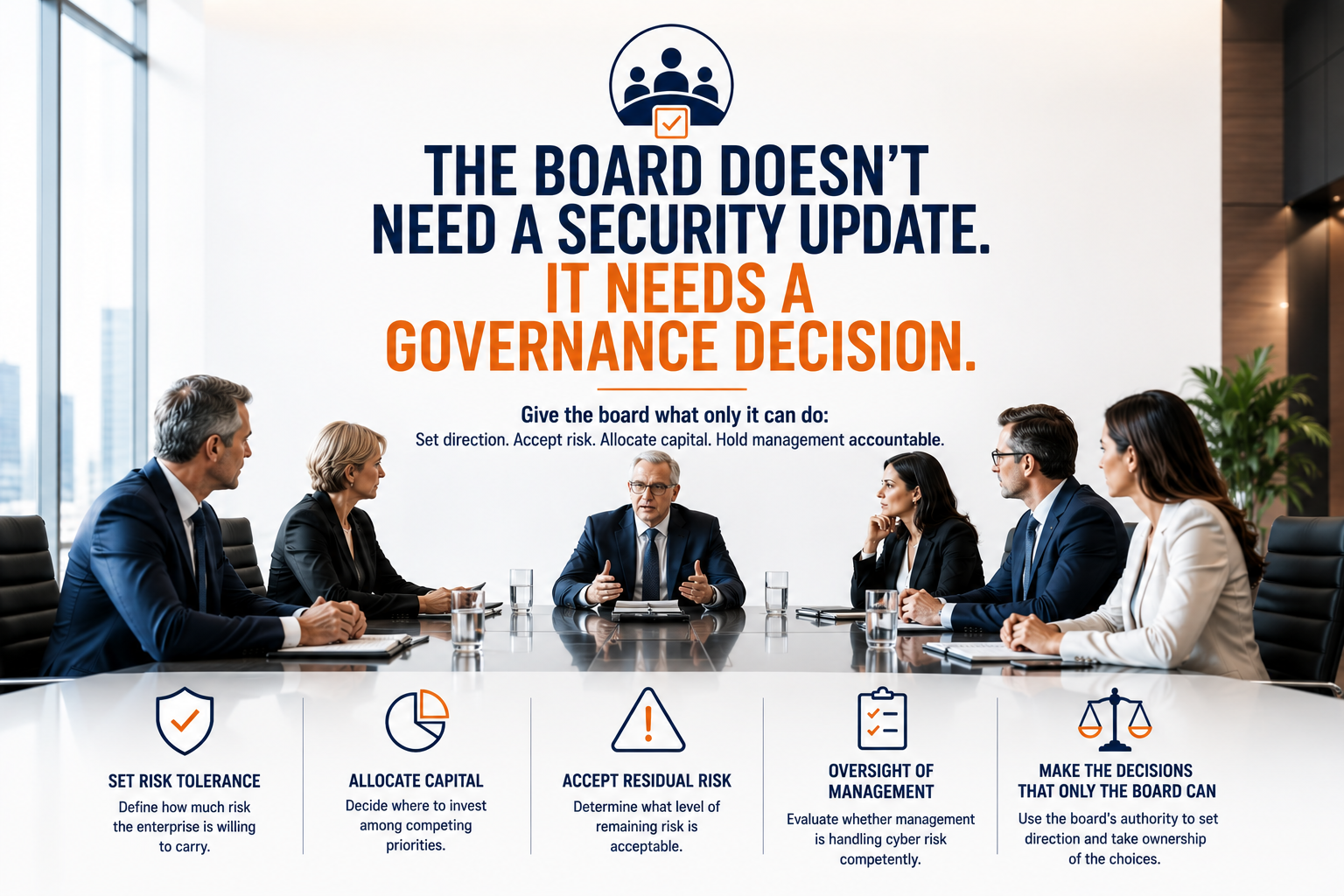
The Board Doesn't Need a Security Update. It Needs a Governance Decision.
Overview
Watch a typical CISO board presentation and a pattern emerges. The slides walk through what the security program has been doing: projects completed, incidents handled, metrics trending, frameworks adopted. The tone is reassuring. The implicit message is "we are working hard and things are under control." The board listens, perhaps asks a clarifying question, and notes that the update was received.
This is a status report. It is not governance. And the gap between the two is one of the most consequential and least examined dynamics in the relationship between security leaders and the boards they serve.
A board's function is not to receive updates. It is to govern — to make the small number of decisions that only it can make: how much risk the enterprise will tolerate, where capital will be allocated against competing priorities, whether a given exposure is acceptable, and whether management is discharging its responsibilities adequately. A security leader who fills the board's limited time with activity reporting has, in effect, taken governance off the table and replaced it with reassurance. The board leaves informed about effort and no better equipped to govern.
Why This Matters Now
The cost of this confusion is rising on both sides. Boards are facing intensifying expectations — from regulators and from the legal exposure of directors personally — to demonstrate active oversight of cyber risk. "We were given regular updates" is no longer a confident answer to whether a board fulfilled its duty. Boards increasingly need a record of having made decisions, weighed options, set tolerances and held management accountable — and they can only build that record if the security leader brings them decisions to make.
Security leaders, in turn, are operating under harder budget scrutiny and need genuine governance backing for their priorities. A board that has merely received updates has not endorsed anything. A board that has been brought a clear decision — these are the options, here is the recommendation, here is what we are choosing not to do — has co-owned the choice. That shared ownership is exactly what a CISO needs when a hard trade-off is later questioned, or when an incident occurs in an area the board explicitly chose not to prioritize.
The shift from reporting to enabling governance serves both parties. It is also, in most organizations, simply not happening.
CISO2CISO Insight
The board's time is the scarcest governance resource in the company. Spend it on what only the board can do — set tolerance, allocate capital, accept or reject risk — and almost none of that is a status update.
What the Board Can Decide That No One Else Can
The reframe begins with a precise understanding of what a board is uniquely positioned to do. Most of what fills board security slides could be handled by management. A handful of things cannot.
Risk tolerance. Only the board can authoritatively define how much cyber risk the enterprise is willing to carry. Management can recommend a tolerance; the board sets it. Without that signal, every prioritization decision below it is being made in the absence of an agreed boundary.
Capital allocation against alternatives. The board governs the allocation of finite resources across competing enterprise priorities. A security investment is not evaluated in isolation — it competes with everything else the company could do with the same capital. Bringing the board that trade-off explicitly is governance. Reporting that the budget was spent is not.
Acceptance of residual risk. After controls are applied, risk remains. Someone with the authority to commit the enterprise must decide whether that residual is acceptable. When the board makes that decision explicitly, it is governing. When residual risk is simply mentioned in a slide, no one has accepted anything — the risk is unowned.
Accountability for management. The board's oversight role includes judging whether management is handling cyber risk competently. That requires the security leader to present in a way that allows the board to actually evaluate the program — including its weaknesses — rather than only its successes.
How to Bring a Decision Instead of an Update
The practical change is in the structure of what the security leader puts in front of the board.
A status report says: here is what we did, here is how the metrics look, here is why you can feel reassured. A governance package says: here is a specific decision the board needs to make, here are the realistic options with their consequences and costs, here is our recommendation and the reasoning behind it, and here is explicitly what we are proposing not to do and why. The first asks the board to acknowledge. The second asks the board to govern — and gives it what it needs to do so.
This does not mean activity and metrics disappear. It means they move to the background as supporting context, and the foreground becomes the decision. The test of a board security session is simple: did the board leave having decided something, accepted something, or set something — or did it merely leave informed?
Executive Framework
| Element | Status update (typical) | Governance package (better) |
|---|---|---|
| Purpose | Inform and reassure | Enable a decision |
| Foreground | Activity, metrics, projects | A specific choice the board must make |
| Options | None — here is what we did | Realistic alternatives with consequences |
| Recommendation | Implicit ("on track") | Explicit, with reasoning |
| Trade-offs | Hidden | Stated, including what we will not do |
| Board's exit | "Update received" | "Decision made / tolerance set / risk accepted" |
What CISOs Should Do Next
- Audit your last several board sessions honestly: how many ended with the board deciding, accepting or setting something — versus simply being informed?
- Restructure board materials around the specific decisions the board needs to make, moving activity and metrics into supporting context rather than the headline.
- For each material decision, bring real options with consequences and costs — and a clear recommendation — rather than a single course of action presented as inevitable.
- Make residual risk and explicit acceptance a standing part of the conversation, so that what the enterprise is choosing to live with is owned by the body with authority to own it.
- State what you are choosing not to do and why — deliberate non-investment is a governance decision, and surfacing it builds far more trust than implying everything is covered.
- Cultivate the relationship between meetings — the highest-functioning CISO-board relationships are built in the conversations that happen outside the formal session, not only in it.
Board-Level Questions
- When our security leader presents, do we leave having governed — set tolerance, allocated, accepted, decided — or merely having been updated?
- Are we being brought real options and recommendations, or a single narrative of activity?
- Do we know, explicitly, what residual cyber risk we are accepting — and have we actually accepted it?
- Are we being told what management has chosen not to do, so we can govern those choices rather than discover them after an incident?
Final Takeaway
The most common failure in cyber governance is not a board that does not care or a CISO who does not work hard. It is a structural mismatch: a security leader bringing updates to a body whose purpose is decisions. The result is a room full of capable people, the scarcest governance resource in the company, spending their limited attention on reassurance — and a security program that emerges with no genuine mandate, because nothing was actually decided.
The fix is not more polished reporting. It is a different kind of conversation — one built around the choices only the board can make, the options it must weigh, and the trade-offs it needs to own. That is harder to prepare and more uncomfortable to present, because it surfaces difficulty rather than hiding it. It is also the only version of the conversation that constitutes governance.
The board doesn't need to know how hard the security team is working. It needs to make the decisions that only it can make — and it can only do that if the security leader stops bringing updates and starts bringing choices.
*To be continued...*