The APIs You Open to Partners Are the Ones You Control Least
Executive Summary
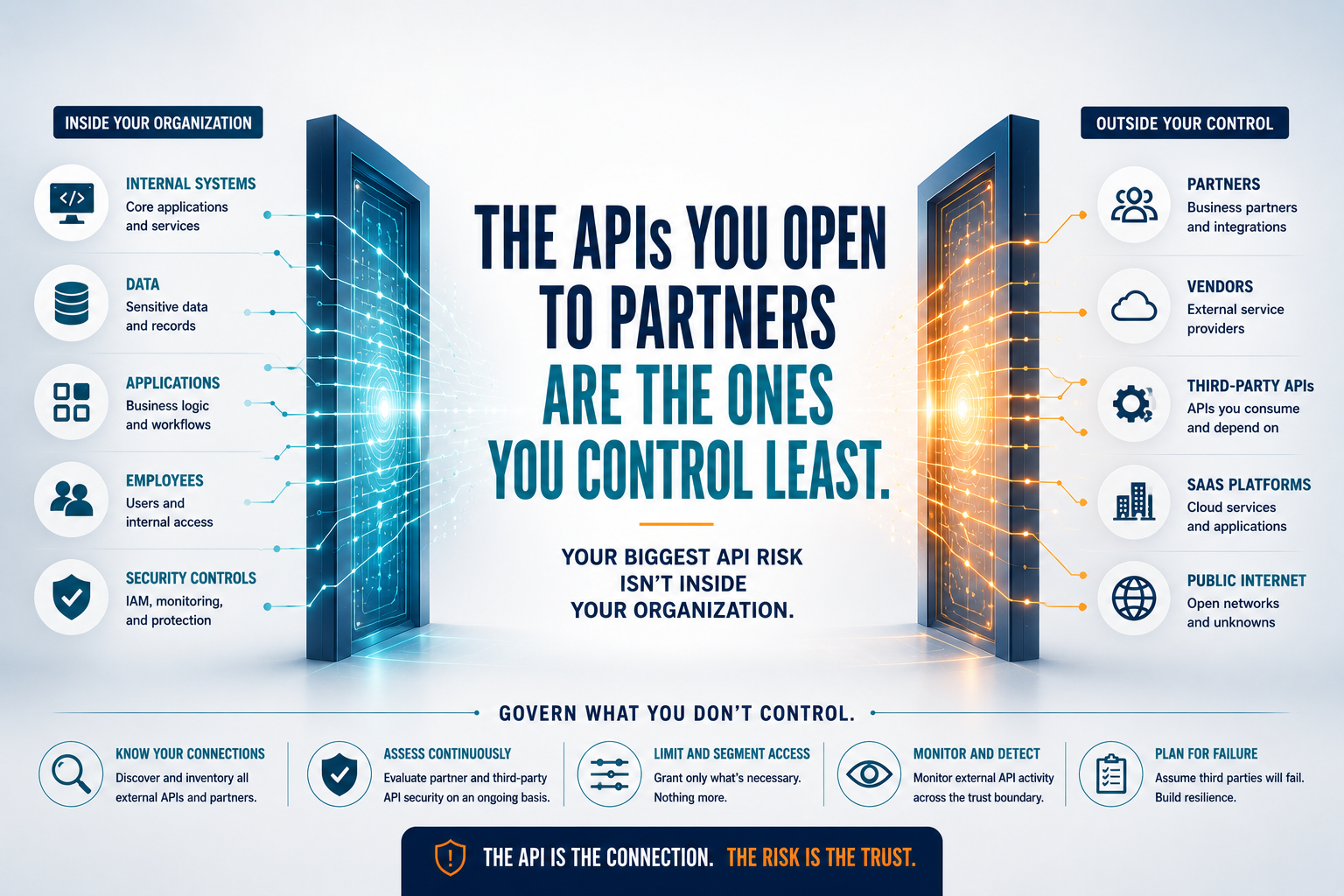
When organizations think about API security, they tend to think about their own APIs — the ones their developers build, deploy and operate inside the environment. Securing those is genuinely difficult, and it rightly absorbs most of the attention. But there is a second category of API risk that is governed far more loosely than its consequences warrant: the APIs that cross the boundary of the organization. The ones it exposes to partners and customers, and the third-party APIs it consumes to make its own systems work.
These external API relationships are different in kind, not just degree. An API exposed to a partner is a doorway the organization has deliberately opened in its own walls, through which an external party reaches in. A third-party API the organization consumes is a dependency through which an external party's systems reach into the organization's operations and, often, its data. In both directions, there is a trust boundary running straight through the business — and the controls built for internal APIs frequently do not extend across it.
The result is a category of risk that is highly consequential, because these relationships are often central to how the business operates, and weakly governed, because they sit at the edge where the organization's direct control ends. The APIs you open to partners and depend on from third parties are, paradoxically, the ones you control least.
Why This Matters Now
The modern business runs on API connections that cross organizational boundaries. Partner integrations, customer-facing APIs, third-party services woven into core processes — these external API relationships are not peripheral; they are increasingly how value is delivered and how operations function. The organization's API surface is no longer bounded by what it builds internally. It extends outward, to every party it exposes an API to and every API it consumes.
This expansion has outpaced the governance applied to it. Internal API security, however imperfect, at least sits within the organization's direct control. The external relationships introduce parties whose security the organization does not control, whose behavior it cannot fully see, and whose compromise can propagate across the boundary in either direction. A partner with access through an exposed API becomes a path into the organization if that partner is compromised. A third-party API the organization depends on becomes a source of risk if it is breached, manipulated, or simply behaves in unexpected ways. The dependence is deep; the visibility and control are shallow; the gap between them is where the risk lives.
CISO2CISO Insight
Your hardest API security problem is not the API your team wrote. It is the one you opened to a partner you do not control, and the one you depend on from a third party you cannot see into. The trust boundary runs through your business — and that is exactly where your controls tend to stop.
The Two Directions of External API Risk
External API risk flows in two directions, and each requires distinct attention.
The APIs you expose. When an organization opens an API to partners or customers, it creates an access path from outside into its own systems and data. The risk is multifaceted: the external party may be compromised, turning their legitimate access into an attack path; the API may be abused through its legitimate functionality; or the access granted may be broader than the relationship requires. Because these APIs are deliberately exposed, they are also discoverable and attractive to attackers, who understand that a partner-facing API is a doorway into an otherwise harder target.
The APIs you consume. When an organization depends on third-party APIs, it inherits risk from those providers. A compromised or manipulated third-party API can feed bad data into the organization's systems, become a vector for attack, or fail in ways that disrupt operations. The organization has limited visibility into the security of these APIs and limited control over them, yet its own operations may depend on them critically. This is third-party risk expressed at the API layer — inherited dependence on parties the organization does not control.
The trust boundary in both directions. What unites the two is the trust boundary. Internal API controls assume a degree of control over both ends of the connection. External API relationships break that assumption — one end is outside the organization's control — which is precisely why the internal control model does not simply extend across the boundary.
Governing the External API Relationship
Managing this risk requires treating external API relationships as the distinct, consequential category they are, rather than as an extension of internal API security.
Govern exposed APIs by least access and strong verification. APIs opened to external parties should grant the minimum access the relationship requires, verify the external party rigorously, and be monitored for abuse — recognizing that the external party itself may be compromised. The access granted defines the blast radius if the partner is breached.
Assess and monitor the third-party APIs you depend on. The third-party APIs woven into critical operations deserve scrutiny proportionate to the dependence — understanding the provider's security posture, monitoring for anomalous behavior, and validating the data and responses they provide rather than trusting them implicitly.
Map the external API surface. Most organizations have a poor inventory of the APIs they expose and consume across organizational boundaries. As with internal APIs, you cannot govern what you have not mapped, and the external surface is frequently even less well understood than the internal one.
Plan for the external compromise. Because these relationships involve parties the organization does not control, it must be prepared for one of them to be compromised — to detect the exposure, contain it at the boundary, and respond without assuming the external party will handle it.
Executive Framework
| Dimension | Internal APIs | External API relationships |
|---|---|---|
| Control over both ends | Within the organization | One end is outside your control |
| Primary risk | Logic abuse, inventory gaps | Trust-boundary compromise in both directions |
| Exposed APIs | — | Partner access becomes a path in if breached |
| Consumed APIs | — | Inherited risk from providers you cannot see into |
| Visibility | Limited but achievable | Shallow on the external end |
| Governance posture | Often the main focus | Frequently under-governed relative to dependence |
What CISOs Should Do Next
- Treat external API relationships as a distinct, consequential risk category, separate from internal API security, because the trust boundary changes the problem fundamentally.
- Map the external API surface — every API you expose to partners and customers and every third-party API your operations depend on — since you cannot govern what you have not inventoried.
- Govern exposed APIs by least access and strong verification, granting external parties only what the relationship requires and monitoring for abuse, on the assumption the party may be compromised.
- Assess and monitor critical third-party APIs proportionate to your dependence, rather than trusting the data and availability of providers you do not control.
- Validate, do not assume, the responses and data from third-party APIs woven into your operations, treating the boundary as a place to verify rather than trust.
- Prepare for external compromise, with the ability to detect exposure, contain it at the boundary, and respond without depending on the external party to do so.
Board-Level Questions
- Do we have a clear inventory of the APIs we expose to partners and customers, and the third-party APIs our operations depend on?
- If a partner with access through one of our exposed APIs were compromised, how far into our environment could that access reach?
- How much of our operation depends on third-party APIs whose security we cannot see into or control, and what happens if one is breached or fails?
- Are we governing our external API relationships proportionately to how much our business depends on them — or far more loosely than the dependence warrants?
Final Executive Takeaway
The hardest part of API security is not always the part the organization built. The APIs that cross the organizational boundary — exposed to partners, consumed from third parties — introduce a trust boundary that the internal control model was never designed to span. One end of these connections sits outside the organization's control, and that single fact reshapes the risk: a compromised partner becomes a path in, a breached third-party API becomes a source of attack or disruption, and the visibility the organization relies on internally simply is not there.
These relationships are also, increasingly, central to how the business operates — which makes the gap between their consequence and their governance the dangerous part. Closing it means mapping the external surface, governing exposed APIs by least access, scrutinizing the third parties the business depends on, and preparing for the compromise of a party the organization cannot control.
The APIs your team wrote are within your reach. The ones you opened to partners and depend on from third parties are not — and that is exactly why they are the ones you most need to govern deliberately, because no one else is going to do it for you.
*To be continued...*