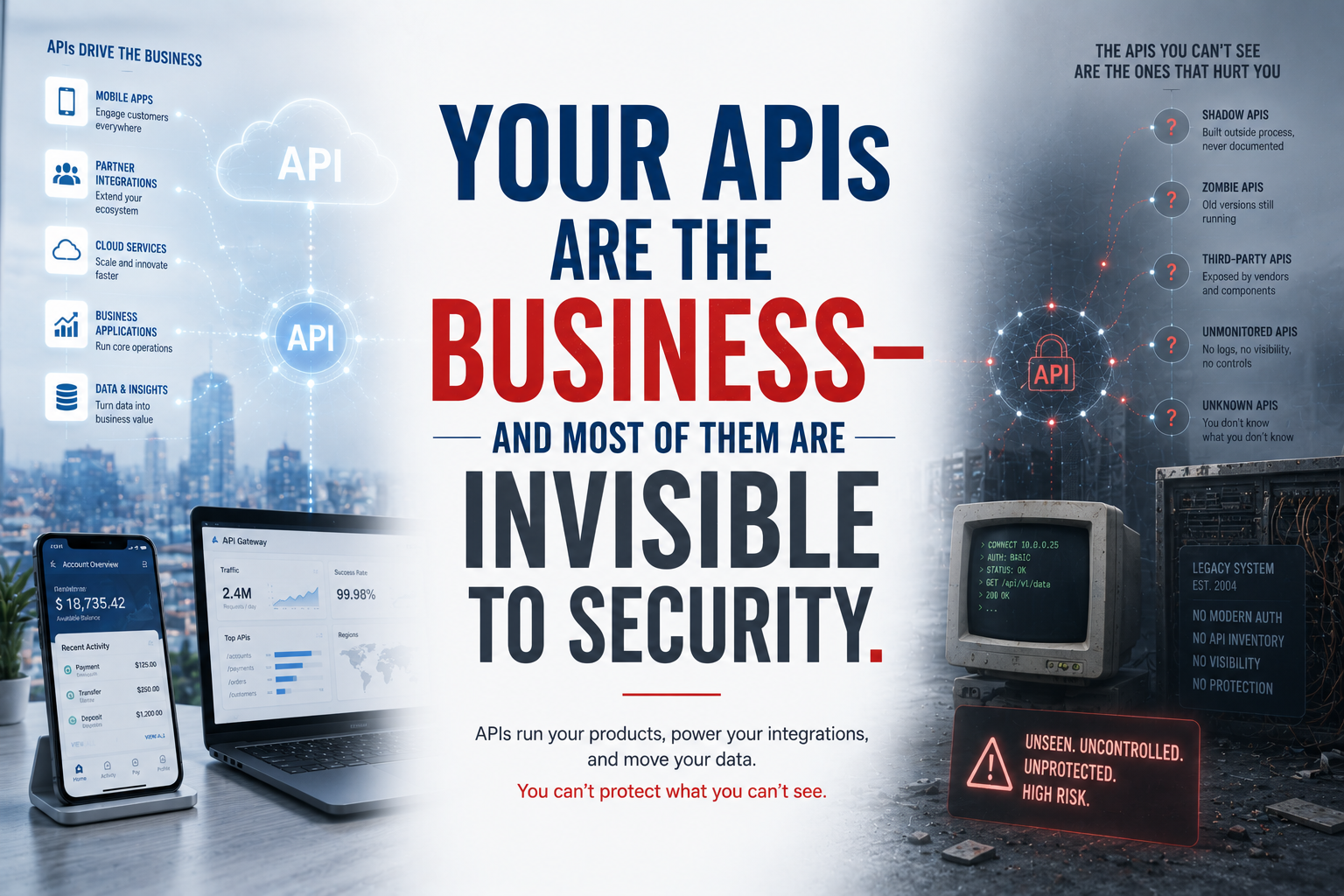
Your APIs Are the Business — and Most of Them Are Invisible to Security
Executive Summary
Somewhere along the way, application programming interfaces stopped being technical plumbing and became the business itself. The way an organization exposes its products, integrates with partners, serves its mobile and web applications, and moves data between its own systems — almost all of it now runs over APIs. The modern enterprise is, in a real sense, a collection of APIs with a brand wrapped around it. Value flows through them, data flows through them, and increasingly, so do customers and partners.
And yet, if you ask most organizations for an accurate, complete inventory of the APIs they operate, you will not get one. They can describe the APIs they meant to build and document. They cannot account for the ones that were deployed quickly and never registered, the old versions left running after they were supposed to be retired, or the ones exposed by third-party components and integrations. The organization depends on APIs for its core operations while being unable to see most of them — and you cannot secure what you cannot see.
This gap, between how thoroughly the business runs on APIs and how poorly security can account for them, is one of the most significant and least-managed exposures in the enterprise today.
Why This Matters Now
The reliance on APIs has grown faster than the discipline to manage them. The shift to microservices, cloud-native architectures and rich web and mobile experiences has multiplied the number of APIs an organization runs by orders of magnitude. Each new feature, integration and service tends to add APIs, and the rate of creation routinely outpaces any process meant to track them. The result is that the API estate is large, growing, and largely uninventoried.
The risk is sharpened by what attackers have understood and many defenders have not: APIs are attacked differently than the applications older tools were built to protect. Many API attacks do not look like attacks in the traditional sense. They are not malformed payloads or obvious exploits that a perimeter tool would flag. They are legitimate-looking requests that abuse the logic of the API — accessing data that should belong to another user, calling functions in unintended sequences, or exploiting authorization gaps. The traffic looks valid because, structurally, it is valid. Only an understanding of what the API should and should not allow reveals the abuse, and that is precisely what generic tools lack.
CISO2CISO Insight
The modern enterprise runs on APIs the way an older one ran on a physical perimeter. The difference is that the perimeter was at least visible. Most organizations cannot list the APIs they depend on — which means they are securing a business whose primary surface they cannot see.
Why API Security Is Its Own Problem
It is tempting to treat API security as a subset of application security, covered by existing tools. The reasons that assumption fails are worth understanding.
You cannot secure an uninventoried API. The foundational problem is visibility. Shadow APIs — deployed outside process and never registered — and zombie APIs — old versions still running after they should have been retired — are common precisely because the rate of API creation and change overwhelms manual tracking. These unknown APIs are disproportionately dangerous because no security process was ever applied to them. Discovery, continuous and automated, is the precondition for every other control.
The attacks are about logic, not payloads. Traditional application security tools and perimeter defenses were largely built to detect malicious content — known attack patterns in the traffic. The most consequential API attacks instead abuse the intended functionality: a request that is perfectly well-formed but asks for data the requester should not be allowed to see. Detecting this requires understanding the API's intended behavior and authorization model, not just scanning for bad payloads.
Authorization is the recurring weak point. A large share of serious API incidents trace back to authorization flaws — the API correctly authenticates who is calling but fails to properly enforce what they are allowed to access. This is a subtle, design-level problem that surface-level scanning does not catch and that has to be addressed in how APIs are built and tested, not only how they are monitored.
APIs expose data directly. An API is, by design, a direct channel to data and functionality. When it is poorly secured, it is not a stepping stone toward sensitive data — it is direct access to it. That directness raises the consequence of every gap.
From Unknown to Governed
A credible API security program follows a sequence that starts with the problem most organizations skip.
It begins with discovery: building and continuously maintaining an accurate inventory of every API the organization runs, including the shadow and zombie APIs that manual processes miss. It pairs that inventory with an understanding of which APIs expose sensitive data or critical functionality, so that attention is proportionate to risk. It addresses authorization deliberately — in design, in testing, and in runtime monitoring — because that is where the most serious failures concentrate. And it monitors API behavior for the logic abuse that generic tools miss, grounded in an understanding of how each API is supposed to be used.
The throughline is that API security is its own discipline, built on visibility and behavioral understanding, rather than a checkbox within application security. The organizations that treat it that way can defend the surface their business actually runs on. The ones that fold it into existing tooling and assume coverage are protecting a fraction of an estate they cannot fully see.
Executive Framework
| Dimension | Assumed (covered by AppSec) | Reality of API security |
|---|---|---|
| Inventory | We know our APIs | Shadow and zombie APIs are common and unseen |
| Attack type | Malicious payloads | Logic and authorization abuse via valid-looking requests |
| Detection | Scan for bad content | Understand intended behavior and authorization |
| Weak point | Input validation | Broken authorization at the object and function level |
| Exposure | A path toward data | Direct access to data and functionality |
| Discipline | A subset of AppSec | Its own discipline grounded in visibility |
What CISOs Should Do Next
- Start with discovery — build and continuously maintain an inventory of every API the organization runs, treating shadow and zombie APIs as expected findings rather than surprises.
- Prioritize by exposure, identifying which APIs handle sensitive data or critical functionality so that protection is proportionate to consequence.
- Address authorization at the design and testing stage, since broken authorization is where the most serious API incidents concentrate and runtime detection alone is too late.
- Deploy monitoring that understands API behavior, capable of detecting logic abuse in valid-looking traffic rather than only scanning for known-bad payloads.
- Treat API security as its own discipline with dedicated ownership, rather than assuming it is covered by existing application security tooling.
- Govern the API lifecycle, so that APIs are registered when created and retired when deprecated, shrinking the shadow and zombie surface over time.
Board-Level Questions
- Can we produce an accurate, complete inventory of the APIs our business depends on — including the ones deployed outside process and the old versions still running?
- Are we equipped to detect attacks that abuse the legitimate logic of our APIs, or only attacks that look obviously malicious?
- How confident are we in the authorization controls of the APIs that expose our most sensitive data and functionality?
- Are we treating API security as its own discipline with clear ownership, or assuming our application security tools already cover it?
Final Executive Takeaway
The transformation of the enterprise into a set of APIs happened faster than the discipline to secure them. The business came to depend on APIs for nearly everything — revenue, integration, customer experience, the movement of its own data — while the security function was left unable to even enumerate them, let alone protect them against attacks that look like ordinary use. The reliance is total; the visibility is partial; the gap between them is where the exposure lives.
Closing it does not start with a new defensive tool. It starts with seeing the surface at all — a continuous, accurate inventory of the APIs the business actually runs — and then understanding each one well enough to recognize when its legitimate logic is being abused. That is unglamorous, foundational work, and it is the only work that addresses the actual problem.
Your APIs are the business. The uncomfortable question is how many of them your security team could even name — because the ones it cannot name are the ones already exposed.
*To be continued...*