The CISO Is Now Personally on the Hook. Here's What That Changes.
Overview
For most of the role's history, the consequences of failure for a CISO were professional in the ordinary sense — a damaged reputation, a lost job, a difficult next interview. Serious, but bounded. A series of high-profile cases has changed that boundary. Security leaders have faced personal legal and regulatory consequences for decisions made during and after incidents — particularly decisions about disclosure, about what was communicated to regulators and the organization, and about how the truth of a security situation was represented.
The precise legal contours vary by jurisdiction and continue to evolve, and this is not legal advice. But the directional shift is unmistakable and consequential: the CISO is no longer insulated from personal accountability for how security risk is handled and disclosed. That changes the role in ways that reach far beyond the individual's exposure. It reshapes the incentives around honesty, the relationship with the board, the documentation of decisions, and the very willingness of capable people to take the job.
How an organization responds to this shift — whether it treats it as a problem for the CISO to absorb alone or as a governance issue for the enterprise — says a great deal about the maturity of its security leadership.
Why This Matters Now
The personal-accountability shift has arrived alongside intensifying disclosure obligations. Regulators increasingly require timely, accurate disclosure of material security incidents, and the consequences of getting that wrong now extend to individuals, not only organizations. A security leader navigating an incident is making decisions — about materiality, timing, and characterization — under conditions where being wrong can have personal repercussions. The pressure is real, and it operates at exactly the moment when judgment is hardest: in the fog of an active incident, with incomplete information and competing pressures.
This creates a dynamic that organizations need to understand, because it can work against their own interests. A CISO who fears personal exposure may become more cautious, more defensive, more inclined to protect themselves — and those instincts do not always align with candid, fast, accurate communication. The organization that wants the truth from its security leader, quickly, has to create conditions where telling the truth is not personally hazardous. Otherwise it has built an incentive structure that quietly discourages exactly the behavior it most needs.
CISO2CISO Insight
When you make the messenger personally liable for the message, do not be surprised if the messages get more careful, more lawyered, and slower. The organizations that want candor from their CISO have to make candor safe.
What Personal Accountability Changes
The shift ripples through several dimensions of the role and the governance around it.
The relationship to truth becomes higher-stakes. A CISO's value to an organization rests substantially on telling it the truth about its security posture — including the uncomfortable parts. Personal exposure raises the stakes of every such communication. The organization needs the unvarnished truth; the individual now has a personal interest in how that truth is framed. Reconciling these requires deliberate effort, not assumption.
Documentation stops being optional. When decisions can later be examined with personal consequences attached, the ability to show what was known, when, and why a given decision was made becomes essential. Sound, contemporaneous documentation of risk decisions — including risks raised and not funded — shifts from good practice to genuine necessity, protecting both the individual and the integrity of the record.
The board relationship carries new weight. A security leader who has clearly and repeatedly communicated risks to the board, and documented those communications, stands in a very different position from one who managed risk quietly. The personal-accountability era rewards the security leader who brings the board into genuine ownership of risk decisions — which, not coincidentally, is also better governance.
Talent and tenure are affected. The role becomes harder to fill and harder to retain when personal exposure is part of the package, particularly if the organization does not provide the protections and support that the responsibility warrants. The pipeline of people willing to take senior security roles is not infinite, and the conditions of the role affect it.
What Organizations Should Do About It
This is where the response separates mature organizations from the rest. The personal-accountability shift can be left for the CISO to absorb, or it can be treated as the governance issue it actually is.
Provide the protections the responsibility deserves. Organizations that hold a leader personally accountable for cyber risk should ensure that leader has appropriate protections and support — the kind of considerations that apply to others who carry significant organizational accountability. Leaving the individual exposed while expecting candid risk leadership is incoherent.
Build a culture where raising risk is safe. If communicating bad news is personally hazardous, the organization will get less of it. Leadership has to make clear, in practice and not just in principle, that surfacing risk and being honest about posture is valued and protected, not punished.
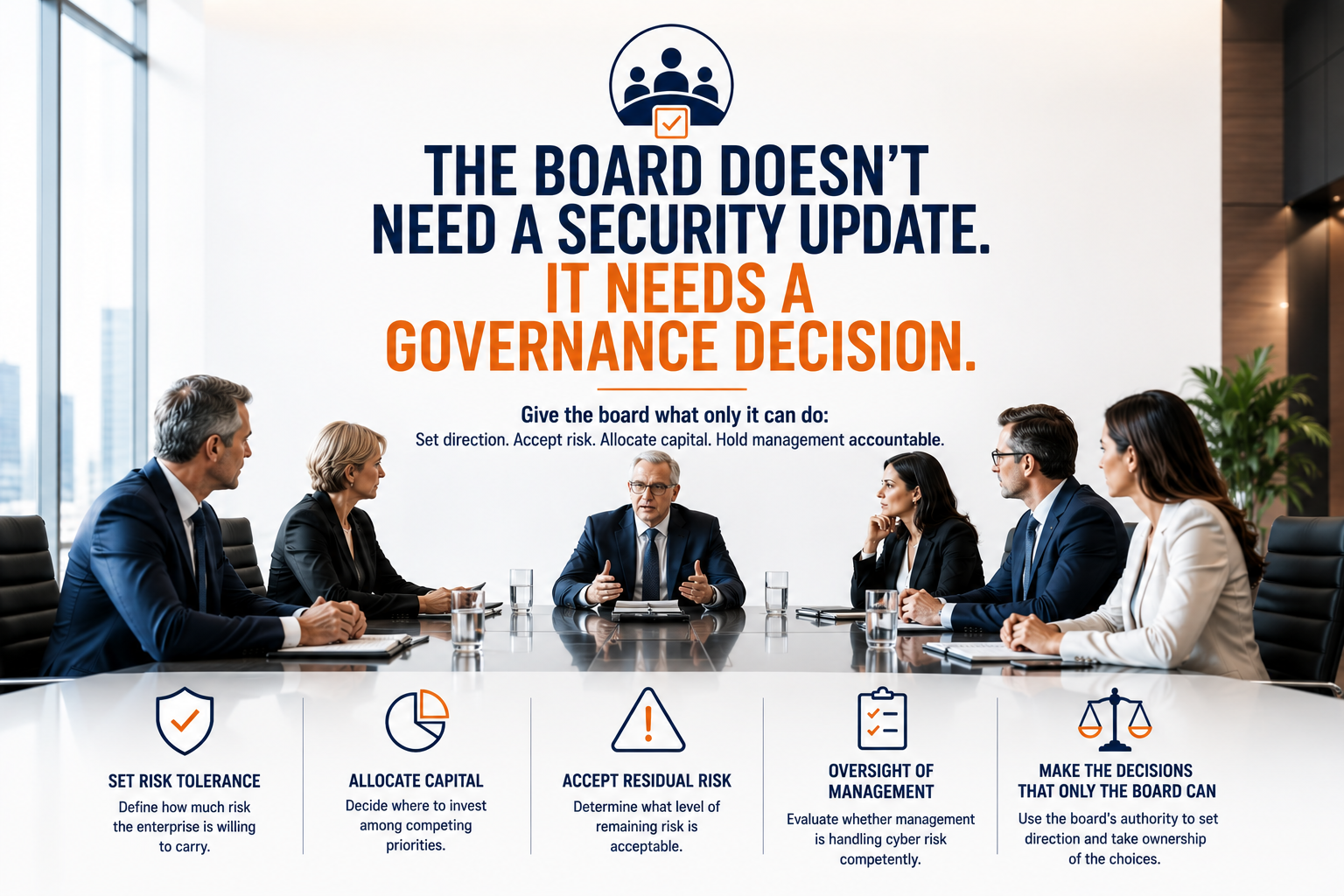
Make decision ownership genuinely shared. Risk decisions — what to fund, what to accept — should be owned by the body with authority to own them, the board, not silently absorbed by the CISO. Shared, documented ownership is both better governance and a fairer distribution of accountability.
Support, do not isolate, during incidents. The moments of greatest personal exposure are during and after incidents. Organizations that surround the security leader with legal, executive and board support during those moments get better decisions and a more candid process than those that leave the CISO to navigate alone.
Executive Framework
| Dimension | The old model | The personal-accountability era |
|---|---|---|
| CISO's exposure | Professional (reputation, job) | Personal (legal, regulatory) |
| Stakes of candor | High, but bounded | Personally consequential |
| Documentation | Good practice | Essential to the record and the individual |
| Risk ownership | Often absorbed by the CISO | Must be genuinely shared with the board |
| Organizational response | Leave it to the individual | Treat as a governance issue, provide protection |
| Effect on talent | Limited | Real impact on who will take the role |
What CISOs Should Do Next
- Document risk decisions contemporaneously — what was known, what was raised, what was decided and by whom — as both sound governance and a protection of the record.
- Bring risks to the board explicitly and repeatedly, ensuring that decisions to fund or accept risk are owned by the body with authority over them rather than absorbed quietly.
- Clarify your protections and support with the organization, so that personal accountability is matched by the considerations the responsibility warrants.
- Foster a culture, by your own example, where surfacing risk and telling the truth about posture is the norm — and advocate for that culture above you.
- Prepare for the incident in advance, establishing the legal, executive and board support structure you would rely on before you are in the middle of one.
- Keep candor as the non-negotiable center of the role, while building the structure that makes candor safe to deliver.
Board-Level Questions
- Do we want the unvarnished truth about our security posture from our CISO — and have we created the conditions that make telling it safe rather than personally hazardous?
- Are risk decisions — what we fund and what we accept — genuinely owned by the board, or quietly absorbed by our security leader?
- Have we provided our security leader the protections and support appropriate to the personal accountability the role now carries?
- During an incident, would our CISO be supported by legal, executive and board structures — or left to navigate personal exposure alone?
Final Takeaway
The shift toward personal accountability for security leaders is, in one sense, a recognition that the role matters — that the decisions made in and around security incidents have consequences serious enough to attach to individuals. But recognition without support is a trap. An organization that holds its CISO personally accountable while leaving them exposed, isolated and incentivized toward self-protection will get a more careful, more defensive, slower security leader at exactly the moments it needs an honest, fast, candid one.
The mature response treats this as what it is: a governance question for the enterprise, not a private burden for the individual. Document the decisions. Share the ownership. Provide the protections. Build the culture where the truth is safe to tell. Done well, the personal-accountability era can actually strengthen security governance — by forcing into the open the honest risk conversations that should have been happening all along.
Making the CISO personally accountable changes everything about how risk gets communicated. Whether it changes things for better or worse depends entirely on whether the organization makes telling the truth safe — or leaves its security leader to carry the exposure alone.
*To be continued...*