The Endpoint Will Be Compromised. Plan for the Hour After.
Executive Summary
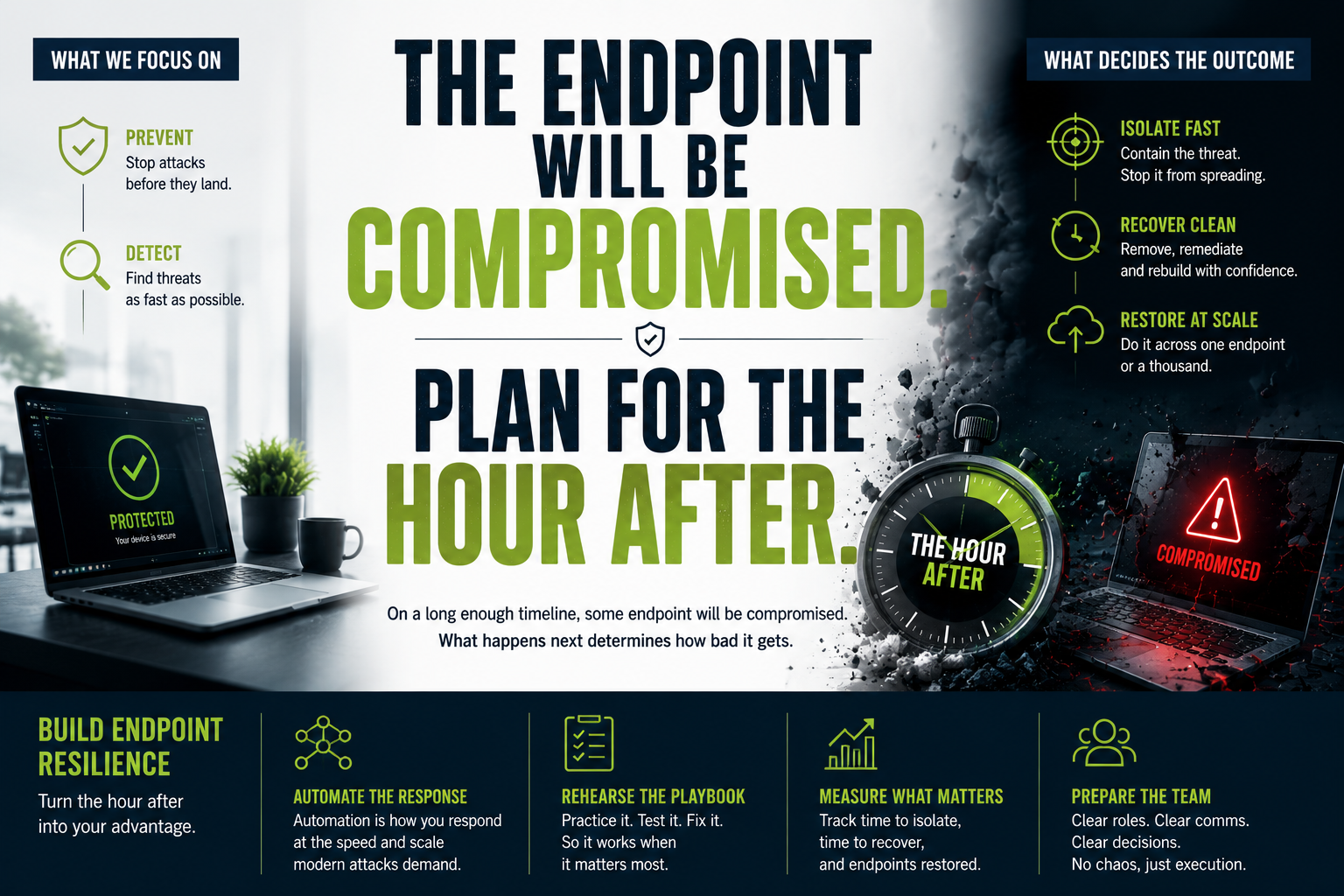
Endpoint security has been built, overwhelmingly, around two ideas: prevent compromise, and detect it quickly when prevention fails. Both are essential, and the industry has gotten dramatically better at them. But there is a third idea that receives a fraction of the investment, and on a long enough timeline it is the one that determines the outcome: what happens in the hour after an endpoint is compromised.
Because on a long enough timeline, some endpoint will be compromised. The assumption that prevention and detection will catch everything, every time, is not one any serious security leader actually holds — and yet endpoint strategies are frequently built as though it were true, with the overwhelming majority of attention on keeping compromise out and spotting it, and comparatively little on the discipline of responding to and recovering from it. The result is organizations that detect a compromise competently and then fumble the response, turning a contained incident into a sprawling one.
Endpoint resilience — the capacity to isolate a compromised endpoint fast, to recover and restore it cleanly, and to do so at scale when many endpoints are affected at once — is the underinvested half of endpoint security. And in an era defined by attacks that move fast and spread wide, it is often the half that decides how bad the incident gets.
Why This Matters Now
The case for resilience rests on the speed and scale of modern attacks. Attack progressions have compressed — the time between an endpoint being compromised and meaningful damage occurring has shortened considerably. In that environment, the determinant of outcome is not only whether you detect the compromise but how fast you can act on it. A detection that arrives in time is wasted if the response that should follow takes hours to organize.
Scale compounds the problem. Some of the most damaging endpoint incidents do not involve one compromised machine but many — an attack that spreads across endpoints faster than any manual response could keep pace with. An organization that can isolate and recover one endpoint methodically but has no capacity to do it across hundreds at once will be overwhelmed exactly when it matters most. The capability that matters is not handling the single case well; it is handling the mass event without collapsing.
The prevention-and-detection investment, in other words, has produced organizations that often know they have been compromised well before they are able to do much about it — which is the gap resilience is meant to close.
CISO2CISO Insight
Detecting a compromised endpoint and being unable to quickly isolate, recover and restore it is like a smoke alarm in a building with no exits. The alarm did its job. The outcome is still a disaster — because the part that determines the damage was never built.
Why Resilience Is Underbuilt
The underinvestment in endpoint resilience is not an oversight so much as a predictable consequence of how the discipline evolved and how it is measured.
Prevention and detection are what gets bought. The market and the budget conversation are organized around stopping and spotting threats. Resilience — the operational capacity to respond and recover — is less of a product and more of a capability, harder to purchase and easier to defer. It tends to lose the budget contest to the next detection improvement.
Recovery is assumed, not tested. Organizations frequently assume they can recover compromised endpoints quickly because, in principle, they have the means to. The assumption holds for the single, calm case and collapses under the mass, urgent one. Untested recovery capability is, in practice, no capability at all — and the test rarely happens until the real event forces it.
Scale is the unrehearsed scenario. Responding to one compromised endpoint is a routine operation most teams handle. Responding to a hundred at once, fast, is a different capability entirely — one that requires automation, preparation and rehearsal that few organizations have built, because the scenario seems remote until it isn't.
The metrics reward the wrong half. Endpoint security is often measured by what it prevents and detects, not by how fast it recovers. What is not measured is not improved, and resilience is rarely measured.
Building the Capability to Respond and Recover
Endpoint resilience is built deliberately, around the principle that compromise is inevitable and the hour after is what counts.
Make isolation fast and decisive. The first move after a compromise is to contain it — to cut the affected endpoint off before it can spread or cause further harm. The capacity to isolate quickly, ideally with automation, is the difference between a contained incident and a spreading one.
Build recovery you have actually tested. The ability to restore a compromised endpoint to a clean state — through reimaging, restoration, or equivalent means — has to be tested under realistic conditions, not assumed. The test reveals the gap between the documented recovery time and the real one, which is consistently larger than organizations expect.
Prepare for scale. The capability that matters most is handling the mass event — many endpoints compromised at once — which requires automation and rehearsed process rather than the manual approach that works for a single machine. Building and practicing the scaled response is the investment that pays off in the worst incidents.
Integrate resilience with detection. Detection and response should be one continuous flow, not two disconnected functions. The value of fast detection is realized only when it triggers fast, prepared response — so the two have to be built and rehearsed together.
Executive Framework
| Dimension | Prevention/detection focus | Resilience focus |
|---|---|---|
| Core assumption | Keep compromise out, spot it fast | Compromise will happen; the hour after decides |
| Primary capability | Blocking and detecting | Isolating, recovering, restoring |
| Tested? | Detection is exercised | Recovery often assumed, not tested |
| Scale readiness | Single-case competent | Mass-event prepared and rehearsed |
| Measured by | Threats prevented and detected | Speed of isolation and recovery |
| Failure mode | Detect and then fumble the response | Contained, fast, recovered |
What CISOs Should Do Next
- Adopt the assumption that some endpoint will be compromised, and build the strategy around the hour after, not only the prevention and detection before.
- Make endpoint isolation fast and automated, so a detected compromise can be contained in moments rather than organized over hours.
- Test recovery under realistic conditions, exposing the gap between assumed and actual restoration time before a real incident does.
- Build and rehearse the scaled response, preparing for many endpoints compromised at once rather than only the single, calm case.
- Integrate detection and response into one continuous, rehearsed flow, so fast detection triggers fast, prepared action.
- Measure resilience, tracking how quickly the organization can isolate and recover endpoints — because the half that is not measured is the half that does not improve.
Board-Level Questions
- Are we built on the assumption that we will keep every endpoint compromise out, or on the realistic assumption that some will get through and what matters is what happens next?
- If an endpoint were compromised right now, how quickly could we isolate it — and have we tested that, or assumed it?
- Could we recover from many endpoints compromised at once, or only handle them one at a time?
- Do we measure how fast we can recover, or only how much we prevent and detect?
Final Executive Takeaway
The investment in endpoint prevention and detection has been one of security's clearer success stories — organizations stop and spot far more than they used to. But that success has obscured a quiet imbalance. The same organizations that detect compromise competently often discover, in the moments after, that they have built very little capacity to do anything about it quickly, especially at scale. The alarm works; the response does not; the incident sprawls.
Endpoint resilience corrects that imbalance. It accepts that compromise is inevitable, and it builds the underinvested capabilities — fast isolation, tested recovery, scaled response — that determine how much a compromise actually costs. It is less marketable than the next detection feature and harder to buy off a shelf, which is exactly why it is so often missing. In an era of fast, spreading attacks, the organizations that have built it contain incidents that overwhelm the ones that have not.
Some endpoint will be compromised. The question that decides the damage is not whether your detection caught it — it is whether, in the hour after, you can isolate, recover and restore faster than the attack can spread.
*To be continued...*