Vibe Coding Accelerates Prototypes — But Production Requires Security Architecture
The Speed Gap Is Real — and So Is the Risk
AI-assisted development — the practice of using large language models to generate, complete, refactor and explain code — has moved from experimental to mainstream in enterprise engineering teams faster than almost any previous technology shift in software development. The productivity benefits are genuine and significant: faster prototyping, lower barrier to entry for teams without deep software engineering backgrounds, accelerated iteration cycles, and the ability to produce working software in domains where the team previously lacked expertise.
The security risk is equally real, and considerably more subtle. The risk is not AI-generated code per se — the code produced by capable models is often syntactically correct, functionally adequate and superficially well-structured. The risk is what happens when the speed of AI-assisted development outpaces the security architecture decisions that production environments require.
Organizations are discovering that engineering teams can move from idea to deployed application faster than ever before. They are also discovering that the security review, threat modeling, secrets management, identity controls, input validation, logging and recovery planning that production applications require are being skipped, deferred, or simply never applied — not out of negligence, but because the development process that AI assistance enables does not naturally include them.
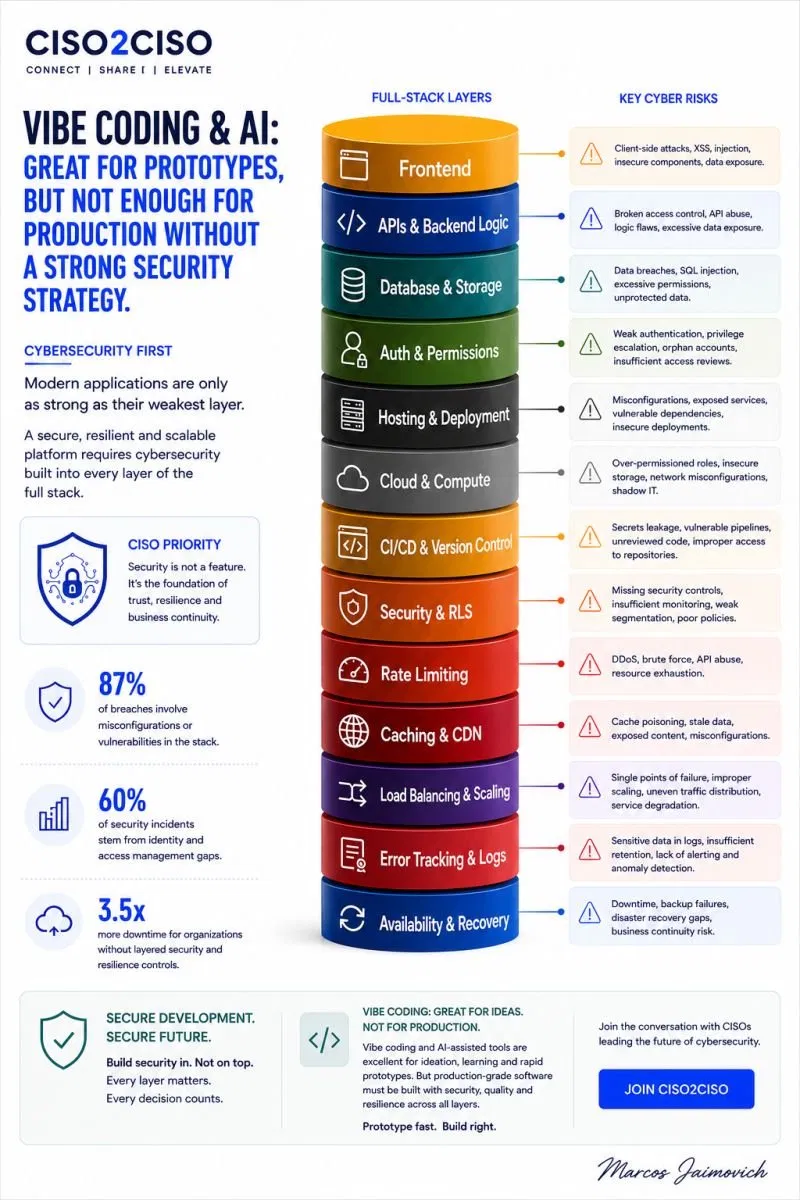
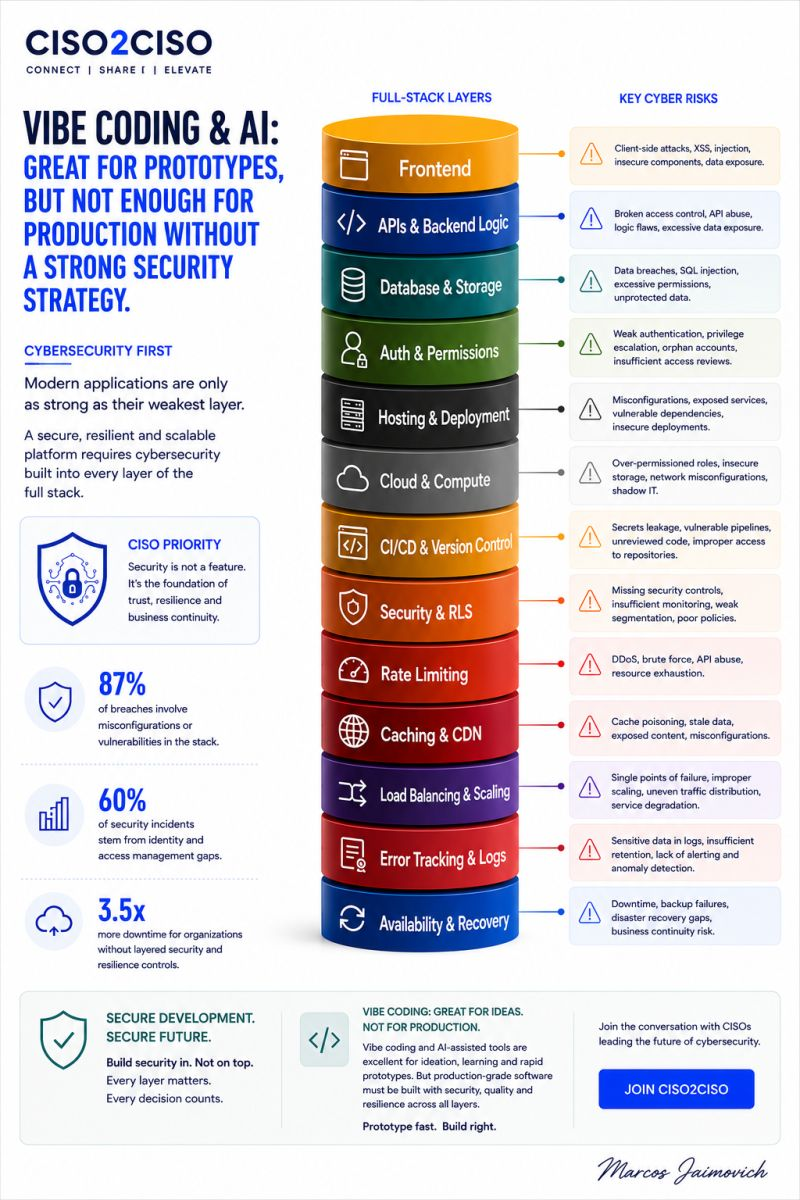
The risk is not AI-assisted coding itself. The risk is false production maturity — teams moving prototypes into enterprise environments without validating architecture, identity, secrets, APIs, deployment, logging and recovery controls. The code works. The security architecture was never built.
Why This Pattern Is Emerging Now
Understanding why vibe coding creates security risk requires understanding what makes it different from previous waves of developer tooling.
Previous productivity tools — IDEs, code libraries, frameworks — accelerated the implementation of code that developers had already designed. The developer made architectural decisions, then used tools to implement them more efficiently. The thinking preceded the code.
AI-assisted development inverts this relationship. The code often precedes the thinking. A developer describes what they want in natural language, receives working code, iterates on it through conversation, and arrives at a functional application without having explicitly made the architectural decisions that the application now embeds. Security architecture decisions — how identity is handled, how secrets are managed, how inputs are validated, how the application logs and monitors its own behavior — are not surfaced by the development process. They are simply absent unless someone explicitly asks for them.
This is not a criticism of the developers using these tools. It is a description of how the tooling works. AI coding assistants are optimized to produce code that satisfies the stated functional requirement. They are not optimized to flag missing security architecture, challenge implicit security assumptions, or refuse to generate code that lacks production-grade controls.
The Four Security Gaps That Appear Consistently
Across the organizations where AI-assisted development has become widespread, four security gaps appear with striking consistency.
Secrets and credential management. AI-generated code frequently includes hardcoded credentials, API keys, database connection strings and authentication tokens — not maliciously, but as functional examples that satisfy the immediate development requirement. Developers moving quickly from prototype to deployment without a systematic secrets scanning step carry these credentials into production environments where they become persistent, often invisible vulnerabilities. Secrets scanners regularly find credentials in repositories that have been "production" for months.
Identity and authorization architecture. Functional prototypes often use simplified or absent authentication and authorization to enable rapid testing and iteration. "Everyone can access everything" is a reasonable assumption for a prototype that will only be used by the developer. It is a catastrophic assumption for a production application handling enterprise data. The authorization logic that determines whether a specific caller can access a specific resource — object-level authorization, the most common source of API security failures — is consistently the gap that AI-assisted development leaves unfilled. The model generates functional code; it does not generate correct authorization architecture.
Input validation and injection prevention. AI-generated code produces handlers that process user input — form submissions, API requests, file uploads — but the validation logic that rejects malicious inputs, prevents injection attacks and enforces data integrity constraints requires explicit attention. Developers focused on functional correctness often omit validation; AI assistants focused on satisfying the stated requirement do the same.
Observability and runtime monitoring. Production applications need logging, monitoring and alerting that surfaces anomalous behavior, failed access attempts, performance degradation and operational errors. Prototypes built for speed and iteration typically have none of this. Deploying prototype code into production without building a production observability layer creates applications that operate invisibly — security teams have no detection capability for compromise, misuse or data exfiltration through these applications.
The Organizational Dynamic That Makes This Worse
The security gap created by AI-assisted development is compounded by an organizational dynamic that security leaders need to understand clearly.
When a business team or a product team uses AI coding tools to build something that works — even if it lacks proper security architecture — they have typically demonstrated organizational value by moving quickly. The working prototype validates the concept. Business stakeholders see the result and want to deploy it. The team that built it is rewarded for speed.
Security review at this point faces a political challenge that technical controls cannot resolve: the application is working, business stakeholders want it deployed, and the team that built it has organizational momentum. Introducing security requirements at this stage is perceived as blocking progress rather than enabling it.
The organizations that are managing this well have recognized that the solution is not to slow down AI-assisted development. It is to build security requirements into the development process from the beginning — as lightweight gates that are triggered automatically, not as heavyweight reviews that are triggered after the fact.
Executive Framework: Production Readiness for AI-Assisted Applications
| Security Requirement | Prototype Reality | Production Standard |
|---|---|---|
| Secrets management | Hardcoded or absent | Secrets vault with rotation |
| Authentication | Simplified or bypassed | Designed identity model |
| Authorization | Coarse or absent | Object-level access control |
| Input validation | Minimal | Systematic validation layer |
| Logging and monitoring | None | Production observability |
| Dependency security | Unscanned | SCA with vulnerability tracking |
| Recovery | Not considered | Tested RTO/RPO |
What CISOs Should Do Now
Define a production readiness checklist for AI-assisted applications. Create a lightweight, explicit checklist that covers the seven requirements in the framework above. Make it available to every engineering team. Require sign-off before production deployment of any application where AI assistance was used in development. The checklist is not a gate that blocks deployment — it is a forcing function that ensures security decisions are made explicitly.
Implement secrets scanning in CI/CD pipelines. Automated secrets scanning is the single highest-value, lowest-friction control for AI-assisted development security. It catches the most common vulnerability class — hardcoded credentials — before it reaches production, without requiring human review of every line of code. This should be non-negotiable for any organization where AI-assisted development is occurring.
Require threat modeling for production-bound applications. AI-assisted development bypasses the design phase where threat modeling traditionally occurs. Reinstate it as a lightweight requirement — not a multi-day exercise, but a structured conversation that forces teams to answer: who are the users, what data does the application handle, what happens if it is compromised, and what authorization controls prevent misuse?
Engage engineering leadership as a partner. The framing that works is not "AI coding creates security problems." It is "we want to enable the team to move fast safely, and here is what we need to build together to do that." Engineering leaders who understand the risk are consistent allies in building lightweight security gates into AI-assisted development workflows.
Audit current AI-generated applications in production. Assume the inventory of applications built with AI assistance and deployed without security review is larger than formally recognized. Commission an assessment focused on the four gap areas — secrets, authorization, validation, observability — prioritized by data sensitivity and business criticality.
Board-Level Questions
- Do we have visibility into which applications in our environment were built with AI-assisted development tools, and whether they received security review before production deployment?
- Is there a defined production readiness process that applies to AI-assisted applications — including secrets scanning, threat modeling and authorization review?
- Are our development teams operating with security architecture requirements as a starting condition, or are those requirements applied after the fact when security teams discover gaps?
- What is our current exposure from applications that moved to production faster than our security review process could address?
Final Takeaway
AI-assisted development is not going away. The productivity benefits are too significant, the adoption is too widespread, and the competitive pressure to build faster is too real. The security response cannot be to slow development down to the pace of traditional security review — that response will simply be ignored.
The response that works is building lightweight security requirements into the AI-assisted development process itself — secrets scanning that runs automatically, threat modeling that takes an hour rather than a week, authorization review that is part of the definition of done rather than a post-deployment audit.
The organizations that solve this well will enable their engineering teams to move fast and safely. The ones that do not will discover the cost of false production maturity through incidents — not audits.