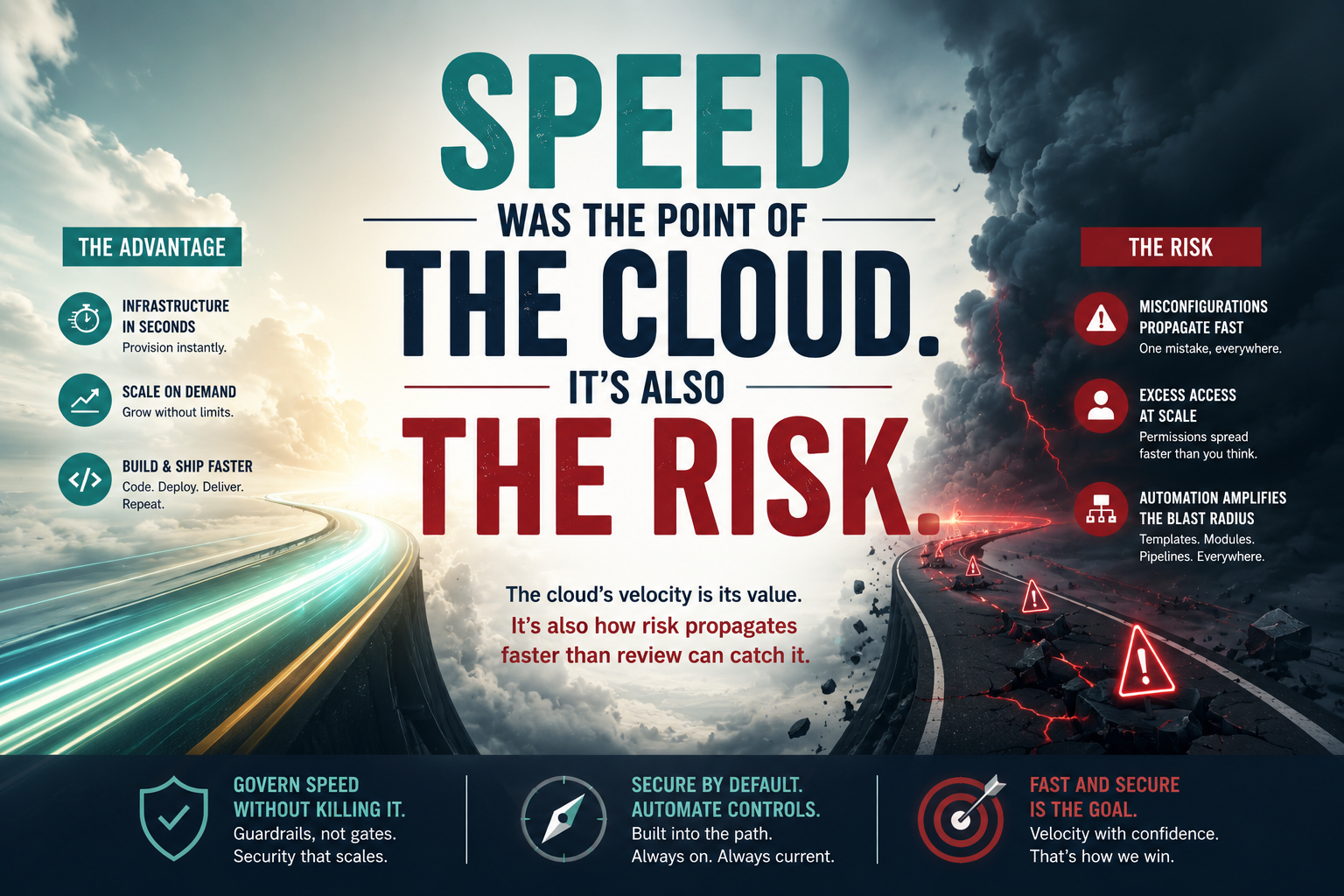
Speed Was the Point of the Cloud. It's Also the Risk.
Executive Summary
Organizations did not move to the cloud for the servers. They moved for the speed — the ability to provision infrastructure in seconds instead of weeks, to scale on demand, to let teams build and ship without waiting on a procurement cycle or a data center. Velocity is the entire value proposition, and it has reshaped how businesses operate. A developer can now stand up an environment, deploy a service, and put it in front of customers faster than a traditional change-review process could even convene.
That same velocity is the source of the cloud's most characteristic risk. When infrastructure is created and modified through code and automation, by many hands, at high speed, the mechanisms that once governed change — review boards, manual checks, sequential approvals — cannot keep up. A misconfiguration is not made once and caught later; it is templated, replicated, and propagated across an entire environment in the time it takes to run a deployment. The speed that delivers the business value also delivers the mistakes, at the same velocity.
The instinctive security response — slow it down, add gates, require approvals — defeats the reason the organization adopted cloud in the first place. The actual challenge is harder and more interesting: how to govern speed without destroying it.
Why This Matters Now
The tension has sharpened as cloud has matured from experiment to default. Infrastructure-as-code, automated pipelines and self-service provisioning are now standard, which means the velocity is structural rather than occasional. The number of changes flowing into cloud environments has grown to a scale where human review of each one is simply impossible, and any organization still relying on manual gates as its primary control is either slowing the business down or, more commonly, being routed around.
The consequences compound because cloud environments are interconnected and identity-driven. A single over-permissive template, replicated by automation, can grant excess access across dozens of resources. A misconfigured default, baked into a reusable module, can propagate an exposure everywhere that module is used. The blast radius of a single mistake is no longer one system — it is everywhere the automation carried it. Velocity does not just create more changes to govern; it amplifies the reach of each error.
CISO2CISO Insight
You cannot review your way to cloud security at cloud speed. The choice is not "fast or secure." It is "secure by default, automatically" or "insecure, repeatedly, faster than you can catch it."
Why the Old Governance Model Fails
The traditional model of change governance was built for a world that no longer exists, and applying it to cloud produces the worst of both outcomes — friction and exposure.
Manual review does not scale to cloud velocity. When changes arrive faster than they can be reviewed, manual gates become a bottleneck. The business pressure to move quickly then finds a way around the bottleneck, and the gate that was supposed to ensure security instead guarantees that the fastest-moving — and often riskiest — changes are the ones that bypass it.
Point-in-time controls miss a continuous problem. A security review conducted at a moment in time assesses a configuration that may change minutes later. In an environment that updates continuously, the assessment is stale almost immediately. Security that is not continuous is not security in the cloud; it is a snapshot of a past that no longer exists.
Catching mistakes after deployment is too late and too slow. Detecting a misconfiguration after it is live means the exposure already existed, possibly replicated across the environment, possibly already found by someone else. The economics of the cloud reward preventing the misconfiguration from being deployable in the first place, not finding it afterward.
Governing Speed With Guardrails, Not Gates
The resolution is to move security from a gate that changes must pass through to a set of guardrails built into the path the changes already travel. The distinction is fundamental. A gate stops and inspects; it creates friction and invites circumvention. A guardrail constrains the road so that staying safe is the default and going off it requires deliberate effort.
Make the secure path the default path. When secure configurations are the built-in default — in the templates, the modules, the platform teams provide — most changes are secure simply by being made the normal way. Security stops depending on every individual remembering to do the right thing and starts being the path of least resistance.
Shift controls left into the pipeline. Embedding automated security checks into the development and deployment pipeline catches issues before they are deployed, at the speed of the pipeline itself, without a human bottleneck. The check runs in seconds as part of the flow, not as a separate approval.
Use continuous, automated visibility. Because the environment changes constantly, the detective control must be continuous and automated — watching configuration and identity state in real time and surfacing exposures as they arise, rather than at a quarterly review.
Constrain through policy as code. Guardrails expressed as code — what configurations are permitted, what access is allowed — can be enforced automatically and consistently across the environment, scaling with the velocity rather than being overwhelmed by it.
Executive Framework
| Dimension | Gate model | Guardrail model |
|---|---|---|
| Mechanism | Manual review and approval | Secure defaults and automated checks |
| Relationship to speed | Slows it or gets bypassed | Preserves it |
| Timing | Point-in-time, before deploy | Continuous and in-pipeline |
| Secure behavior | Depends on remembering | The default path |
| Scale | Breaks at cloud velocity | Scales with automation |
| Mistakes | Caught after the fact | Prevented from being deployable |
What CISOs Should Do Next
- Reframe the goal as governing speed, not reducing it — the organization will not accept, and should not accept, giving up the velocity that justified the cloud.
- Replace manual gates with guardrails wherever possible, building security into the defaults, templates and modules so the secure path is the easy path.
- Shift security controls left into the pipeline, catching issues automatically before deployment at the speed of the pipeline itself.
- Deploy continuous, automated visibility into configuration and identity state, since point-in-time review cannot govern an environment that changes constantly.
- Express security policy as code, so guardrails are enforced automatically and consistently at the same velocity as the changes they govern.
- Partner with the teams building in the cloud rather than policing them, because guardrails that developers help design are guardrails they do not route around.
Board-Level Questions
- Are we securing our cloud environments at the speed they actually change, or relying on review processes that the velocity has outpaced?
- Is our security built into the default path our teams take, or does it depend on people remembering to do the right thing under time pressure?
- When a misconfiguration is introduced, do we prevent it from being deployed, or detect it after it is already live and possibly replicated?
- Are we governing cloud speed in a way that preserves its value, or creating friction that teams are routing around?
Final Executive Takeaway
The cloud made a trade that most organizations accepted eagerly: enormous velocity in exchange for a new kind of risk. The mistake many security functions made was trying to claw back the velocity — to reimpose the gates and reviews that made sense when infrastructure changed slowly. That approach fails twice over: it frustrates the business, and it gets bypassed, leaving the organization both slower and less secure than if it had never tried.
The organizations that secure the cloud well have accepted that speed is permanent and built their security to operate at that speed — secure defaults, guardrails in the pipeline, continuous visibility, policy as code. They do not slow the road down. They shape it, so that moving fast and staying safe are the same direction.
Speed was the point of the cloud, and it still is. The job of cloud security is not to take the speed away — it is to make sure that going fast and going safely are, by default, the same thing.
*To be continued...*