Will MSSPs Survive the AI Shift?
Executive Summary
AI will not eliminate managed security providers, but it will change the economics and expectations of managed security. Commodity alert triage becomes less defensible as automation improves.
Clients will increasingly expect investigation quality, detection engineering, proactive hunting, business-context reporting and measurable risk reduction.
Why This Matters Now
This is no longer a narrow technical topic. It is a leadership question about control, accountability, resilience, investment and operational decision-making.
CISO2CISO Insight
MSSPs will survive if they become intelligence partners, not alert factories.
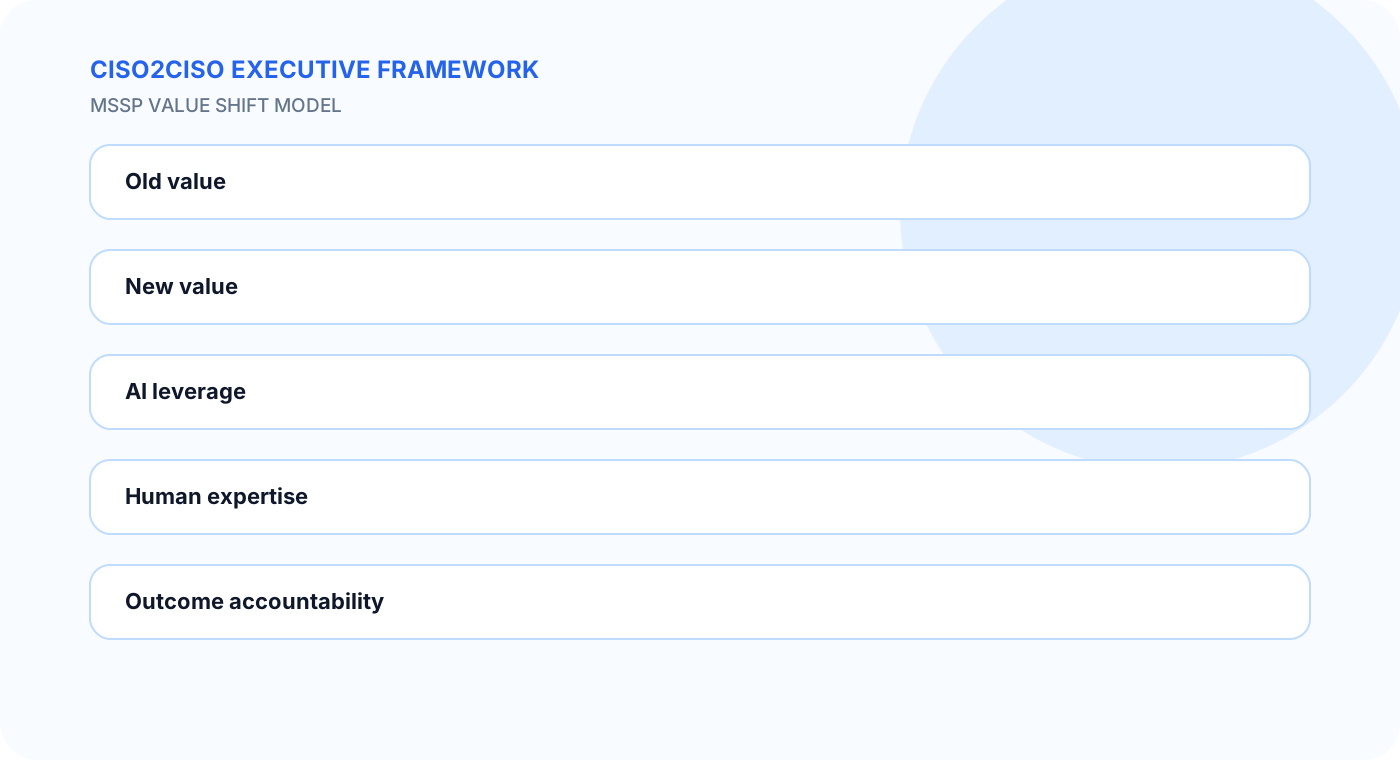
Executive Framework
Old value
This dimension matters because it changes how CISOs prioritize risk, assign ownership, measure progress and communicate with executive stakeholders.
New value
This dimension matters because it changes how CISOs prioritize risk, assign ownership, measure progress and communicate with executive stakeholders.
AI leverage
This dimension matters because it changes how CISOs prioritize risk, assign ownership, measure progress and communicate with executive stakeholders.
Human expertise
This dimension matters because it changes how CISOs prioritize risk, assign ownership, measure progress and communicate with executive stakeholders.
Outcome accountability
This dimension matters because it changes how CISOs prioritize risk, assign ownership, measure progress and communicate with executive stakeholders.
Strategic Implications
The strategic implication for CISOs is clear: this topic must be connected to enterprise governance, architecture, operating processes and executive reporting.
Organizations that treat it only as a technical activity will struggle to show whether risk is actually being reduced. Organizations that connect it to decision-making, ownership and measurable outcomes will be better positioned to scale securely.
Operational Reality
- Define clear ownership and decision rights.
- Map the issue to critical business processes.
- Identify controls and capabilities that operate in production.
- Build evidence that executives can understand.
- Review the topic as part of cyber resilience and enterprise risk governance.
Board-Level Questions
- What is the business impact if this risk materializes?
- Which assumptions have been tested?
- Who owns the risk and the decision?
- What investment or operating change is required?
What CISOs Should Do Next
- Translate the issue into a business-risk narrative that executives can understand.
- Identify owners, decisions and operating processes required to manage it.
- Define measurable outcomes rather than relying only on activity-based reporting.
- Build evidence that shows whether controls and capabilities operate in practice.
- Use the topic to improve board communication, investment prioritization and resilience planning.
Final Executive Takeaway
MSSPs will survive if they become intelligence partners, not alert factories.