Executive Summary
Somewhere in your plant there is a remote path that a vendor engineer can use at 3 a.m. It was approved once, during a commissioning project or an urgent outage. It has never been closed. It may be a VPN account that nobody has reviewed, a hosted remote-support tool installed by the equipment maker, or a cellular modem that came inside the cabinet. Each of these was a reasonable decision on the day it was made. Together they are a standing set of doors into the systems that run your operations.
In January 2026 the UK National Cyber Security Centre published Secure Connectivity Principles for Operational Technology, together with CISA, the FBI and agencies from Australia, Canada, Germany, the Netherlands and New Zealand. The guidance sets out eight principles. For vendor access, the direction is specific: use brokered connections through a secure gateway in a separate, security-controlled segment such as a DMZ, centralise remote access instead of building a new route for each third party, and log and monitor every connection.
This note turns that direction into a decision framework a CISO can take to the COO and the board: how to decide which vendor paths to replace first, what the target state looks like, and what to put into contracts so the change survives the next vendor renewal.
Why This Matters Now
Remote access is where OT incidents tend to start. The Dragos 2026 OT/ICS Cybersecurity Year in Review reported that 73 percent of all-time incident response cases involved compromised VPN or jump host credentials. The same report found poor IT/OT segmentation in 81 percent of assessments. Dragos has also stated that 49 percent of its 2025 services reports included elevated findings related to remote access.
Governance is not keeping up with the number of vendors involved. Secomea's State of Industrial Remote Access 2026 survey of 400 OT, IT, compliance and executive leaders found that only 43 percent of organizations report full audit trails of vendor sessions. In its North American data, 57 percent of organizations manage six or more external vendors with remote access into OT, only 46 percent report full auditability of vendor sessions, and just 23 percent review vendor credentials monthly or more often. The same survey found that only 9.1 percent of organizations rely on a single category of remote-access tool, which means most run parallel paths with different identity handling and different logging. Secomea sells remote-access technology, so read the survey as a vendor-sponsored view, but the pattern matches what the Dragos field data shows.
Government attention is also moving from guidance to enforcement signals. In a July 2026 public service announcement on internet-exposed PLCs in the water sector, the FBI and EPA told operators to follow the joint secure connectivity principles for safe remote access. They specifically quoted the instruction to "remove inbound port exposure" and to broker connections through a secure gateway. The FBI is now citing this guidance in operational warnings, not only publishing it.
CISO2CISO Insight
A standing vendor VPN is not an access control. It is a decision made once, by someone who has probably left, and never revisited.
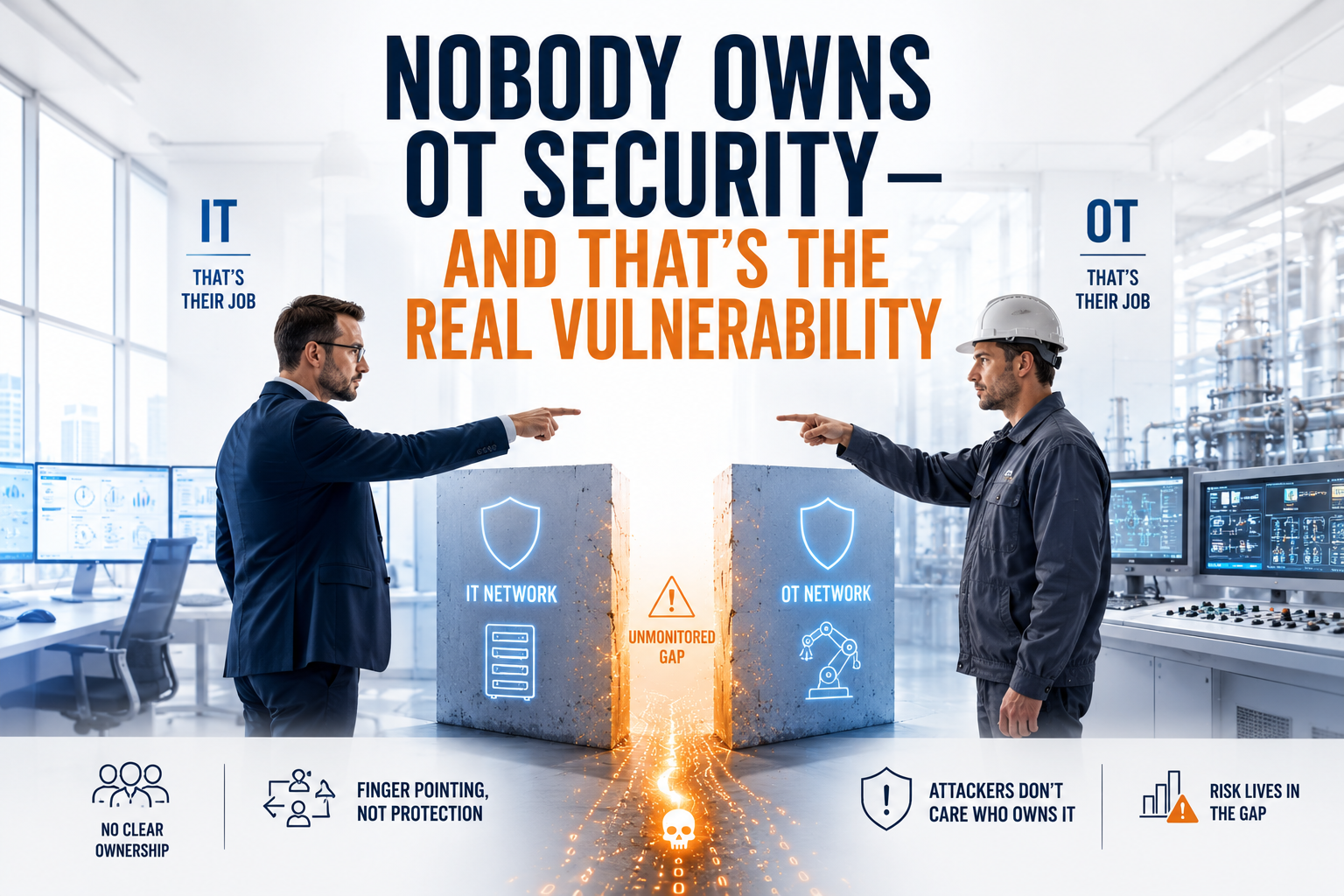
The reason this persists is not technical ignorance. It is that remote vendor access is the one place where operations, procurement and security each assume another team owns the risk. Operations wants the vendor to connect fast when a line is down. Procurement signed a support contract that says the vendor will have remote access, without saying how. Security finds out when someone audits the firewall rules.
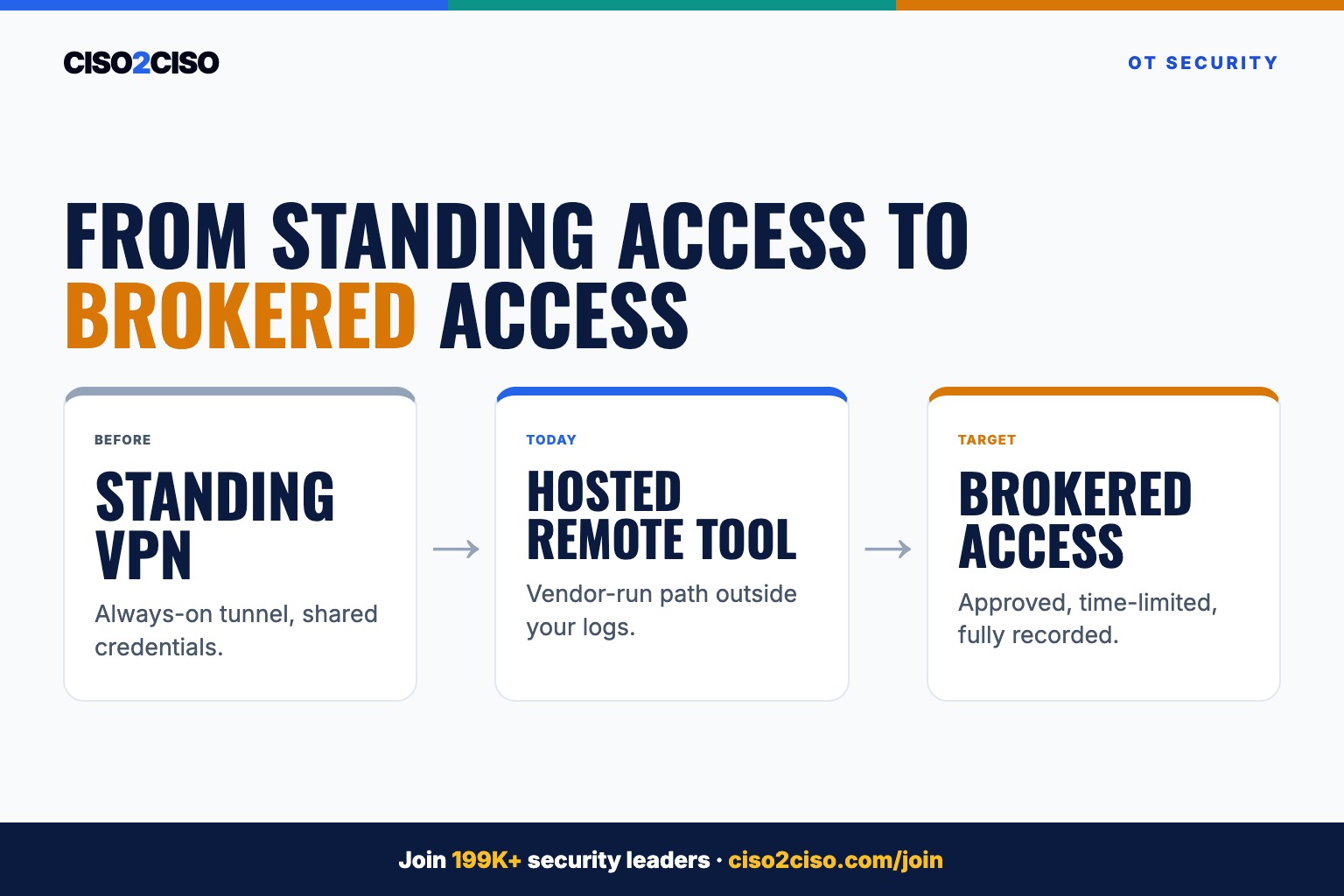
The brokered model changes who holds the key. In a standing VPN, the vendor holds the path and you hope they use it responsibly. In a brokered model, you hold the path: the vendor asks, your people approve, the connection opens for a defined job and window, and everything is recorded. The joint guidance gives a practical reason to care. If you learn that a third party with access to your environment has been compromised, a well-architected just-in-time model lets you temporarily revoke that access. A standing tunnel gives you no such lever.
Hosted remote-access paths deserve the same scrutiny. When the vendor operates the remote-support platform, the session may run outside your logs, your identity controls and your approval workflow. The guidance asks organizations to avoid duplicating routes into the network for each third party. A vendor-run platform is, by design, a route you did not build and cannot fully observe.
A Decision Framework: Four Tests for Every Vendor Path
Do not try to replace every path at once. Inventory them, then run each through four tests. The tests and tiers below are a practical way to apply the joint guidance, not wording taken from it.
Test 1: Does this need to be remote at all? Some access exists out of habit. Routine diagnostics can often be replaced by data pushed outbound to the vendor, with no inbound session. Work on safety-critical logic may be better done on site or with a local escort. Every session you eliminate is a path you no longer defend.
Test 2: Who opens the door, and who approves it? A path that is always on fails this test. The target is a session that is requested per job, approved by a named person on your side, and opened by your broker. The guidance also favors connectivity that is outbound-initiated rather than listening for inbound connections, which is why it treats inbound port exposure as the thing to remove.
Test 3: What can the vendor reach, and for how long? Scope the session to named assets and protocols, and set it to expire when the approved window ends. A vendor jump host inside the DMZ, with firewall rules limiting it to specific control assets, is far narrower than a VPN that lands the contractor on a flat OT network.
Test 4: Can you prove what happened and cut it off? The guidance calls for logging and monitoring of all connectivity, and for human-to-machine access to be user-aware so every action leaves an audit trail tied to a specific person. Add the last question from the guidance: do you have an isolation plan, so you can shut a path without shutting the plant?
Then tier by consequence, so effort follows risk:
- Tier 1, control and safety systems: per-session approval, live supervision and local enablement where feasible.
- Tier 2, engineering and maintenance: per-window approval, recorded sessions and automatic expiry.
- Tier 3, read-only diagnostics: outbound data flow where possible, otherwise brokered read-only sessions.
What to Require in Contracts
Architecture is only half of it. If the contract still entitles the vendor to a permanent tunnel, operations will keep granting one. Put the access model into procurement language, and apply it at renewal and at every new project.
- Your access path only. The vendor must use the customer's broker for all remote work. Vendor-operated tunnels, hosted support platforms and embedded modems are not permitted unless disclosed and approved in writing.
- Named individuals, strong authentication. No shared accounts. Each engineer has a named identity, with phishing-resistant multi-factor authentication, and the vendor notifies you when staff leave or change roles.
- Job-based scope. Each engagement states the assets, protocols, access level and time window. Anything outside that scope requires a new approval.
- Session evidence. You retain logs and recordings of vendor sessions, and the vendor cooperates with investigations.
- Compromise notification and suspension. The vendor must notify you within a defined period if its environment or credentials are compromised, and you hold an unconditional right to suspend access immediately without breach of contract.
- Endpoint and tool hygiene. The vendor keeps its remote-access tooling patched and its engineer laptops managed, and flows the same terms down to subcontractors.
- Connectivity disclosure. Equipment delivered with cellular or cloud connectivity must be documented, with default credentials removed and the connection configurable or disableable by you.
- Exit and isolation. The vendor agrees to support service continuity when access is suspended, for example through on-site support at agreed response times.
The last item matters most commercially. Operations will resist any control that risks slower vendor response. Agreed response times for brokered and on-site support remove the objection that security is putting uptime at risk.
Executive Framework
| Decision | Standing VPN or hosted path | Brokered target state |
|---|---|---|
| Initiation | Vendor connects whenever it wants, or the tunnel is always up | Per-job request; your broker opens the session, outbound-initiated where possible |
| Identity | Shared or long-lived accounts, rarely reviewed | Named individual, phishing-resistant MFA, disabled by default |
| Scope | Network-level reach, often into a flat OT zone | Named assets and protocols through a DMZ gateway or hardened jump host |
| Duration | Open-ended | Expires at the end of the approved window |
| Evidence | Partial logs, sometimes held by the vendor | Recorded, user-attributed sessions retained by you |
| Containment | Shutting it down means finding it first | Suspension right in the contract and a tested isolation plan |
What CISOs Should Do Next
- Inventory every remote path into OT. Include VPNs, vendor-hosted tools, modems, cellular routers and cloud links embedded in equipment. Most organizations will find paths nobody on the security team knew about.
- Tier vendor access by consequence. Start with Tier 1 and Tier 2 paths that reach controllers, engineering workstations or safety systems, and leave low-risk diagnostics for later.
- Stand up one brokered path in the DMZ. Build a single, hardened, monitored route that multiple vendors share, rather than adding new tunnels per project.
- Move one vendor first. Pick a cooperative, high-volume vendor and prove the model, including approval speed, before you mandate it everywhere.
- Rewrite contract language at the next renewal. Give procurement a standard access schedule using the terms above, and make it a gate for new equipment purchases.
- Agree response times with operations. Define how quickly approvals happen at night and on weekends, so the new model does not fail on its first outage.
- Test the kill switch. Run an exercise in which a vendor is reported compromised, and measure how long it takes to revoke every path and keep the plant running.
Board-Level Questions
- How many third parties can reach our operational systems remotely today, and who approved each path?
- Which vendor connections are always on, and which require a fresh approval for each job?
- If a vendor told us tonight that its credentials were stolen, how quickly could we cut its access, and what would it cost operations?
- Do our contracts allow us to suspend vendor access immediately, and do they ban vendor-operated paths we cannot log?
- Who is the named executive accountable for remote access into OT, across operations, procurement and security?
Final Executive Takeaway
The joint guidance from the NCSC, CISA, the FBI and their partners does not ask you to stop vendors from helping your plants. It asks you to stop leaving the door open between jobs. Brokered, time-limited, logged access gives operations what it needs, which is a vendor who can fix the problem, and gives the board what it needs, which is proof of who connected, to what, and for how long. The technology is the easy part. The harder work is a contract that stops granting standing access, an approval process that is fast enough at 3 a.m., and an owner who is accountable for all of it. If your vendors still hold the keys, the first decision for the next quarter is simple: take the keys back, and lend them out one job at a time.