Executive Summary
The integrator who designed your control system, installed it and still supports it probably holds more knowledge of your plant than most of your own staff. It may hold network diagrams, PLC and HMI project files, device inventories, passwords and a remote tunnel into the control network. In many organizations, the paper governing all of that is a commercial services agreement written before anyone asked a security question.
On September 23, 2026, CISA and the FBI published a joint fact sheet, "Considerations for Critical Infrastructure Operators Working With Third-Party ICS Integrators." It asks operators to apply least privilege to integrators, assess what data they hold, monitor remote access through routes the operator controls, and write cybersecurity requirements into contracts. This note turns that guidance, together with the service-provider requirements in IEC 62443-2-4, into a checklist procurement and legal can use before a remote vendor touches a control network.
Why This Matters Now
The fact sheet is anchored in a real case. According to reporting by SecurityWeek and WaterISAC on the document, the FBI analyzed an intrusion into a U.S. industrial automation company between March and April 2025. WaterISAC reports that the actors staged roughly 800 files in nine compressed archives, apparently for exfiltration, including customer SCADA information, ICS device details and schematics. The operators whose files were taken were not the ones breached. They were downstream.
That is the structural problem. WaterISAC notes that a single integrator may support dozens of utilities in a region, so one compromise at that firm could expose many systems at once. Your security program can be sound and your exposure still depends on the weakest practice at a firm you do not control.
The guidance also reflects a shift in tone. CISA's page frames least privilege as something designed to protect owners and operators. That reverses the usual commercial dynamic, in which the integrator asks for broad access "to be able to help" and the operator concedes to avoid delay. The contract is where that concession either gets bounded or becomes permanent.
CISO2CISO Insight
An integrator's access is only as safe as the contract that defines it, and most contracts define the work but not the access.
CISA's fact sheet recommends security requirements in contracts and service agreements, covering areas such as data storage locations, remote access and patch management, as SecurityWeek summarizes it. Industrial Cyber adds that CISA expects remote access to run through routes the operator can monitor and log. Those are principles. Procurement and legal need clauses, evidence and consequences.
One point of transparency: CISA's published text emphasizes monitoring, logging, least privilege, contractual requirements and the ability to operate without the integrator. Session recording, credential ownership and exit obligations are our translation of those principles into contract language, supported by IEC 62443-2-4. They are not a quotation of the fact sheet.
The Four Clauses: A Checklist for Procurement and Legal
1. Named access. The practical starting point is a rule that no one connects as "the integrator." Every remote session must trace to a named individual on an approved personnel list, with multi-factor authentication and an expiry date. Require that:
- Accounts are individual, never shared, and are issued per engagement or per task, not as a standing entitlement.
- The integrator supplies and maintains a list of authorized personnel, and notifies you within a defined period when staff leave or change roles.
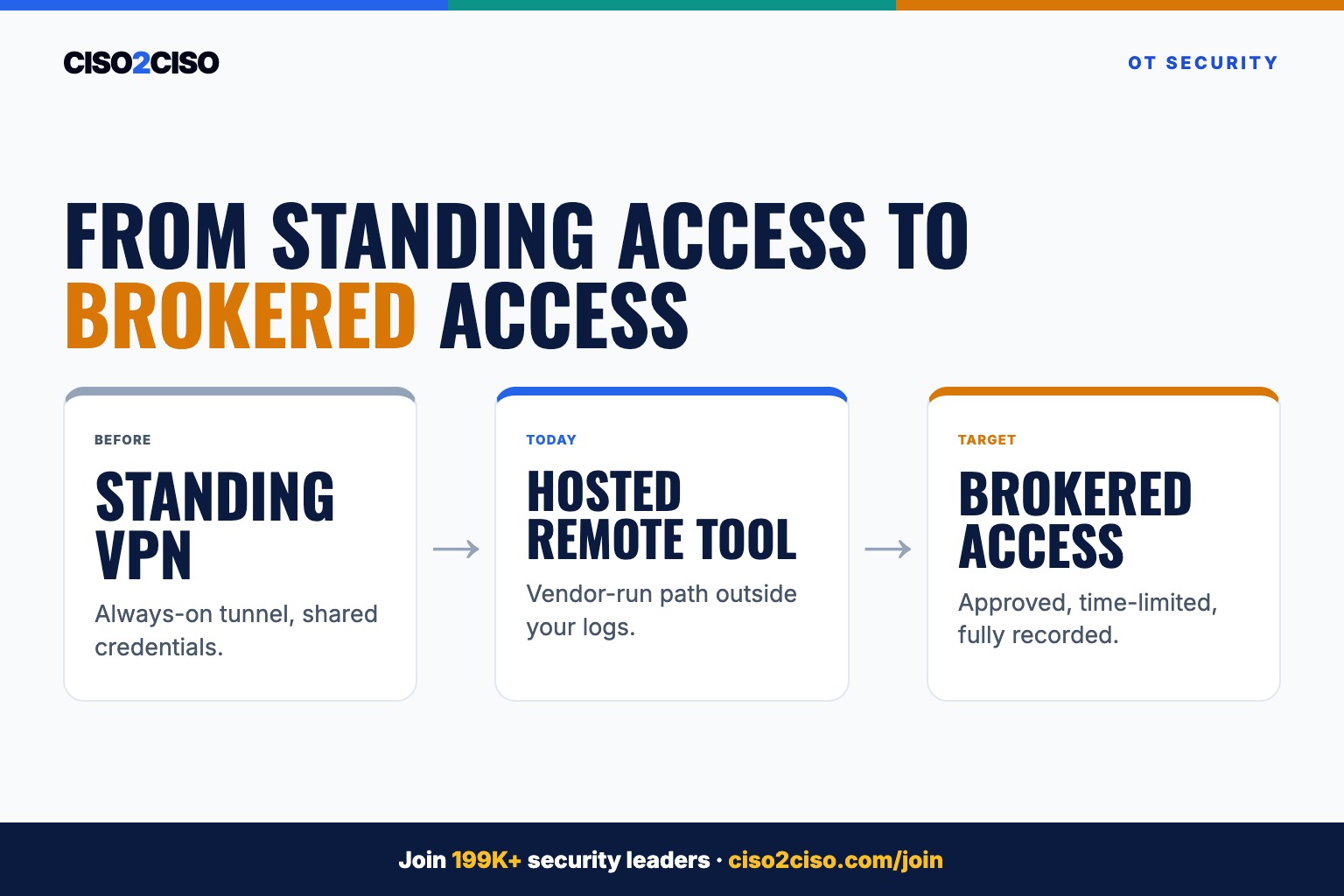
- Access is on demand where possible: approved by your team for each session, not an always-on tunnel.
- Each connection is approved by the asset owner. IEC 62443-2-4 expects the service provider to be capable of obtaining asset owner approval before using each remote access connection, as reproduced in an industrial remote access guide mapping the standard to NIS2.
- No modems, cellular routers or remote access software are installed by the provider outside your inventory.
2. Session recording and monitoring. CISA says to monitor and log remote access and to require integrators to use routes you can monitor. Logging tells you that someone connected. Recording tells you what they did on a safety-relevant system. Require that:
- All integrator sessions pass through a broker, jump host or equivalent that you own or control, not a tunnel the integrator operates.
- Sessions are logged with timestamps and the named user, and, for engineering workstations and controllers, recorded in a form you retain.
- You hold the logs and recordings, not only the integrator, and the retention period is stated.
- You have the right to terminate a session in progress. IEC 62443 control requirements, as summarized by one industry guide, include automatic termination of idle remote sessions and continuous monitoring of access.
3. Credential ownership. Credentials are the asset the attacker wants. A MITRE ATT&CK technique commonly associated with integrator compromise is valid accounts: once the vendor is breached, the attacker simply uses the vendor's legitimate access. The contract must say who owns, issues, stores and revokes every credential. Require that:
- Credentials for your systems are issued, held and revoked by you, and are never stored in the integrator's own repositories or password tools unless you have approved the controls on them.
- Default and project passwords are changed at handover, and the integrator documents every account it created.
- Project files, backups and engineering data containing credentials are stored in locations you have approved. CISA recommends assessing what organizational data the integrator holds and where it is stored.
- Integrator-supplied hardware and software are inventoried, a point the fact sheet itself raises.
4. Exit obligations. Most contracts end with a final invoice, not a handover. Require that, on completion or termination:
- All accounts, tokens, certificates, VPN profiles and remote tools are revoked or removed, and the integrator attests to this in writing.
- Your data is returned or destroyed, including diagrams, configuration files and backups, with proof.
- You receive complete, current documentation and offline copies of all software needed to operate and recover the equipment. CISA recommends operators maintain secure, offline backups of that software.
- The integrator notifies you of a compromise on its own side within a defined period, and cooperates with investigation and audit.
Beyond the Clauses: Can You Run Without Them?
CISA's guidance asks a question that is easy to skip: if the integrator is compromised tomorrow and you cut their access, can you keep operating? The fact sheet says redundancy and the ability to recover and operate without the integrator, especially for operationally critical processes, reduce risk. Contracts that give you the right to terminate access do not help if only the vendor can restore the system.
This is where legal and operations meet. Exit obligations are only enforceable if you tested them. Run a tabletop in which the integrator's access is cut without notice, and learn what your plant cannot do alone.
IEC 62443-2-4 as Your Evidence Standard
IEC 62443-2-4 defines security capabilities for IACS service providers. Wikipedia's summary of the series notes that Edition 2.0 was published in December 2023 and divides requirements into 12 topics, including remote access, event management and logging, user management, patch management, backup and recovery, and project staffing. The standard's value in a contract is that it gives you a recognized vocabulary: you can require the integrator to state which capabilities it meets, at what maturity, for which engagements.
Use it carefully. A claim of "alignment" is not an assessment. Ask whether the program has been independently evaluated, and what is excluded from scope. The related 62443-3-3 sets system-level requirements the delivered solution must meet, and 4-1 and 4-2 address the products the integrator selects. Reference them in the statement of work so that what is delivered, not just how it is serviced, is specified.
Executive Framework
| Control area | What to require in the contract | Evidence to request |
|---|---|---|
| Named access | Individual accounts, MFA, authorized personnel list, per-session approval, time-limited access | Current personnel list, access request records, tool and route inventory |
| Session recording | Brokered access through your infrastructure; logs and recordings retained by you; right to terminate sessions | Sample recording, retention statement, log feed to your monitoring |
| Credential ownership | You issue, store and revoke credentials; no shared or default passwords; approved storage for project data | Account register, handover test, data location statement |
| Exit obligations | Revocation, attestation, data return or destruction, offline software copies, documentation | Signed exit certificate, tested restore from offline copies |
| Supplier security program | IEC 62443-2-4 capabilities, independently assessed where possible; incident notification and audit rights | Assessment report or attestation with scope, notification timeline |
| Independence | Ability to operate and recover without the integrator for critical processes | Tabletop results, offline backup test record |
What CISOs Should Do Next
- Inventory integrator relationships and what each one holds. For every integrator, list the access paths, the data they store (drawings, project files, passwords) and where it sits. This is the first risk question CISA and the FBI pose.
- Remove standing and shared access first. Identify shared logins, always-on VPN profiles and undocumented cellular links, and convert them to named, on-demand, brokered access.
- Put the checklist into every new and renewing contract. Use the four clauses above as a standard schedule, and agree the wording with legal before the next negotiation, not during it.
- Make procurement a gate. No remote access is provisioned until the contract schedule is signed and the integrator's personnel list and tools are on file.
- Ask for IEC 62443-2-4 evidence, then verify it. Request scope-stated attestations or independent assessment, and treat unsupported claims of alignment as open items.
- Test the exit. Run a drill that revokes integrator access and restores from offline software copies, and record what failed.
- Report on it. Give the board a short view of integrators with access to control networks, those with named and monitored access, and those with tested exit plans.
Board-Level Questions
- Which outside firms can reach our control networks today, and can we name the individuals who did so last month?
- Do our integrator contracts specify remote access, data storage, incident notification and audit rights, or only the scope of work?
- Who owns the credentials and project files that integrators hold, and could we revoke and retrieve them within a day?
- If our principal integrator were breached tonight, could our plants keep running and recover without them?
- How many integrator contracts renewed this year without new security terms?
Final Executive Takeaway
The CISA and FBI fact sheet does not argue that integrators are untrustworthy. It argues that their access is concentrated, valuable and often loosely governed, and that the operator holds the lever that matters: the contract. Named access, recorded sessions, owned credentials and enforceable exit duties are not exotic requests. They are what IEC 62443-2-4 already expects a capable service provider to support. Your task is to make them conditions of entry rather than favors negotiated after an incident. An integrator that cannot meet them before touching your control network is telling you something important about what happens afterwards.