The CISO Is No Longer a Technical Role
Executive Summary
The CISO role has undergone a quiet but radical transformation over the past decade. What began as a technical function — managing firewalls, running vulnerability scans, overseeing security operations — has evolved into something that more closely resembles a business leadership role than an engineering one.
The most effective CISOs today are not the ones who can explain the most technical vulnerabilities. They are the ones who can translate risk into financial terms, build coalitions across the C-suite, influence procurement decisions, and hold their own in a boardroom conversation about strategic exposure.
This is not a trend. It is a structural shift — and organizations that have not updated their model of what a CISO should be are carrying a quiet but compounding risk.
Why This Matters Now
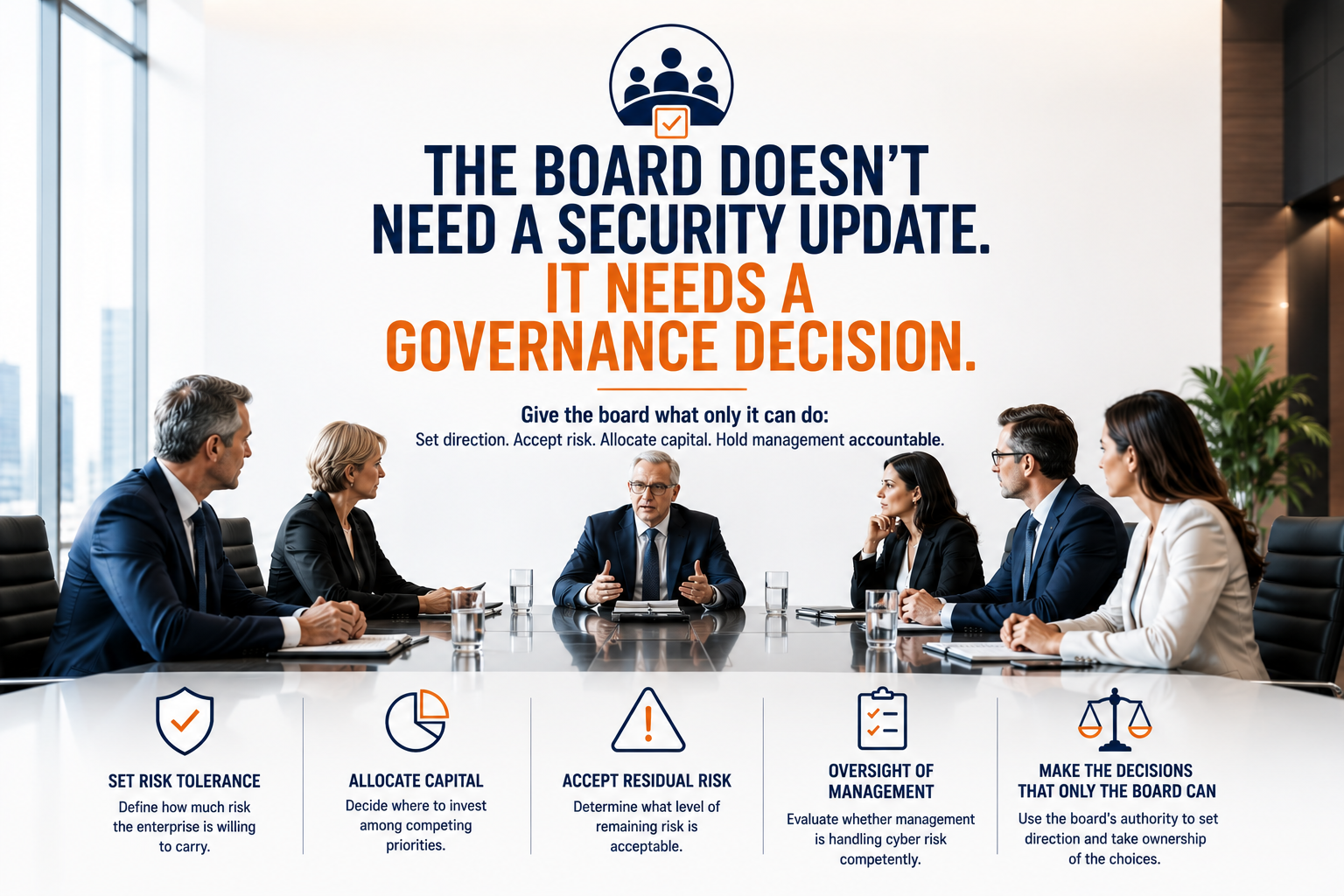
Boards are being held to a higher standard of cyber oversight following a wave of regulatory changes, public incidents, and shareholder scrutiny. The SEC's cybersecurity disclosure rules in the US, NIS2 in Europe, and similar frameworks globally have elevated cyber risk from an IT concern to a governance obligation.
The consequence for CISOs is significant. They are now expected to communicate with the clarity and authority of a CFO or General Counsel — not just in terms of jargon simplification, but in terms of ownership, accountability, and decision-making authority. The technical mastery that built careers a decade ago is now a baseline expectation, not a differentiator.
What differentiates the exceptional CISO today is business fluency: the ability to connect security investment to business outcomes, to frame cyber risk as enterprise risk, and to make the case for resources in a language that CFOs, CEOs, and board members actually use to make decisions.
CISO2CISO Insight
The technical floor for the CISO role has never been higher — and it has also never mattered less as the primary differentiator of executive effectiveness.
What the Role Has Actually Become
The modern CISO is operating across four dimensions simultaneously — and none of them are primarily technical.
Business risk translation. The first job of the modern CISO is converting technical complexity into business language. Not dumbing it down — translating it. There is a difference between simplifying and translating. Simplification loses precision. Translation preserves it in a different vocabulary. The best CISOs can explain why a zero-day in a third-party SaaS platform is actually a business continuity problem, a contractual liability, and a customer trust issue — not just a patch management gap.
Cross-functional influence. Cyber risk does not live inside the security team. It lives in procurement decisions, in software development practices, in M&A due diligence, in product launches, in how the company manages vendors. The CISO who operates only within their own department is governing a fraction of the actual risk surface. The effective CISO has relationships with the CFO, the General Counsel, the CPO, and the CTO — and uses those relationships to embed security thinking into decisions before they become problems.
Investment stewardship. Security budgets have grown substantially over the past decade, but the era of automatic budget increases is ending. CFOs and CEOs are increasingly asking for evidence that security investment is actually reducing risk — not just increasing activity. The CISO who can connect spending to outcomes, who can demonstrate what changed as a result of an investment, and who can build a risk-reduction roadmap that boards can evaluate — that CISO has a durable seat at the table.
Regulatory navigation. The compliance landscape has become genuinely complex — not as a bureaucratic exercise, but as a material business risk. Regulatory penalties, mandatory disclosure timelines, board-level accountability provisions, and the reputational consequences of public incidents have made regulatory fluency a core CISO competency. Understanding what regulators actually care about — not just what they require — is a significant strategic advantage.
Executive Framework
| Dimension | What boards actually evaluate |
|---|---|
| Risk communication | Can the CISO explain material cyber risk in business terms without requiring translation? |
| Investment accountability | Is there evidence that security spending is connected to measurable outcomes? |
| Cross-functional reach | Does the CISO have influence beyond the security team? |
| Regulatory confidence | Can the CISO navigate disclosure, compliance, and governance obligations with authority? |
| Strategic alignment | Is the security roadmap connected to business strategy or running in parallel? |
What CISOs Should Do Next
- Audit your own communication: review your last three board presentations and ask honestly whether they were written for a board member or a security professional.
- Build a relationship with the CFO that goes beyond budget cycles — the CFO is your most important ally in translating risk into financial terms.
- Map your influence: identify the five business decisions made in the last quarter that carried material cyber risk and assess whether you were in the room when they were made.
- Replace activity metrics with outcome metrics in your reporting — not "vulnerabilities patched" but "exposure reduced in these critical systems."
- Develop a point of view on the business — know the company's strategic priorities well enough to explain how security enables them, not just protects them.
- Invest in your own executive presence: the best security thinking in the world is wasted if it cannot be delivered with confidence and clarity in high-stakes conversations.
Board-Level Questions
- Does our CISO have the business fluency to participate meaningfully in strategic conversations, not just security briefings?
- Are we evaluating CISO performance on business outcomes or technical activity?
- Does our CISO have the cross-functional relationships needed to govern risk that lives outside the security team?
- Are we giving the CISO the access and authority commensurate with the accountability we expect of them?
Final Executive Takeaway
The CISO who thrives in the next five years will not be defined by their technical depth. They will be defined by their ability to lead — to build consensus across competing priorities, to make the case for investment in a language that drives decisions, and to hold accountability for outcomes that span far beyond the security team.
This is not a diminishment of the technical dimension. Deep technical understanding remains essential context for sound judgment. But it is no longer the primary currency of executive effectiveness.
The question every CISO should be asking themselves is not "do I understand the threats?" — it is "do I have the influence, the relationships, and the language to do something about them?"