The CISO's First 100 Days: A Strategic and Tactical Playbook
Overview
The first 100 days as CISO represent a critical — and largely unrepeatable — window to establish the foundation of the information security program. It is the period during which the organization forms its perception of the new security leader, the relationships that will determine access to resources and executive support are built, and the strategic direction that may last for years is set.
The arrival of a new Chief Information Security Officer is not simply a personnel change. It is a structural opportunity to rethink the organization's security posture, surface gaps that have been normalized over time, and build the executive consensus needed to address them.
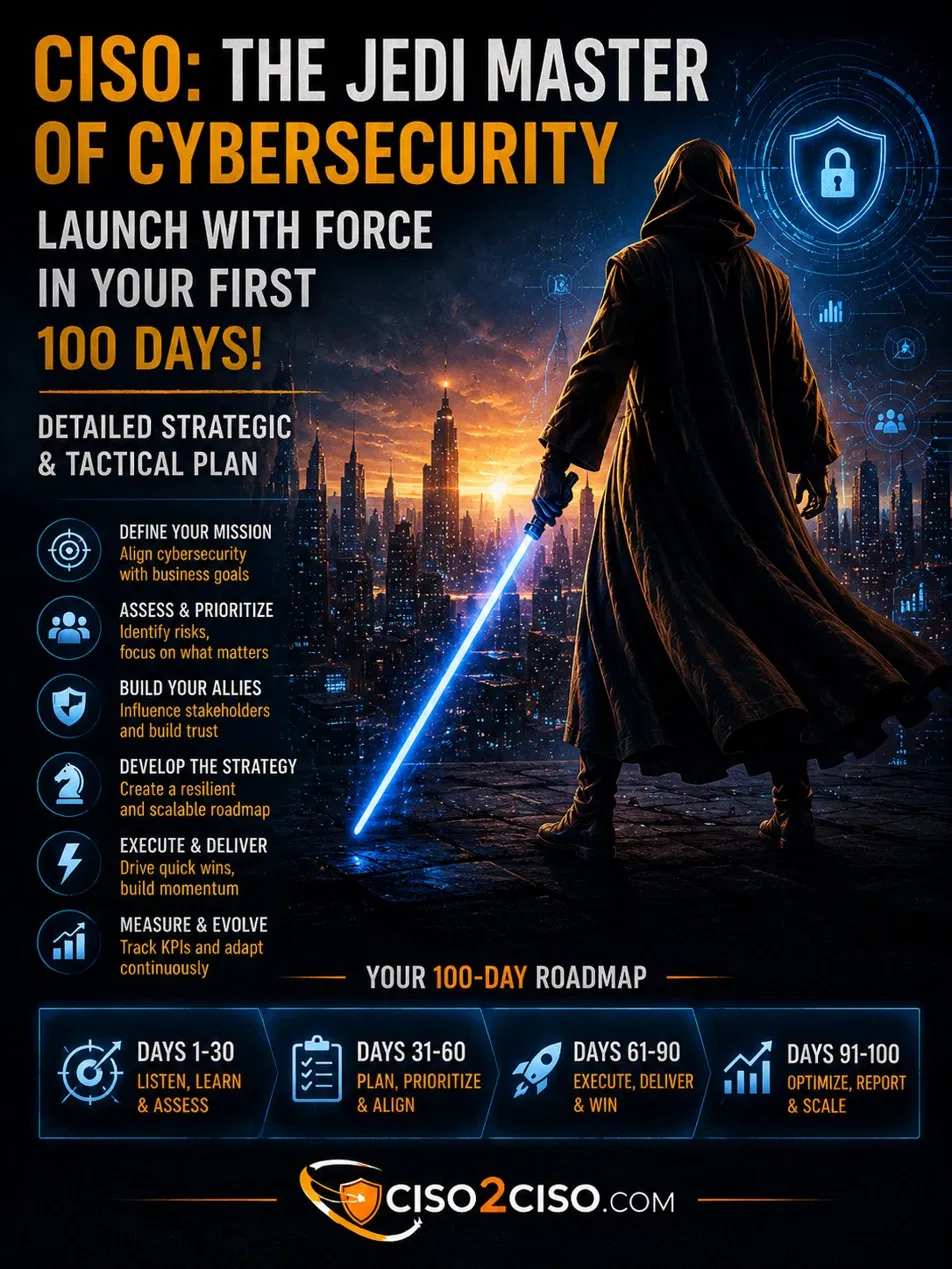
This plan offers a strategic and tactical guide for the first 100 days, organized into four progressive phases that take the CISO from active listening to execution with visibility and demonstrable results.
The CISO who arrives with answers before asking the right questions loses credibility in the first weeks. The one who arrives to listen, understand and then act with precision builds the kind of trust that lasts for years.
Why the First 100 Days Are Different
There is a reason why leaders talk about the first 100 days as a special category: it is the only moment when the organization expects you to ask questions, to explore, and to not have all the answers. After that period, the CISO is expected to know the environment and decisions must flow with greater speed and conviction.
That grace period is a strategic asset. Using it well means arriving at week 16 with a deep understanding of the business, solid relationships with the stakeholders who matter most, and a plan that has both technical rigor and organizational legitimacy.
Using it poorly — arriving with a preconceived plan, ignoring existing context, or focusing exclusively on the technical — can generate resistance that takes months or years to overcome.
The Four Strategic Objectives
1. Build solid and lasting relationships
Security is a function that depends on collaboration more than almost any other area of the company. The CISO needs CEO and board support to secure resources. They need the CIO's trust to coordinate architectural changes. They need alignment with the legal team to manage incidents. They need credibility with business leaders so that security is not perceived as an obstacle.
None of those relationships are built by sending an introduction email. They are built in one-on-one meetings, listening to each stakeholder's priorities, understanding their frustrations with the current security posture, and demonstrating that the new CISO is there to solve business problems — not just manage technical risk.
2. Comprehensive assessment of the current state
Before proposing any change, the CISO needs to understand what exists. This means reviewing the security architecture, implemented controls, recent incidents, previous risk assessments, compliance status — and equally important — the organization's security culture.
The assessment is not only technical. The most dangerous gaps are often organizational: processes that are not followed, policies that exist on paper but not in practice, teams that have learned to work around security controls because they perceive them as obstacles.
3. Define a clear, ambitious vision aligned with the business
A security program that cannot articulate its connection to business objectives will always be seen as a cost center. The CISO who understands what the organization needs to protect in order to grow, fulfill commitments to customers, and maintain investor trust can speak the board's language.
The vision does not need to be grandiose. It needs to be honest, achievable, and connected to the reality of the company. SMART objectives — specific, measurable, achievable, relevant, and time-bound — are the difference between a vision that generates commitment and a statement of intent that nobody remembers.
4. Deliver visible quick wins
The first tangible results are essential to build credibility. Not because the CISO needs validation, but because the organization needs evidence that investment in security produces real results.
Ideal quick wins are high-impact, moderate-effort projects: patch management improvements, multi-factor authentication hardening, security awareness programs, review of critical policies. Each must be communicated clearly — what risk was reduced, what changed in the security posture, what it means for the business.
The Tactical Plan: Four Phases
Phase 1 — Weeks 1 to 4: Listen, Assess and Build Relationships
The first month is fundamentally about active listening. The CISO who arrives to change things in the first week makes the most common mistake of the new leader: assuming that prior context is irrelevant.
Key actions:
- One-on-one meetings with all relevant stakeholders — CEO, CFO, CIO, CHRO, Audit, Legal, business leaders and the security team itself. The objective is not to present yourself but to understand.
- Comprehensive asset inventory: what exists, where it is, who has access and what level of protection it currently has.
- Documentation review: policies, procedures, network architecture, incident reports from the past 12-24 months, previous risk assessments, business continuity plans.
- Scenario-based risk analysis: identify the most critical risks to the business — not the technically most complex, but those with the greatest operational, reputational or regulatory impact.
- Communication channel setup: define how security information will flow to the different levels of the organization.
What must come out of this phase: a clear understanding of the current state, the most critical gaps and the relationships that need the most work.
Phase 2 — Weeks 5 to 8: Design the Plan and Secure Alignment
With the information gathered in the previous phase, the CISO can begin to build the strategic plan. This is not a technical document — it is a business document that articulates risks in terms of business impact and proposes investments in terms of return.
Key actions:
- Development of the strategic security plan: vision, objectives, strategies, tactics, required resources and implementation timeline. The initial horizon should be 12-18 months, with projection to 3-5 years.
- Initiative prioritization with risk matrix: classify projects by potential impact and probability of occurrence. Projects in the high impact / high probability quadrant are the first priority.
- Budget development: with the plan in hand, build the financial case for each priority initiative. Numbers must be in the CFO's language: cost of implementation vs. expected cost of unmitigated risk.
- Presentation to senior leadership: not as a formality, but as a conversation. The objective is to obtain alignment, not passive approval.
What must come out of this phase: an approved plan with committed resources and a clear mandate to move forward.
Phase 3 — Weeks 9 to 12: Execute with Visibility
The third phase is execution. Quick wins must begin to materialize, the security team must be aligned, and the organization must begin to see concrete results.
Key actions:
- Quick win implementation: execute high-priority projects with a focus on measurable results. Each project must have a clear owner, a defined timeline and success metrics.
- Team assessment and strengthening: understand the current capabilities of the security team, identify skill gaps and develop a training plan. Talent is the most critical asset of the program.
- Policy review and update: ensure that policies are current, aligned with best practices and applicable regulatory requirements. Policies that nobody follows are worse than having no policies — they create a false sense of control.
- KPI establishment: define the indicators that will measure program success. Less is more: 5-7 metrics that truly matter are more useful than a dashboard of 50 indicators nobody reads.
What must come out of this phase: first visible results, aligned team and baseline metrics established.
Phase 4 — Weeks 13 to 16: Consolidate, Communicate and Plan for the Future
The close of the first 100 days is a moment for honest review and long-term planning. The CISO must be able to answer clearly: what did I promise, what did I deliver, what did I learn, and where are we going?
Key actions:
- Progress evaluation: formal review of the results of each implemented initiative. Were the objectives met? What worked? What needs adjustment?
- Results communication: present the achievements of the first 100 days to senior leadership and the board, connecting each result with its impact on business risk.
- Long-term planning: develop the security strategy for the next 3-5 years, incorporating lessons learned and emerging trends in the threat landscape.
- Momentum maintenance: the first 100 days are the beginning, not the destination. The security program needs a sustained rhythm of communication, execution and continuous improvement.
Security Maturity Assessment Framework
A tool the CISO can use in Phase 1 to structure the assessment is a simple maturity model covering the main domains:
| Domain | Current State | Priority |
|---|---|---|
| Identity and access management | Basic / Developing / Mature | High / Medium / Low |
| Endpoint security | Basic / Developing / Mature | High / Medium / Low |
| Vulnerability management | Basic / Developing / Mature | High / Medium / Low |
| Incident detection and response | Basic / Developing / Mature | High / Medium / Low |
| Cloud security | Basic / Developing / Mature | High / Medium / Low |
| Third-party risk management | Basic / Developing / Mature | High / Medium / Low |
| Security awareness and culture | Basic / Developing / Mature | High / Medium / Low |
| Regulatory compliance | Basic / Developing / Mature | High / Medium / Low |
This simple framework allows the CISO to communicate the current state in executive terms and prioritize investments with clear logic.
Questions Every CISO Must Ask in the First 30 Days
- What are the three most critical information assets for the business and how are they protected today?
- When was the last significant security incident and what was learned from it?
- What controls exist on paper but are not applied in practice?
- What are the board's expectations for the security program?
- Does the security team have the tools, talent and mandate it needs to do its job?
- What is the relationship between security and business units — collaboration or friction?
The answers to these questions are more valuable than any technical assessment. They are the map of the real territory.
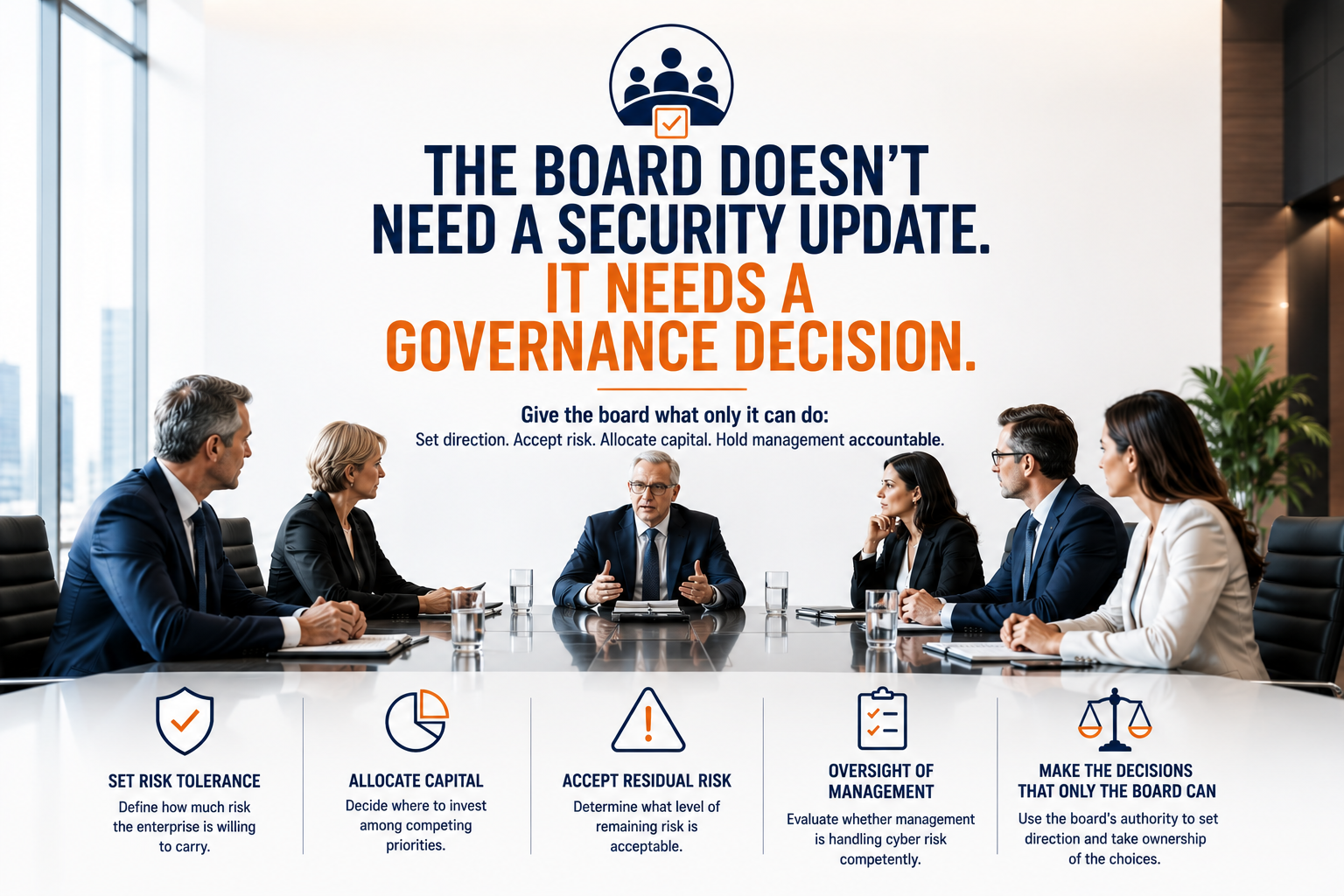
Board-Level Questions
- Does the board receive regular security reporting in business risk terms — not just technical metrics?
- Is cybersecurity explicitly included in the enterprise risk register?
- What would a significant security incident cost the organization — in operational, financial and reputational terms?
- Does the security program have the budget and executive sponsorship it needs to address the risks that matter most?
Final Reflection
The CISO role is one of the most complex in the modern enterprise. It requires technical competence, strategic vision, political skills and the ability to communicate complex risks to non-technical audiences under pressure.
The first 100 days will not solve all of the organization's security problems — nor should they try to. Their purpose is more precise and more important: to build the foundation of trust, understanding and credibility upon which a lasting and effective security program can be constructed.
The CISO who ends their first 100 days with solid relationships, an approved plan, the first wins delivered and a motivated team has accomplished exactly what they needed to accomplish. Everything else comes after.
*To be continued...*