The Corporate Network Was the Security Model. SASE Is What Replaces It.
Executive Summary
For most of the history of enterprise security, the corporate network was not just where work happened — it was the security model itself. Being inside the network meant being trusted. Traffic was backhauled to a central location where the security stack lived, inspected, and sent on its way. The perimeter defined the boundary between trusted and untrusted, and an enormous amount of security architecture was built on that single distinction.
That model has collapsed, and not gradually. The users left the network when work went remote and hybrid. The applications left when the organization adopted software-as-a-service. The data left when it moved to the cloud. When the users, the applications and the data are all outside the corporate network, routing everything back through a central perimeter to be secured is not just inefficient — it is securing a place that no longer contains the things that matter.
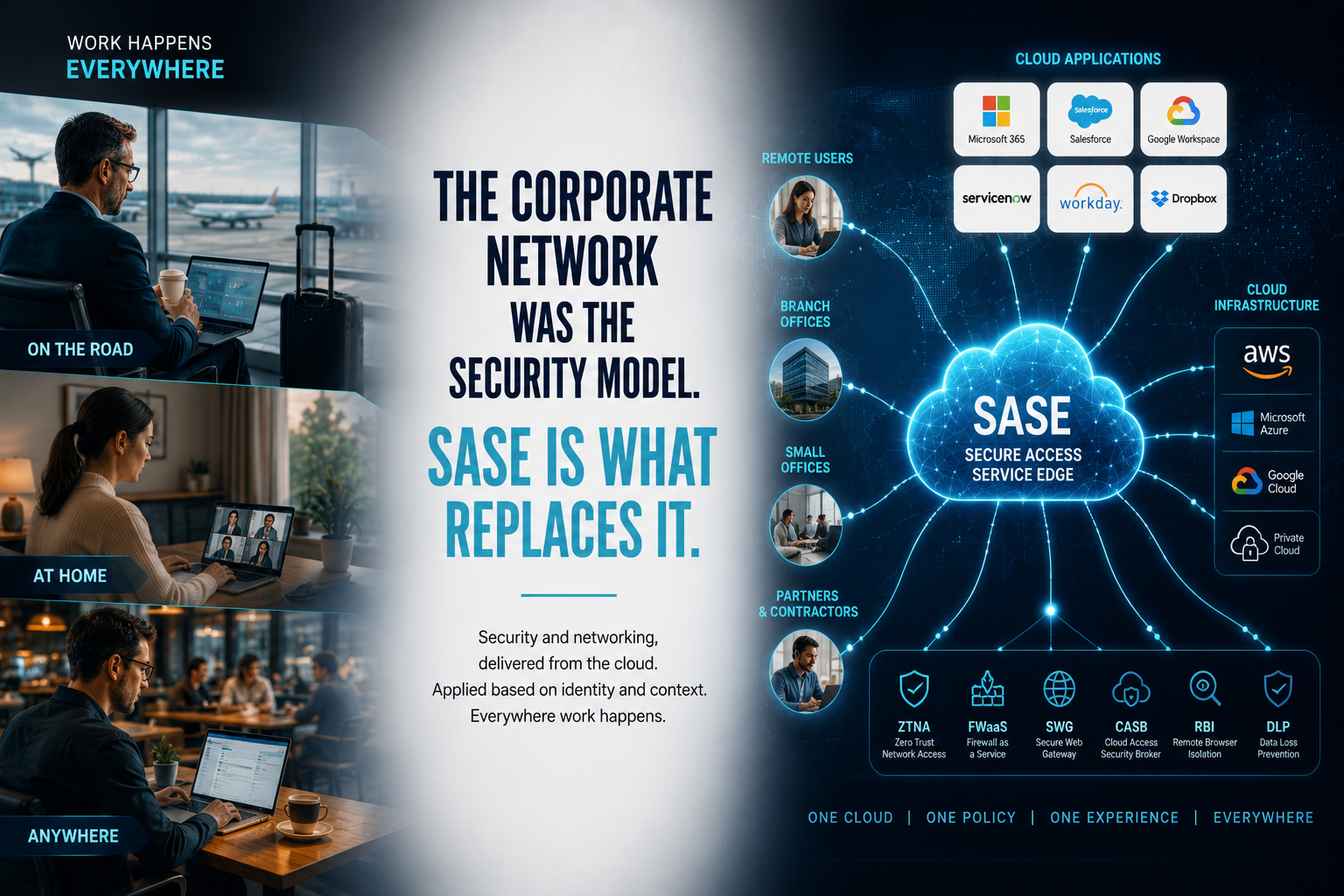
SASE — secure access service edge — is the architecture that emerged to replace location-based security with something that fits this reality: security and networking delivered from the cloud, applied based on identity and context rather than position on a network. It is one of the more significant architectural shifts in enterprise security, and one of the most frequently misunderstood.
Why This Matters Now
The pressure behind this shift is structural and permanent. The distributed workforce is not a temporary condition; it is the operating model. Cloud and SaaS adoption is not slowing; it is the default for new capability. The consequence is that the traditional architecture — a centralized security stack with traffic backhauled to it — now imposes a tax on every interaction, routing a remote user's traffic to a corporate location and back out to a cloud application that may sit physically closer to the user than the security stack does.
Beyond inefficiency, the old model leaves security gaps that matter. Traffic that goes directly from a remote user to a cloud application — increasingly the norm — may never pass through the centralized controls at all, meaning the organization's security stack is inspecting a shrinking portion of what actually happens. The location-based trust assumption, meanwhile, is exactly the assumption that modern attacks exploit: anything that reaches the inside is treated as trusted.
SASE matters now because the alternative is maintaining an expensive architecture that secures progressively less of the organization's real activity.
CISO2CISO Insight
The old model secured a place and assumed the right things were in it. SASE secures the connection between an identity and a resource, wherever both happen to be. The first made sense when work lived inside the network. The second is the only one that makes sense now that it doesn't.
What SASE Actually Converges
The substance of SASE is the convergence of capabilities that were historically separate products and separate teams, delivered together from the cloud and applied consistently regardless of location.
Networking and security become one fabric. SASE brings together wide-area networking and a set of security services into a single cloud-delivered model. The point is not the specific acronyms but the principle: networking and security are designed together rather than bolted together, so that a connection is routed and secured as one decision.
Access is granted based on identity and context, not location. The defining shift is away from "you are inside the network, therefore trusted" toward "this identity, on this device, in this context, is authorized to reach this specific resource." This is the same principle as Zero Trust, expressed at the level of network access — which is why SASE and Zero Trust are deeply related rather than competing ideas.
Security follows the user. Because the controls are delivered from the cloud, they apply consistently whether the user is at headquarters, at home, or anywhere else. Security is no longer a property of being in a particular location; it is a property of the identity and the session, applied everywhere.
Direct, secured paths replace backhauling. A remote user reaching a cloud application is secured on a direct path rather than routed through a distant corporate stack, removing the performance penalty while extending — not abandoning — inspection and control.
The SASE-Washing Trap
The single most important thing for a security leader to understand about SASE is that the market has strong incentives to mislabel as SASE any collection of security and networking products sold together. A genuine SASE architecture is converged — designed as a unified fabric where networking and security decisions are made together and policy is applied consistently. A bundle of separate products, integrated loosely and sold under the label, delivers the marketing of SASE without the architecture.
The difference shows up in operation. True convergence means one policy model, one place to manage it, and consistent enforcement everywhere. A repackaged bundle means multiple consoles, inconsistent policy, and integration gaps at every seam — which is to say, much of the complexity the organization adopted SASE to escape. Evaluating SASE is largely a matter of distinguishing genuine architectural convergence from products in a trench coat.
Executive Framework
| Dimension | Perimeter-era model | SASE model |
|---|---|---|
| Basis of trust | Location on the network | Identity and context |
| Where security lives | Central corporate stack | Cloud-delivered, follows the user |
| Networking and security | Separate products and teams | Converged fabric |
| Remote/cloud traffic | Backhauled to the perimeter | Secured on direct paths |
| Consistency | Strong inside, weak outside | Uniform everywhere |
| Key risk | Implicit internal trust | "SASE-washing" — a bundle, not an architecture |
What CISOs Should Do Next
- Recognize that location-based security is no longer the model — the users, applications and data have left the network, and the architecture has to follow them.
- Treat SASE and Zero Trust as related expressions of the same principle, ensuring your network-access strategy and your identity strategy are designed together rather than separately.
- Evaluate SASE offerings for genuine convergence — one policy model, consistent enforcement, unified management — rather than a bundle of separate products under a shared label.
- Prioritize identity as the foundation, since SASE access decisions are only as good as the identity context they are based on.
- Plan the transition as an architectural migration, sequenced by use case, rather than a single cutover — the move from perimeter to SASE is a journey, not a switch.
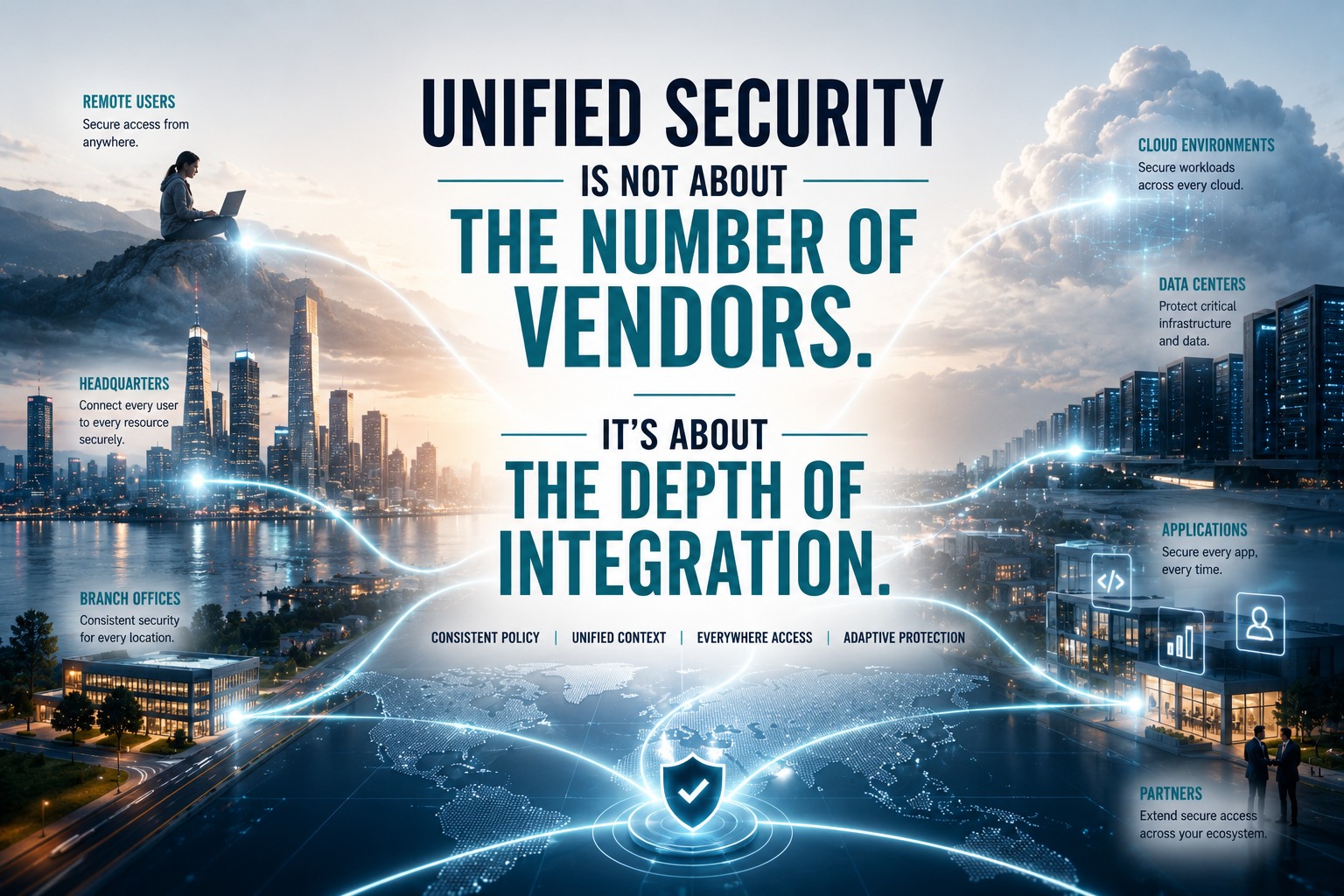
- Measure success by consistency of policy and control across all locations and access paths, not by the number of products deployed.
Board-Level Questions
- Does our security architecture still assume that being on the corporate network means being trusted — and is that assumption still valid given where our work actually happens?
- Are our remote and cloud interactions being secured consistently, or is a growing share of our activity bypassing our central controls?
- If we are pursuing SASE, are we acquiring a genuinely converged architecture or a bundle of products under the label?
- Are our network-access and identity strategies designed together, given that they are now the same security decision?
Final Executive Takeaway
The corporate network spent decades doing double duty — carrying the organization's traffic and, by defining an inside and an outside, serving as the foundation of its security model. That second job became untenable the moment the users, applications and data it was supposed to contain moved outside it. Continuing to secure the perimeter when the perimeter no longer contains anything important is an expensive way to protect a location that has emptied out.
SASE is the architecture built for the world that actually exists: one where security follows the identity rather than the location, where networking and security are converged rather than bolted together, and where a connection between a user and a resource is secured wherever both happen to be. The opportunity is significant. So is the trap of buying a bundle that carries the label without the architecture.
The corporate network used to be the security model. It isn't anymore. SASE is the architecture that replaces it — provided you buy the convergence, not just the acronym.
*To be continued...*