DLP Was Built for a World Where Data Stayed Put
Executive Summary
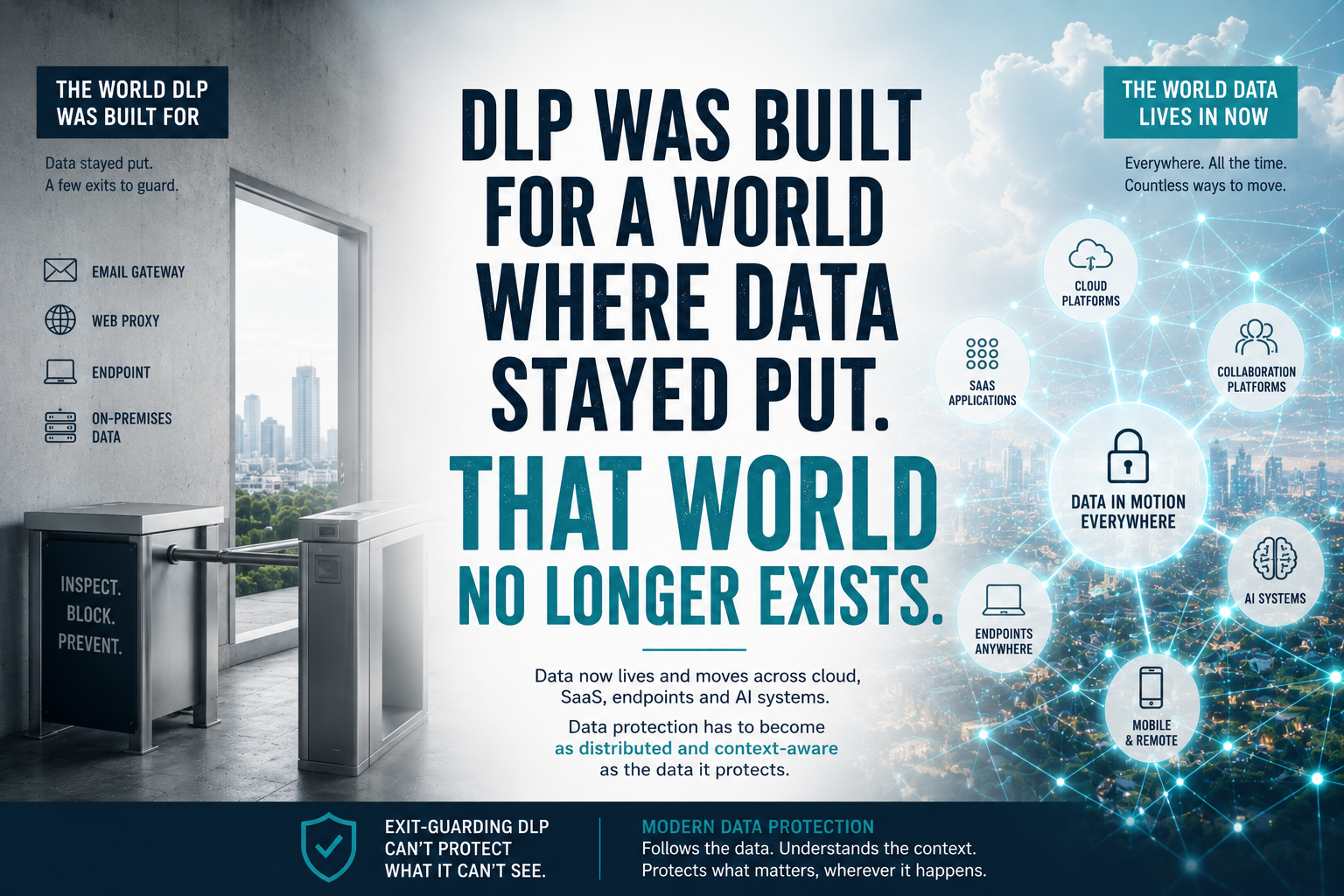
Data loss prevention was one of the more sensible ideas of its era. In a world where data lived inside a contained corporate environment, the way to stop it from leaking was to watch the exits — the email gateway, the web proxy, the endpoint — and inspect what passed through them for sensitive content. Define what sensitive data looks like, watch the handful of places it could leave, and block it when it tries. For an environment with clear boundaries and few exits, this was a reasonable model, and organizations invested heavily in it.
That environment has dissolved. Data no longer lives in a contained place with a few exits to guard. It lives across cloud platforms, scattered SaaS applications, endpoints inside and outside the network, and now AI systems that ingest and emit it in ways no exit-watching model anticipated. The number of places data can move has exploded, the boundaries that DLP watched have largely disappeared, and the pattern-matching approach at the core of classic DLP struggles in an environment this distributed and dynamic.
The result is a control that many organizations still run, that generates considerable noise, and that protects a shrinking fraction of how data actually moves. Data protection has to evolve to become as distributed and context-aware as the data it is meant to protect — which is a different proposition from watching the exits.
Why This Matters Now
The mismatch between classic DLP and the modern data environment has widened to the point of consequence. Data is created, copied and moved across a sprawling set of cloud and SaaS environments that the traditional exit-watching model was never positioned to cover. Sensitive data flows directly between cloud services, gets shared through collaboration platforms, and moves in ways that never pass through the gateways DLP was deployed to inspect. An exit-guarding control cannot guard exits that no longer route through it.
Artificial intelligence has sharpened the problem in a new dimension. AI systems ingest data as input and produce it as output, creating data flows that classic DLP has no model for. Sensitive information can move into an AI system and emerge in its outputs in forms that pattern-matching was not designed to catch. As organizations connect AI to their data at speed, the gap between how data actually moves and what traditional DLP can see has become a live exposure rather than a theoretical one.
Meanwhile, the operational reality of classic DLP — high volumes of false positives, heavy tuning burden, and frustrated users working around controls that block legitimate work — has long undermined its effectiveness even in the environment it was designed for. The model was straining before the environment changed; the change has pushed it past the point where it can carry data protection on its own.
CISO2CISO Insight
Classic DLP watches the doors. The problem is that the building has no walls anymore — the data is in the cloud, in a dozen SaaS apps, on unmanaged devices, and flowing through AI systems. You cannot guard the exits of a structure that no longer has a perimeter.
Why Classic DLP Struggles
The difficulties are structural, rooted in assumptions that no longer hold.
It assumes a perimeter with few exits. The entire model depends on there being a small number of chokepoints through which data must pass to leave. In a distributed cloud and SaaS environment, that assumption collapses — data moves through countless paths, most of which never touch the inspected exits.
It relies on pattern-matching content. Classic DLP largely works by recognizing sensitive content based on patterns. This approach generates significant false positives, misses sensitive data that does not match the patterns, and lacks the context to distinguish a legitimate use of data from a risky one. Content recognition without context is both noisy and porous.
It lacks context about appropriateness. Whether a given data movement is a problem depends heavily on context — who is moving it, to where, in what circumstances. Classic DLP, focused on whether content matches a sensitive pattern at an exit, has limited ability to make that contextual judgment, which is why it blocks so much legitimate activity and misses so much risky activity.
It does not follow data into the cloud, SaaS and AI. The places data increasingly lives and moves are precisely the places the exit-watching, endpoint-and-gateway model does not reach. Data protection that cannot follow the data into these environments is protecting the environment data is leaving, not the one it lives in.
What Modern Data Protection Looks Like
The evolution is from guarding exits to protecting data wherever it lives and moves, with the context to tell appropriate use from risky use.
Protection follows the data. Rather than watching a few chokepoints, modern data protection extends to where data actually resides and moves — across cloud, SaaS, endpoints and the AI systems that consume it. This connects directly to data discovery and posture: you protect data where it is, which first requires knowing where it is.
Context drives the decision. The judgment about whether a data movement is acceptable has to incorporate context — identity, destination, circumstance — not just whether content matches a pattern. Context-aware protection is what reduces the false positives that plagued classic DLP while catching the risky movements it missed.
It accounts for AI data flows. As data moves into and out of AI systems, protection has to extend to those flows — controlling what sensitive data AI systems can ingest and being aware of what they can emit, a dimension classic DLP simply does not address.
It integrates with the broader data security posture. Modern data protection is not a standalone exit guard but part of a coherent approach grounded in knowing where sensitive data is, who can access it, and how it moves — with protection applied based on that complete, continuously updated picture.
Executive Framework
| Dimension | Classic DLP | Modern data protection |
|---|---|---|
| Assumption | Contained environment, few exits | Distributed data, no perimeter |
| Mechanism | Pattern-match content at exits | Follow data; decide with context |
| Coverage | Endpoint and gateway chokepoints | Cloud, SaaS, endpoints, AI flows |
| Decision basis | Does content match a pattern? | Is this movement appropriate in context? |
| Operational profile | High false positives, workarounds | Context reduces noise |
| AI data flows | Not addressed | Explicitly covered |
What CISOs Should Do Next
- Recognize that the environment classic DLP was built for no longer exists, and that exit-watching protects a shrinking fraction of how data actually moves.
- Extend data protection to where data actually lives and moves — cloud, SaaS, endpoints and AI systems — rather than concentrating it on the traditional chokepoints.
- Make protection context-aware, incorporating identity, destination and circumstance so that appropriate use is distinguished from risky use, reducing noise and closing gaps.
- Address AI data flows explicitly, controlling what sensitive data AI systems can ingest and being aware of what they can emit.
- Integrate protection with data discovery and posture, applying controls based on a complete, continuously updated picture of where sensitive data is and how it moves.
- Reassess legacy DLP investments honestly, recognizing where they generate noise and workarounds without protecting the modern data environment, and evolving accordingly.
Board-Level Questions
- Is our data protection following our data into the cloud, SaaS and AI systems where it now lives, or guarding exits that most of our data no longer passes through?
- How much of our data protection effort generates false positives and user workarounds without protecting how data actually moves today?
- Are we controlling what sensitive data our AI systems can ingest and aware of what they can emit?
- Is our data protection grounded in a current picture of where our sensitive data is, or operating blind to most of it?
Final Executive Takeaway
Data loss prevention earned its place by solving a real problem in a world that had a clear shape: data inside, a few exits, content to inspect on the way out. None of those conditions describes the modern environment. The data is distributed across cloud and SaaS, moving through paths that never touch the inspected exits, and now flowing through AI systems that the model never anticipated. Classic DLP did not become wrong so much as it became a control for an environment that has largely ceased to exist.
The evolution data protection has to make is the same one the rest of security has been forced into: stop defending a perimeter that is gone, and instead protect the thing itself — the data — wherever it lives and moves, with the context to make good decisions about its use. That is a harder and more distributed proposition than watching the doors. It is also the only one that fits the world data actually lives in now.
DLP was built for a world where data stayed put. Data does not stay put anymore — so protection has to follow it, everywhere it goes, with the context to know when its movement is a problem and when it is just the business working.
*To be continued...*