You Cannot Protect the Data You Cannot Find
Executive Summary
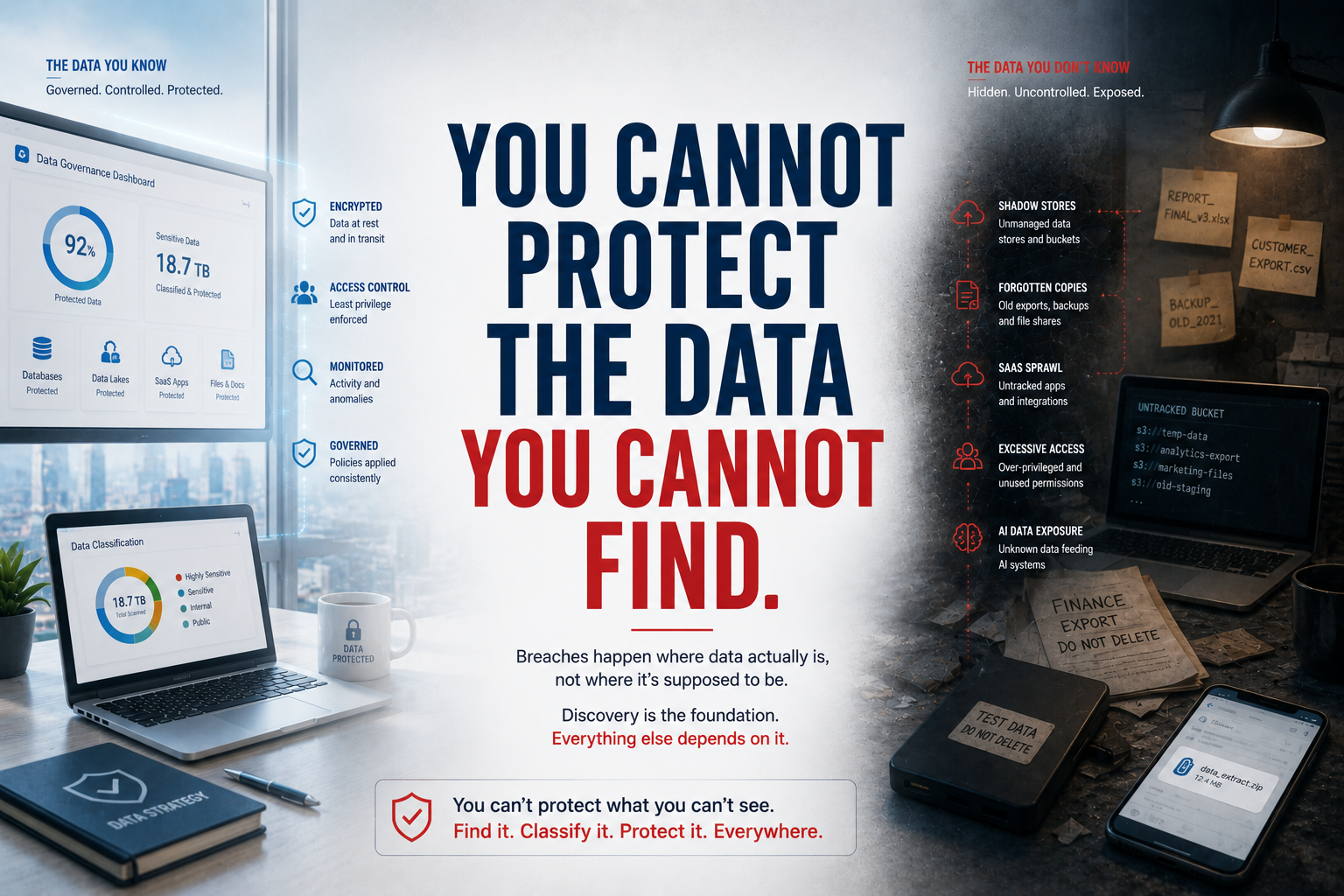
Data security has a foundational problem that most programs quietly work around rather than solve: organizations do not know where their sensitive data actually is. They know where it is supposed to be — the sanctioned databases, the approved repositories, the systems of record. And they build controls around those places. But sensitive data does not stay where it is supposed to be. It is copied into spreadsheets, exported into reports, replicated across cloud environments, embedded in test systems, attached to messages, and accumulated in repositories that no one is tracking.
The breach, when it comes, almost never happens in the well-governed system of record. It happens in the copy. The forgotten export. The shadow data store that a team spun up and never registered. The backup that was never inventoried. The organization protected the data it could see and was compromised through the data it could not.
This is why data security cannot begin with controls. It has to begin with discovery — with the unglamorous, continuous work of finding where sensitive data actually lives, understanding what it is, and only then deciding how to protect it. You cannot protect the data you cannot find, and most organizations cannot find most of their data.
Why This Matters Now
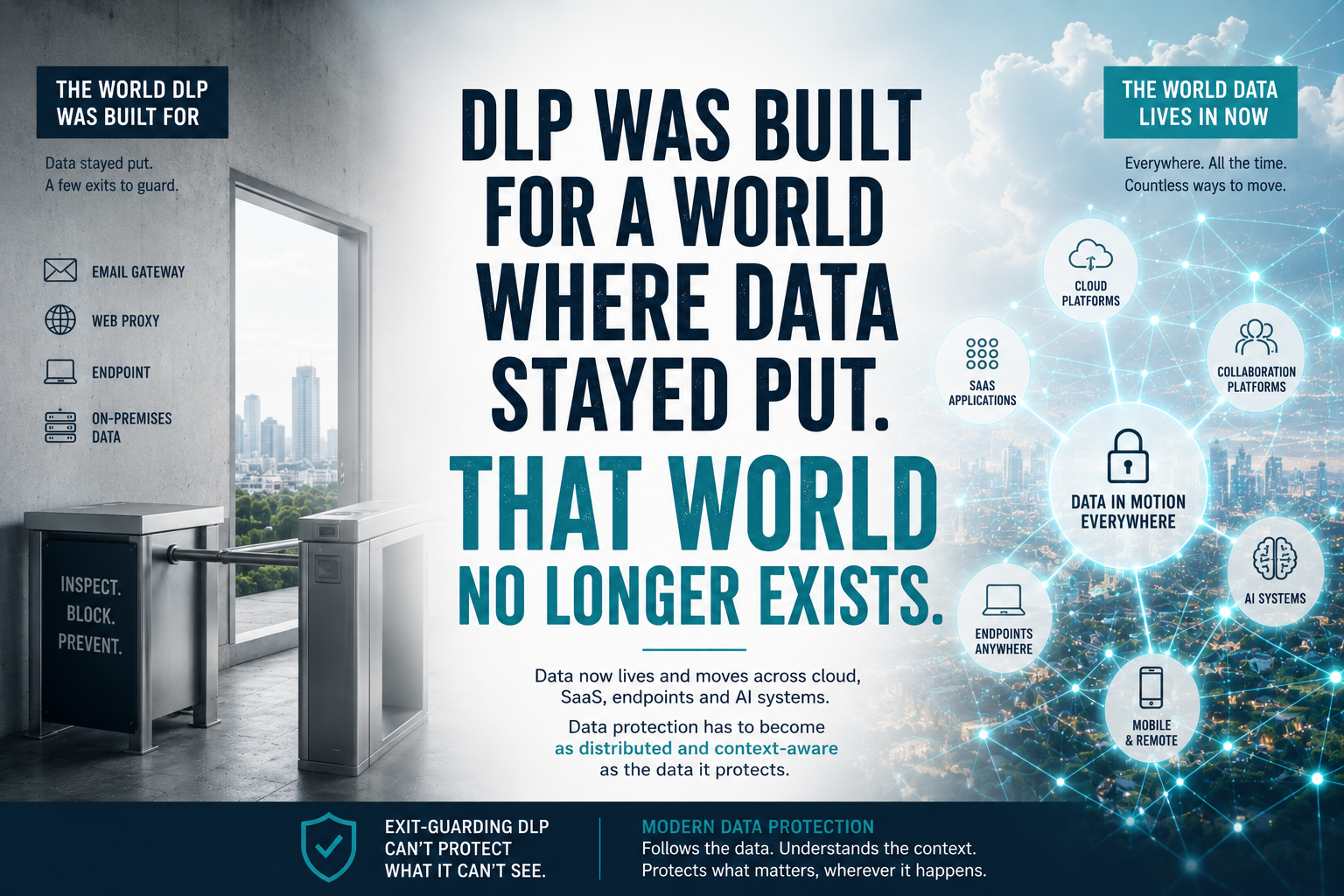
Two developments have turned a long-standing weakness into an urgent one. The first is the explosion of where data can live. Cloud adoption, the proliferation of SaaS applications, and the ease with which anyone can create a new data store have multiplied the number of places sensitive data can accumulate, far faster than governance has kept pace. Data sprawl is no longer an edge case; it is the default condition of the modern enterprise.
The second, and more pressing, is artificial intelligence. AI systems are voracious consumers of data — they are trained on it, fed it as context, and given access to it to perform their functions. An organization that does not know where its sensitive data lives cannot possibly control what its AI systems are ingesting, exposing, or learning from. The rush to deploy AI on top of enterprise data has dramatically raised the stakes of not having mapped that data first. A model given access to a repository no one realized contained sensitive information is a data exposure waiting to be discovered — often by the wrong party.
The cost of not knowing where your data is has never been higher, and it is rising with every AI system the organization connects to its data.
CISO2CISO Insight
Every data security program implicitly answers the question "where is our sensitive data?" The mature ones answer it with evidence from continuous discovery. The rest answer it with an assumption — and the breach is almost always in the gap between the assumption and the reality.
Why Discovery Has to Come First
The logic is simple and frequently inverted. Controls — encryption, access governance, loss prevention, monitoring — are only as effective as the completeness of what they are applied to. A control applied to the known repositories does nothing for the unknown ones, and it is the unknown ones where the risk concentrates.
Data does not respect boundaries. The moment data is useful, it is copied, moved and transformed. A perfectly governed database becomes the source for an export that becomes a spreadsheet that becomes an attachment that lands in a personal cloud drive. Each step takes the data further from the controls built around its origin. Governing only the origin governs a snapshot of where data started, not where it is.
Classification determines proportionality. Not all data deserves the same protection, and treating it all identically means either over-controlling the trivial or under-protecting the critical. Discovery has to be paired with classification — understanding what the data is and how sensitive it is — so that protection can be proportionate. A program that cannot distinguish its crown-jewel data from its routine data cannot prioritize, and prioritization is the whole game when resources are finite.
Shadow data is where the unmanaged risk lives. The data stores no one registered, the environments spun up outside process, the copies made for a project and never deleted — this shadow data carries risk precisely because no control was ever applied to it. It is invisible to the security program by definition, which is exactly what makes it dangerous.
What a Data-Centric Approach Looks Like
The shift is from protecting places to protecting data. A place-centric program secures the known systems and assumes data stays in them. A data-centric program starts from the data itself — finding it wherever it lives, classifying it by sensitivity, and applying protection that travels with it.
This is the discipline that data security posture management has emerged to support: continuously discovering where data resides across the environment, classifying it, identifying who and what can access it, and surfacing the exposures — the sensitive data in the wrong place, accessible to the wrong identity, protected by nothing. The value is not in any specific tool but in the principle that data security must be grounded in an accurate, continuously updated picture of where sensitive data actually is and what is exposed.
With that picture, the controls finally have something complete to act on. Access governance can be applied where the data really is. Exposures can be prioritized by the sensitivity of what is exposed. And the organization can answer, with evidence rather than assumption, the question that underpins everything: where is our sensitive data, and what is at risk?
Executive Framework
| Dimension | Place-centric data security | Data-centric data security |
|---|---|---|
| Starting point | Known, sanctioned repositories | Discovery of data wherever it lives |
| Assumption | Data stays where it belongs | Data sprawls, copies, and moves |
| Classification | Often absent or coarse | Sensitivity-based, drives proportionality |
| Shadow data | Invisible, ungoverned | Surfaced and assessed |
| Controls applied to | What we can see | What actually exists |
| AI readiness | Cannot control AI data access | Knows what AI can reach |
What CISOs Should Do Next
- Treat discovery as the foundation, not an optional add-on — invest first in knowing where sensitive data actually lives across every environment, including the unsanctioned ones.
- Pair discovery with classification, so protection can be proportionate to sensitivity rather than uniform and therefore either wasteful or inadequate.
- Hunt for shadow data deliberately — the copies, exports and unregistered stores — because that is where the ungoverned risk concentrates.
- Make data exposure, not just access policy, a primary metric: sensitive data in the wrong place, reachable by the wrong identity, is the condition breaches exploit.
- Map data before connecting AI to it, because an AI system given access to data the organization has not mapped is an exposure the organization cannot see.
- Apply controls based on the complete, continuously updated picture, so that encryption, access governance and monitoring act on where data actually is rather than where it was assumed to be.
Board-Level Questions
- Do we actually know where our most sensitive data resides — across cloud, SaaS and the copies and exports that proliferate — or are we protecting only the places it is supposed to be?
- Have we classified our data by sensitivity so that our protection is proportionate to what matters most?
- How exposed are we through shadow data — the stores, copies and environments no one registered?
- Before we connect AI systems to our data, do we know what data they will be able to reach?
Final Executive Takeaway
Data security programs fail in a characteristic way. They are not undone by inadequate encryption or weak access policy on the systems they manage. They are undone by the data they never knew they had — the copy, the export, the shadow store, the repository that an AI system was quietly given access to. The controls were real; they were simply applied to a fraction of the data, and the breach found the rest.
The discipline that prevents this is not a better lock. It is the willingness to do the unglamorous work first: to find the data wherever it actually lives, to understand what it is, and to let that complete picture drive where protection goes. Everything else in data security is built on that foundation, and a program without it is protecting an assumption.
You cannot protect the data you cannot find. And in an era where AI systems consume enterprise data at a scale no one anticipated, finding it first is not the preliminary step. It is the whole strategy.
*To be continued...*