The Future Cyber Workforce Problem Nobody Is Solving
Executive Summary
The cybersecurity industry has spent considerable energy discussing the talent shortage — the gap between the number of security roles organizations need to fill and the number of qualified candidates available to fill them. The proposed solutions have ranged from expanded university programs to bootcamp certifications to skills-based hiring that de-emphasizes traditional credentials.
AI has added a new dimension to this conversation: the promise that AI augmentation will reduce the effective demand for security talent by making existing practitioners more productive. Fewer analysts needed to process the same alert volume. Automated triage reducing the headcount required for tier-one operations. AI-assisted detection engineering reducing the specialist expertise needed to maintain detection coverage.
These efficiency gains are real. And they are creating a problem that the industry is almost entirely ignoring: if AI absorbs the repetitive, pattern-recognition-intensive work that has historically served as the training environment for developing security expertise, what replaces it? The entry-level analyst position was not just a low-cost labor solution — it was the apprenticeship model through which most of the senior security talent that exists today was formed. Remove the position without replacing the learning model, and the pipeline of senior talent ten years from now becomes a serious organizational risk.
Why This Matters Now
Security expertise is developed through exposure — to real alerts, real investigations, real incidents, real threat actor behavior, and the accumulation of pattern recognition that comes from sustained engagement with actual security data in actual environments. The senior analysts, incident responders, and threat hunters who are most valued in security operations did not become valuable through classroom instruction or certification programs. They became valuable through thousands of hours of working through security data and developing the intuition that comes from pattern exposure at scale.
Tier-1 analyst work — the alert triage, first-level investigation, and escalation work that AI is rapidly automating — was the primary environment for this pattern exposure. It was not efficient work. It was often repetitive and frustrating. But it was the work through which analysts developed the foundational pattern recognition that made them useful for more sophisticated work over time.
The elimination of this learning environment without a replacement creates a talent pipeline that will look healthy in the near term — the existing population of experienced security professionals is still there — and will begin showing structural weakness in three to five years, as the pipeline of developing talent runs thin.
CISO2CISO Insight
The cybersecurity industry is celebrating the automation of entry-level work without noticing that it is automating the apprenticeship model through which entry-level practitioners became experienced ones. That lag will show up in talent pipelines before anyone has a good solution for it.
Three Dimensions of the Problem
The learning environment collapse. The volume of real security events that entry-level analysts processed was an irreplaceable source of pattern exposure. An analyst who has worked through ten thousand alerts — even routine, uninteresting ones — has a calibrated sense of what normal looks like that no amount of classroom instruction can replicate. As AI absorbs this work, the question of how developing analysts accumulate equivalent pattern exposure becomes urgent. Synthetic data environments, accelerated learning programs, and structured mentorship can partially address this — but they require deliberate investment and organizational commitment that most enterprises have not made.
The escalation path disruption. In the traditional model, an analyst escalated from tier-one triage to tier-two investigation to senior analysis through demonstrated competence at each level — competence that was visible because each level involved doing observable work that could be evaluated. In an AI-augmented model where tier-one work is largely automated, the escalation path is disrupted. There is less visible work at the entry level, making it harder to identify developing talent and harder for developing talent to demonstrate readiness for advancement. Building new visibility mechanisms for early-career development is an organizational design challenge that most security functions have not yet addressed.
The institutional knowledge transfer gap. The senior security practitioners who carry the deepest institutional knowledge — about the organization's specific threat profile, the historical context of its security architecture decisions, the lessons learned from past incidents — are often the same practitioners who developed their expertise through the exact learning environment that is now being automated. When they eventually leave, the pattern recognition and contextual knowledge they carry will need to transfer to practitioners who may have developed through a substantially different path. The institutional knowledge transfer challenge compounds over time, and organizations that are not investing in deliberate knowledge management now will face it acutely.
What the Industry Should Be Building
The honest answer is that the industry does not yet have a fully adequate replacement for the learning model that AI augmentation is disrupting. What exists is a set of partial responses:
Structured simulation environments that expose developing analysts to realistic, complex security scenarios — not the sanitized exercises of traditional training programs, but environments that replicate the ambiguity, time pressure, and incomplete information of real incidents. These require investment in curriculum development, scenario design, and the instructor expertise to debrief and teach from exercises rather than just score them.
AI-assisted learning pathways that use AI to accelerate pattern exposure while maintaining the cognitive engagement of the developing analyst — presenting complex scenarios, prompting investigation and hypothesis formation, and calibrating difficulty based on demonstrated competency. The AI in this model is a learning amplifier rather than a work replacement.
Deliberate apprenticeship structures that pair developing analysts with experienced practitioners on real work — not tier-one triage, but the tier-two and tier-three work that experienced practitioners are being freed up to focus on as AI handles routine processing. The learning value is in the observation, explanation, and guided practice that experienced practitioners provide, which requires organizational investment in mentorship time and culture.
Broadened entry paths that recognize security expertise developed outside traditional SOC environments — in development, in system administration, in data analysis, and in adjacent technical disciplines. The pattern recognition relevant to security is more broadly distributed than the traditional talent pipeline acknowledged.
Executive Framework
| Workforce challenge | Near-term impact | Long-term impact without action |
|---|---|---|
| Learning environment collapse | Reduced entry-level pipeline | Senior talent shortage in 5-10 years |
| Escalation path disruption | Less visibility into developing talent | Promotion decisions made with less evidence |
| Institutional knowledge gap | Manageable while seniors are present | Structural loss when senior cohort turns over |
| New skill requirements | Skill gaps in current workforce | Mismatch between training and operational needs |
What CISOs Should Do Next
- Audit your talent development program against the AI augmentation reality: does your current entry-level development path still expose analysts to sufficient real security data, or has AI automation reduced that exposure without a replacement?
- Invest in simulation and structured learning environments that compensate for reduced real-event exposure — and evaluate them based on demonstrated analyst capability development, not just program completion.
- Build deliberate mentorship structures into your AI-augmented security operations: experienced practitioners who are freed from routine work by AI augmentation should be redirected toward developing talent, not just toward more sophisticated individual work.
- Develop explicit capability frameworks for security roles that reflect what AI-augmented security operations actually require — the skills that matter in an AI-augmented environment are different from the skills the traditional job description valued.
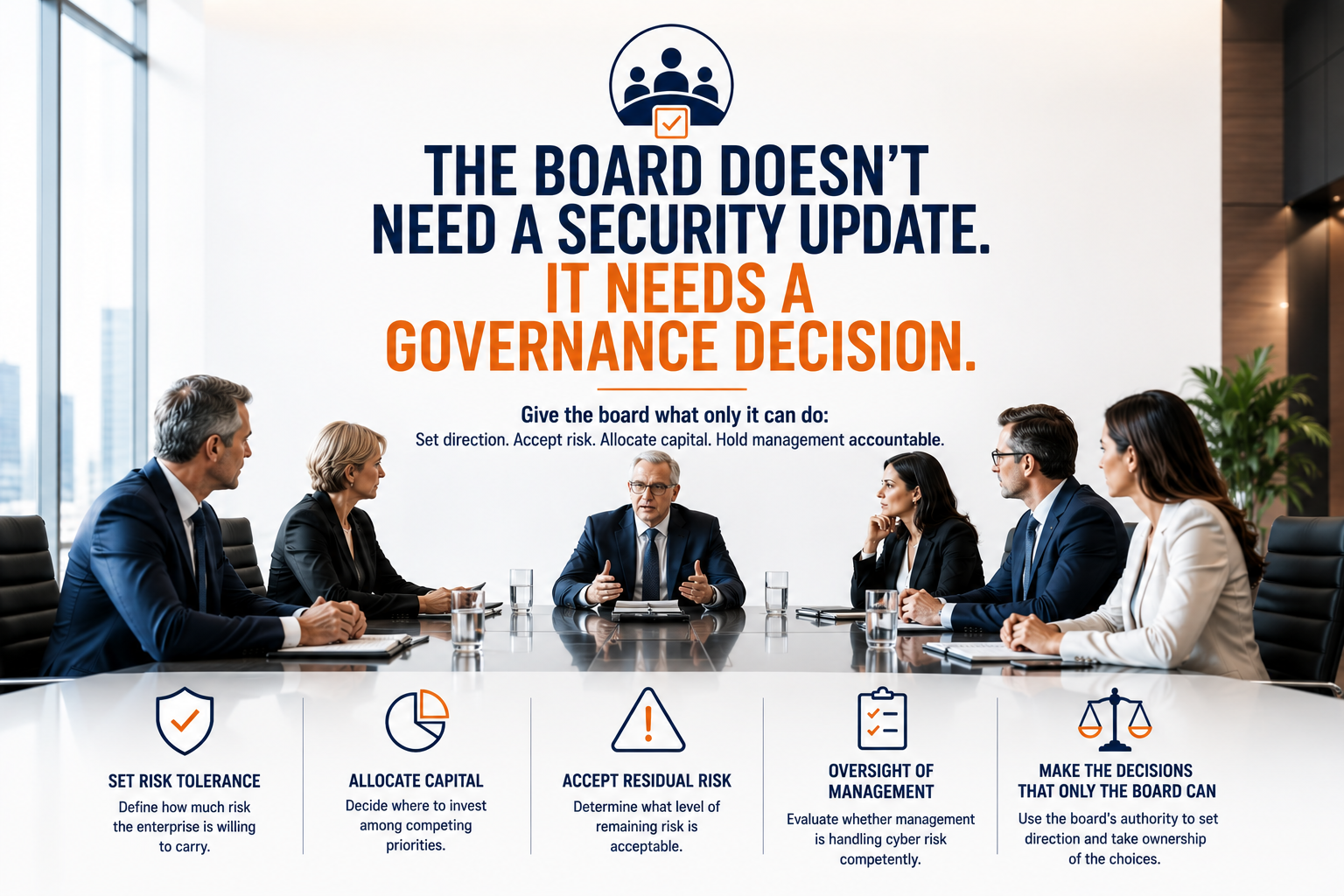
- Brief the board on security workforce planning as a long-term risk: the talent pipeline implications of AI augmentation will show up in organizational capability over a multi-year horizon, and executive visibility into the risk is the prerequisite for the organizational investment required to address it.
- Engage with the broader industry on workforce development: the problem is sector-wide, and solutions that work at scale require industry-level investment in curriculum, standards, and pipeline development.
Board-Level Questions
- Does our security workforce planning account for the impact of AI augmentation on the talent development pipeline?
- Are we investing in the learning environments that will develop the senior security talent we will need in five to ten years?
- Do we have a strategy for transferring institutional security knowledge from experienced practitioners to developing ones as AI augmentation changes what entry-level security work looks like?
- Are we engaging with the industry-level workforce development challenge, or assuming that the talent market will solve it without organizational investment?
Final Executive Takeaway
The cybersecurity workforce problem of 2026 is not the same as the talent shortage of the past decade. The near-term shortage is real and persists — but the longer-term problem that AI augmentation is creating is structural: the learning environment that produced the experienced practitioners the industry values is being automated away without an adequate replacement.
The organizations that will have the security talent they need in 2031 are the ones that are investing now in learning environments, mentorship structures, and career development models that work in an AI-augmented context. The ones that are not investing are relying on a talent pipeline that is narrowing without anyone noticing — until the narrowing becomes a crisis.
The question is not whether AI will change security workforce economics. It will. The question is whether organizations are investing in the workforce development models that will produce the security talent they need a decade from now — or assuming the market will handle it.