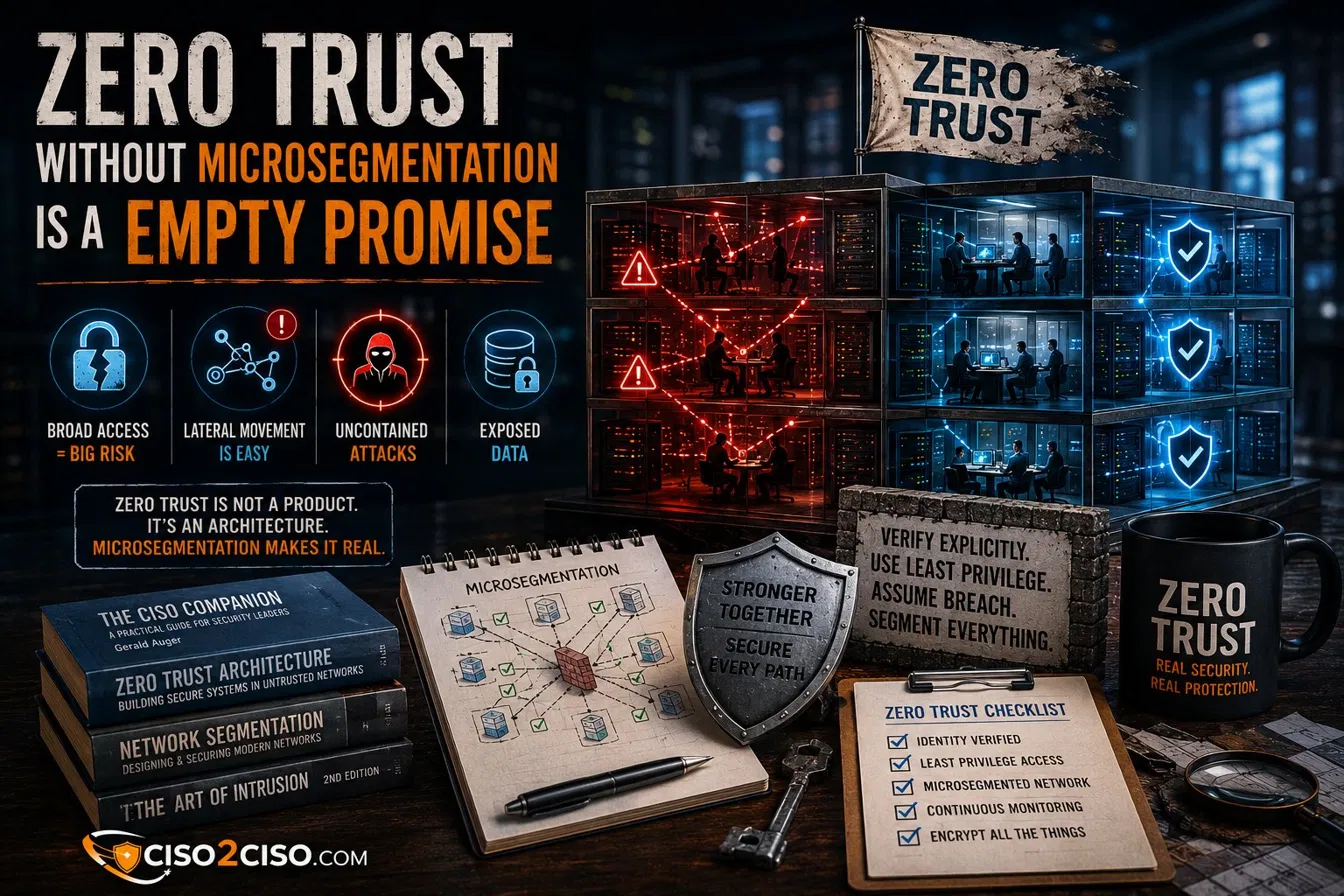
Without Microsegmentation, Zero Trust Is an Empty Promise
Why Microsegmentation Is Now Practically Mandatory
Modern attackers no longer enter through the perimeter. They no longer break central firewalls. They no longer hit hard and fast. Instead, they move laterally — silent, slow, precise.
And if there is no microsegmentation in place, they can discover assets, escalate privileges, pivot across systems, move between zones, exfiltrate data without making noise, and prepare a ransomware deployment within 48 hours.
Without microsegmentation, attackers have a free corridor through your environment. With microsegmentation, they hit electrified walls at every turn.
Without microsegmentation, Zero Trust is a promise. With it, it becomes architecture.
What Network Segmentation Actually Means
Real segmentation means separating the network into zones that should never communicate with each other. If an attacker compromises a user endpoint, they should not be able to walk freely through servers, databases, OT systems, vendor connections or your Active Directory.
Real segmentation means an explosion affects one room — not the entire building.
The problem is that most organizations segment their networks thinking about topology, not about risk. And when everything is connected because the business asked for it, the blast radius of any compromise becomes organization-wide.
What Microsegmentation Actually Is
Microsegmentation is segmentation — but with precision engineering, operational discipline and a Zero Trust foundation.
It does not divide by broad areas. It divides by application, function, traffic flow, identity, context, risk level and specific services.
A practical example of what microsegmentation looks like in operation:
- Server A communicates ONLY with Server B on port 443
- And ONLY if both are authenticated
- And ONLY if they comply with the applicable policy
- And ONLY if that specific flow is explicitly permitted
- And ONLY if there is a verifiable identity on both ends
- And ONLY if the traffic passes through inspection
- And EVERYTHING is logged
That is microsegmentation.
Everything else is hope with VLANs.
Why the Distinction Between Segmentation and Microsegmentation Matters
Traditional segmentation was designed for a world where the perimeter was the primary defense. Networks were divided into broad zones — corporate, DMZ, server — and firewall rules controlled traffic between them.
That model assumed that what was inside the perimeter was trusted. Zero Trust proved that assumption wrong, and ransomware confirmed it catastrophically.
Microsegmentation assumes the opposite: nothing inside the network is automatically trusted. Every flow must be explicitly authorized. Every connection must be verified. Every deviation must be detected and logged.
The operational implication is significant. Microsegmentation requires knowing what traffic should legitimately flow between every system in the environment — a level of visibility and documentation that most organizations have never achieved. Getting there is not easy. But without it, Zero Trust remains a policy document rather than a security architecture.
The Attack Path That Microsegmentation Breaks
Consider a typical ransomware intrusion sequence without microsegmentation in place:
Initial access — a phishing email compromises a user workstation. The attacker has a foothold in the corporate network.
Reconnaissance — the attacker scans the network from the compromised workstation. They discover servers, databases, backup systems and domain controllers. All are reachable because the network is flat.
Lateral movement — using harvested credentials and standard protocols, the attacker moves from the user segment to the server segment, then to the backup infrastructure, then to the domain controller. Nothing blocks them because all of these flows are permitted by default.
Ransomware deployment — with access to the domain controller and backup systems, the attacker deploys ransomware across the environment, disables backups, and encrypts at scale.
The outcome — a 48-hour operation that started with one phishing email results in a complete operational shutdown.
Now consider the same sequence with microsegmentation in place. The initial compromise of the workstation is contained to the user segment. The attacker cannot reach servers, databases or backup systems because those flows are not permitted. The attack stalls at the first wall, and the blast radius is contained to a single endpoint.
What CISOs Should Address
Start with visibility. You cannot segment what you cannot see. The first requirement for microsegmentation is a complete map of what communicates with what in your environment — every application flow, every server dependency, every legitimate connection. Most organizations discover that this map does not exist in any formal form.
Define the protection surfaces. Zero Trust methodology recommends identifying the most critical assets first — the Protect Surface — and building microsegmentation policy around them. Starting with crown jewels rather than trying to microsegment everything at once is how successful deployments proceed.
Implement incrementally. Microsegmentation deployed incorrectly breaks applications. The operational approach is to start in observation mode — understand the traffic flows without enforcing policy — then build policy incrementally, zone by zone, starting with the highest-risk segments.
Integrate with identity. The most effective microsegmentation is identity-aware — policy is enforced based on who is initiating the connection and what they are authorized to access, not just what IP address the traffic comes from. This is what makes microsegmentation a genuine Zero Trust control rather than a network access control exercise.
Board-Level Questions
- If an attacker compromised one of our user endpoints today, how far could they move through our environment before being stopped?
- Do we have a documented map of which systems are permitted to communicate with each other?
- Is our network segmentation based on topology — physical or logical zones — or on actual risk and traffic flow analysis?
- Have we tested our segmentation controls against realistic lateral movement scenarios?
Final Takeaway
Zero Trust is an architecture, not a product. And at its core is a simple principle: nothing inside the network is trusted by default. Every connection must be verified. Every flow must be authorized.
Microsegmentation is the control that operationalizes that principle at the network layer. Without it, Zero Trust is a framework that exists in documentation but not in the environment where attackers actually move.
The organizations that implement microsegmentation do not prevent every attack. But they do ensure that a single compromised endpoint cannot become a full organizational compromise. That is the difference between a contained incident and a catastrophic one.