Zero Trust Dies in the Legacy Estate
Overview
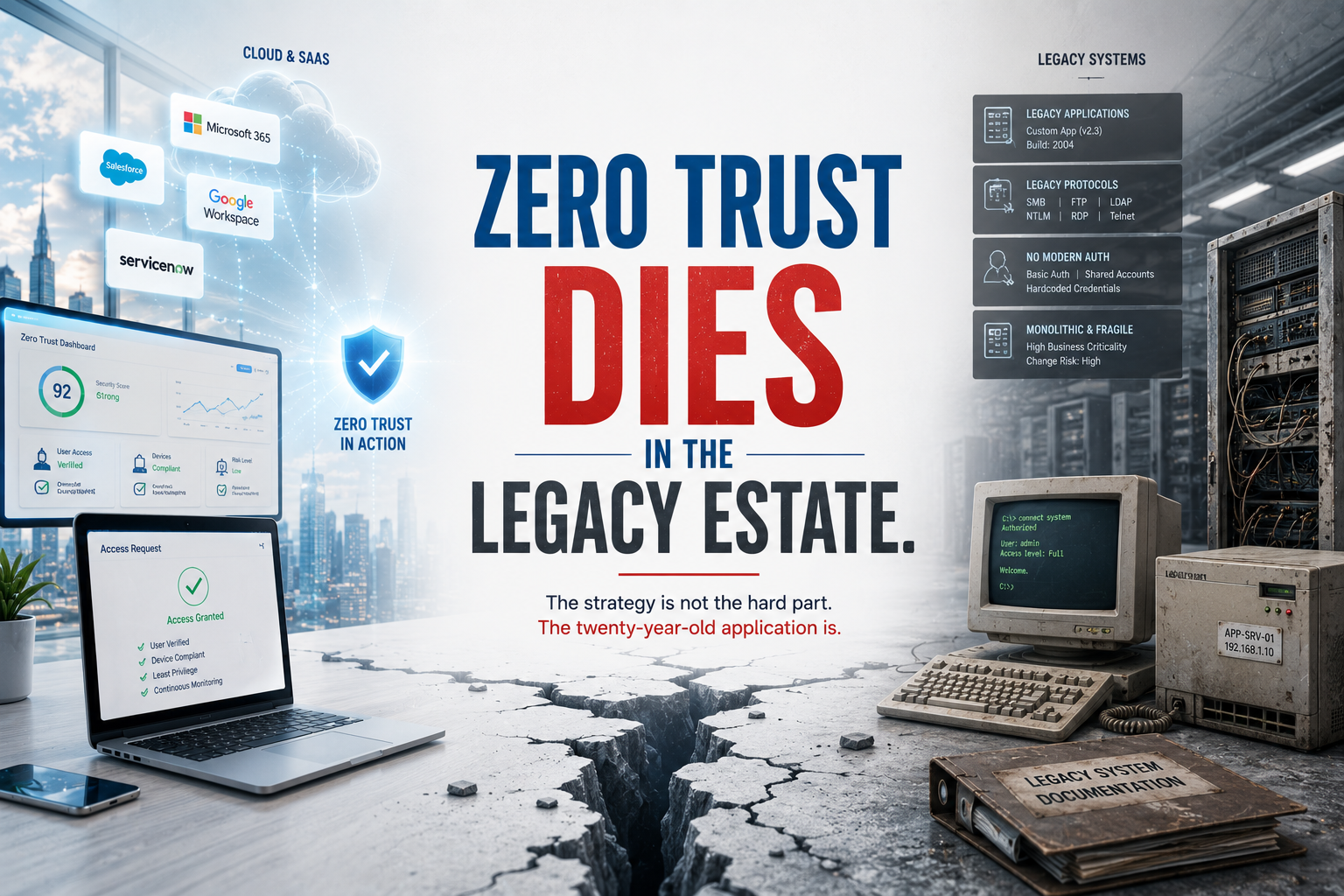
Read the literature on Zero Trust and it sounds eminently achievable. Verify every access request. Authenticate strongly. Apply least privilege. Make trust contextual and continuous. On a modern, cloud-native application — one built with identity-aware access and modern protocols in mind — these principles slot in naturally. The greenfield case is genuinely straightforward.
The problem is that almost no organization runs a greenfield estate. They run an accumulation of decades — old applications that authenticate in ways modern verification cannot easily wrap, legacy protocols that have no concept of identity-aware access, systems that cannot be modified without enormous risk or cost, and a long tail of things that simply predate the entire model. This is the brownfield reality, and it is where Zero Trust initiatives go to stall. The modern slice of the environment gets to Zero Trust relatively quickly; the legacy estate sits there, resistant, and the initiative grinds to a halt against it.
The uncomfortable truth that most Zero Trust programs avoid stating plainly is this: the hard part was never the strategy or the modern systems. It was always the legacy estate, and any program that does not confront that directly is destined to declare partial victory on the easy part and quietly abandon the rest.
Why This Matters Now
The gap matters because the legacy estate is rarely peripheral. The old systems an organization cannot easily modernize are frequently the ones running its most critical functions — the core business applications, the operational systems, the things too important to risk changing. The attacker, of course, understands this perfectly. The legacy estate often holds the most valuable assets and presents the weakest verification, which is precisely the combination an adversary seeks. A Zero Trust program that has secured the modern systems and left the legacy estate untouched has, in many cases, secured the less important half and left the crown jewels in the part of the environment that still trusts everything implicitly.
The pressure is compounded by how Zero Trust is often sold and measured. The temptation is to report progress on the systems where progress is easy, creating an impression of a maturing Zero Trust posture while the hardest and most consequential portion remains essentially untouched. The metric looks good; the actual risk is concentrated in exactly the place the metric does not reflect.
CISO2CISO Insight
Anyone can do Zero Trust on the systems that were built for it. The measure of a real Zero Trust program is what it does about the twenty-year-old application running a critical process that has never heard of identity-aware access — and that is the part most programs quietly skip.
Why Legacy Resists Zero Trust
Understanding why the legacy estate is so resistant is the precondition for making real progress against it, rather than simply avoiding it.
Old systems cannot do modern verification. Many legacy applications and protocols have no native capacity for the strong, contextual, continuous verification Zero Trust calls for. They authenticate in ways that predate the model, and they cannot be made to participate in it without significant work or wrapping.
They often cannot be changed. The reasons legacy systems persist are usually that they are risky, expensive or impractical to modify — they run critical functions, they are poorly understood, their original builders are gone, or any change risks breaking something the business depends on. The same fragility that makes them hard to modernize makes them hard to bring into a Zero Trust model directly.
They were built for implicit trust. Legacy systems frequently assume a trusted network — they were designed in and for the perimeter era, expecting that anything able to reach them was authorized. That assumption is the precise opposite of Zero Trust, and it is baked into how they work.
They are numerous and poorly mapped. The legacy estate is often large and incompletely understood. An organization may not have a full picture of what it runs, how those systems communicate, or what depends on them — and you cannot apply Zero Trust to systems you have not fully mapped.
Making Pragmatic Progress
The answer is not to abandon Zero Trust in the face of legacy, nor to pretend the legacy problem does not exist. It is to apply the Zero Trust principle pragmatically to systems that cannot implement it natively — wrapping protection around what cannot be changed.
Wrap, don't rebuild. When a legacy system cannot do modern verification itself, the principle can often be applied around it — controlling and verifying access to the system through an intermediary, even when the system itself remains unchanged. The goal is to remove the implicit trust in front of the legacy system, not necessarily to modernize the system.
Segment the legacy estate aggressively. Where verification cannot be applied to the system directly, controlling what can reach it becomes the primary defense. Isolating legacy systems so that a compromise elsewhere cannot freely reach them contains the risk that their weak verification creates.
Prioritize by consequence. The legacy estate cannot all be addressed at once, so the effort should concentrate on the legacy systems whose compromise would be most damaging — the critical applications and the most valuable assets — rather than spreading thinly or starting with the easy remnants.
Be honest in the metrics. A Zero Trust program should report its progress in a way that distinguishes the modern systems from the legacy estate, so that leadership sees where the real residual risk concentrates rather than an aggregate number flattered by the easy wins.
Executive Framework
| Dimension | Modern systems | Legacy estate |
|---|---|---|
| Native verification | Built in or easily added | Often absent and hard to add |
| Modifiability | Changeable | Risky, expensive, sometimes impossible |
| Trust assumption | Designed for explicit verification | Built for implicit trust |
| Mapping | Generally understood | Often incomplete |
| Zero Trust approach | Apply directly | Wrap, segment, isolate |
| Where the risk hides | Visible and managed | Concentrated and frequently skipped |
What CISOs Should Do Next
- Confront the legacy estate explicitly in your Zero Trust strategy, naming it as the hard and consequential part rather than allowing the program to drift toward the easy modern systems.
- Map the legacy estate, since you cannot apply any protection — direct or wrapped — to systems and dependencies you do not fully understand.
- Prioritize legacy by consequence, concentrating effort on the old systems whose compromise would be most damaging rather than the easiest remnants.
- Wrap protection around what you cannot change, applying the verification principle through intermediaries when the legacy system itself cannot participate.
- Segment the legacy estate aggressively, controlling what can reach systems whose weak verification you cannot fix directly.
- Report progress honestly, distinguishing modern from legacy so leadership sees where the real residual risk lives rather than an aggregate flattered by easy wins.
Board-Level Questions
- Is our Zero Trust progress concentrated on the modern systems that were easy, while our most critical legacy systems remain in an implicit-trust state?
- Do we have a clear picture of our legacy estate — what runs there, how it communicates, and what depends on it?
- For the critical systems we cannot modernize, how are we removing the implicit trust in front of them — wrapping, segmenting, isolating?
- Does our Zero Trust reporting distinguish the secured modern systems from the unaddressed legacy estate, so we see where the real residual risk concentrates?
Final Takeaway
Zero Trust has a credibility problem that its proponents rarely acknowledge: it is demonstrably achievable on the systems built for it, and it is demonstrably hard on the systems most organizations actually depend on. The result is a pattern of initiatives that make rapid, reportable progress on the modern slice of the environment and then stall, indefinitely, against the legacy estate — declaring a maturing posture while the most valuable, least verified systems sit untouched.
A real Zero Trust program is defined by how it handles that legacy estate, not by how quickly it secures the easy systems. It maps the old environment honestly, prioritizes by consequence, wraps protection around what cannot be changed, segments aggressively, and reports progress in a way that does not hide the residual risk behind an aggregate number. That is harder, slower and less flattering than the greenfield story. It is also the only version of Zero Trust that addresses where the risk actually lives.
Zero Trust does not die because the strategy is wrong or the modern systems are hard. It dies in the legacy estate — and any program that does not go there has not done Zero Trust. It has done the easy part and called it done.
*To be continued...*