The Risk Heat Map Is Where Accountability Goes to Die
The Scene
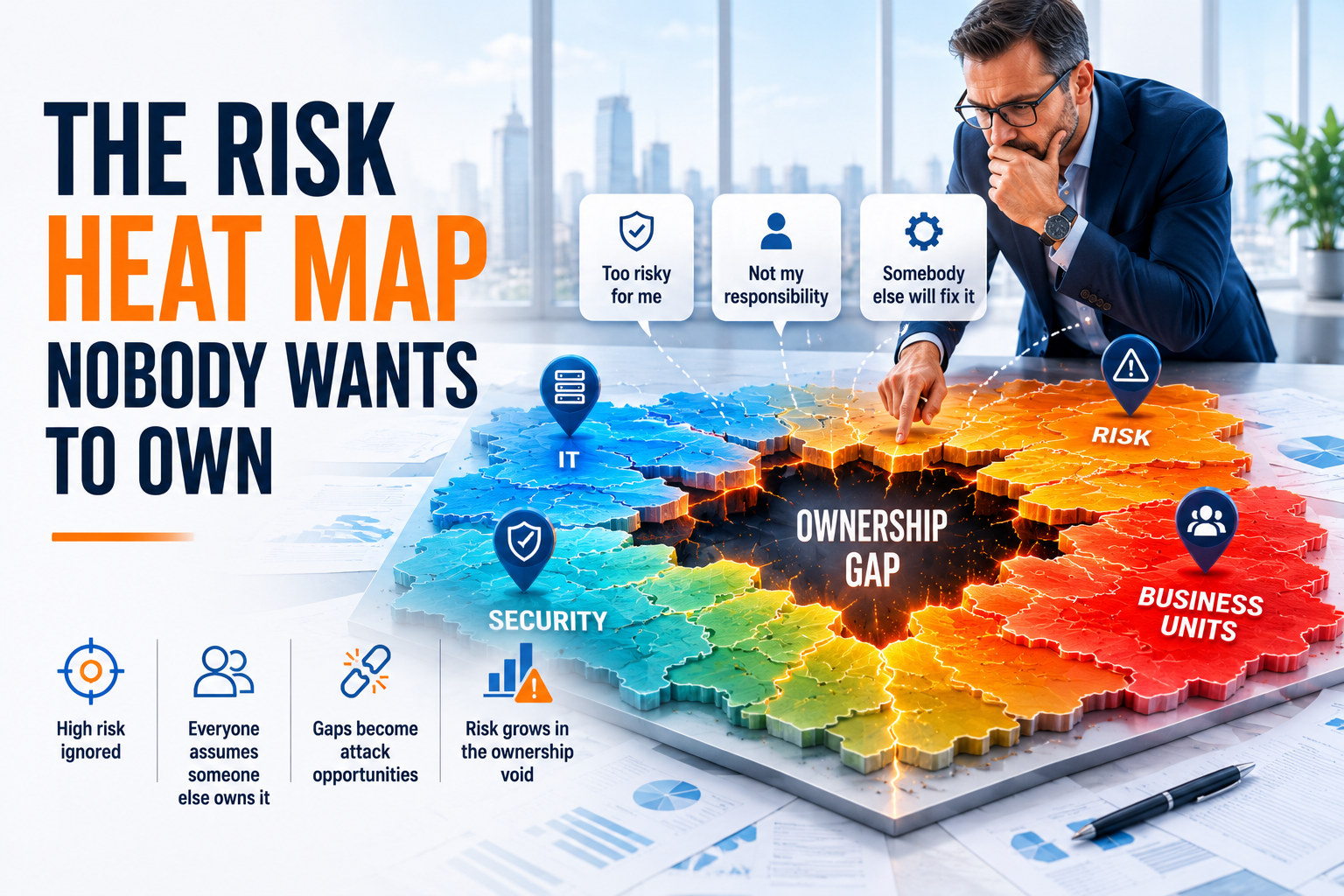
A board risk committee meets. The cyber risk slide goes up. It is a familiar grid — likelihood on one axis, impact on the other, a scatter of colored dots, several of them sitting in the red zone. The CISO walks through them. The directors nod. Someone asks whether the red items are being addressed. The answer is yes, they are on the roadmap. The slide comes down. The committee moves on.
Nothing was decided. No resource was allocated against an alternative. No risk was explicitly accepted or rejected. The conversation had the appearance of governance and none of its substance. And the reason is the slide itself: a heat map cannot support a decision, because it does not contain decision-grade information.
This is one of the quiet dysfunctions of enterprise security. The heat map feels rigorous — it has axes, it has color, it looks like analysis. But it asks a board to govern a multi-million-dollar risk surface using a vocabulary of "high," "medium" and "red," and then expresses surprise when the board fails to govern it well.
Why This Matters Now
The tolerance for this is running out. Boards are under increasing pressure — from regulators, from auditors, from their own fiduciary exposure — to demonstrate genuine oversight of cyber risk, not the appearance of it. "We reviewed a heat map quarterly" is becoming an inadequate answer to the question of whether a board exercised its duty of care.
At the same time, the budget environment has hardened. The era in which security investment grew almost automatically on the strength of board anxiety has given way to a demand for evidence — that a given investment reduces a quantified risk by a meaningful amount, at a cost that is justified relative to the exposure. A heat map cannot answer that question. It cannot tell a CFO whether spending a defined amount to move a dot from red to amber is a good use of capital, because it never expressed the risk in terms that capital decisions are made in.
The organizations that are pulling ahead are the ones that have abandoned the comfort of color for the discipline of quantification.
CISO2CISO Insight
A heat map answers the question "how worried should we be?" A board does not need help being worried. It needs help deciding — how much to spend, what to accept, what to transfer, and what to prioritize. Those are quantitative questions, and color is not a quantity.
Why the Heat Map Fails as a Decision Tool
The problem is not that heat maps are wrong. It is that they are structurally incapable of supporting the decisions boards exist to make.
They are not additive. You cannot add a "high" to a "medium." You cannot tell whether ten amber risks are collectively worse than two red ones. A board trying to allocate finite resources across a portfolio of risks needs to be able to compare and aggregate them, and a categorical scale does not permit it.
They hide the range. A single dot for "ransomware" collapses an enormous range of possible outcomes — from a contained, recoverable incident to an existential one — into one position on a grid. The most important information for a decision is often the shape of that range, and the heat map erases it.
They invite gaming. Because the placement of a dot is a judgment call rather than a calculation, it is subject to pressure. Risks get moved to amber because red is uncomfortable. The map ends up reflecting organizational politics as much as actual exposure.
They do not connect to money. The board governs the enterprise in financial terms. A risk expressed as "high impact" has not been translated into the language the board makes every other decision in. The translation — what would this actually cost us, across what range, with what likelihood — is exactly the work the heat map skips.
What Quantification Actually Looks Like
Quantifying cyber risk does not require false precision or a pretense that the future is calculable. It requires expressing risk in terms of probable financial loss across a range, so that it can be compared, aggregated, and weighed against the cost of reducing it.
The shift is from "this risk is red" to "this scenario carries a probable annual loss in a defined range, driven by these factors, and this specific investment would reduce that range by this much, at this cost." That is a sentence a CFO can act on. It enables the board to do the three things it is actually there to do with risk: decide what to mitigate, what to transfer through insurance, and what to consciously accept.
Quantification also changes the CISO's standing in the room. A leader who can express risk in business terms is participating in the enterprise's financial conversation as a peer. A leader who can only show colors is reporting status to an audience that is, justifiably, unsure how to use it.
Executive Framework
| Dimension | Heat map | Quantified risk |
|---|---|---|
| Unit | Color category (red/amber/green) | Probable financial loss across a range |
| Aggregation | Not possible | Risks can be combined and compared |
| Decision support | "Should we worry?" | "What do we mitigate, transfer or accept?" |
| Investment logic | None | Cost of control vs. reduction in exposure |
| Board's role | Acknowledge | Govern — allocate, accept, transfer |
| CISO's position | Status reporter | Participant in the financial conversation |
What CISOs Should Do Next
- Stop presenting risk in color alone — even a simple move toward expressing the most material risks as probable loss ranges changes the quality of the board conversation immediately.
- Identify the handful of scenarios that actually carry enterprise-level consequence and quantify those first, rather than attempting to quantify the entire register at once.
- Tie every proposed investment to the specific risk reduction it produces, expressed in the same financial terms, so capital decisions can be made on a like-for-like basis.
- Make the three governance options explicit for each material risk — mitigate, transfer, accept — and bring the board a recommendation, not just a description.
- Be transparent about uncertainty: quantification expresses risk as a range with assumptions, not as a single false-precision number, and saying so builds credibility rather than undermining it.
- Use quantification to drive prioritization internally as well — the same logic that informs the board should be driving where the security program spends its own effort.
Board-Level Questions
- Are we governing cyber risk with information we can actually make decisions on — or are we acknowledging a heat map and calling it oversight?
- For our most material cyber scenarios, do we know the probable financial impact across a range — and the cost to reduce it?
- For each significant risk, have we explicitly decided whether to mitigate, transfer or accept it — and is that decision recorded?
- Can our CISO connect the security budget to specific, quantified reductions in our exposure?
Final Takeaway
The heat map endures because it is comfortable. It looks analytical, it is easy to produce, and it lets everyone in the room feel that risk has been reviewed. But comfort is not the purpose of risk reporting. Decisions are. And the heat map is where the decision quietly fails to happen — where a board acknowledges a red dot, asks if it is being handled, hears that it is on the roadmap, and moves on, having governed nothing.
Quantification is harder. It requires expressing risk in ranges, connecting controls to loss reduction, and being honest about uncertainty. But it is the only form of risk reporting that lets a board do its actual job — and the only form that lets a CISO stand in that room as a participant in the business rather than a narrator of colors.
If your board cannot make a resource decision from your risk reporting, you are not reporting risk. You are decorating it.
*To be continued...*