Your Risk Is Now Other People's Risk: The Third-Party Problem
Overview
There is a question that exposes how much of an organization's cyber risk has migrated outside its own walls: if your most critical software vendor, your cloud platform, or a key supplier were compromised tomorrow, how exposed would you be — and how quickly would you even know? For most organizations, the honest answers are "very" and "not quickly," and that combination describes one of the most significant shifts in the nature of enterprise risk over the past decade.
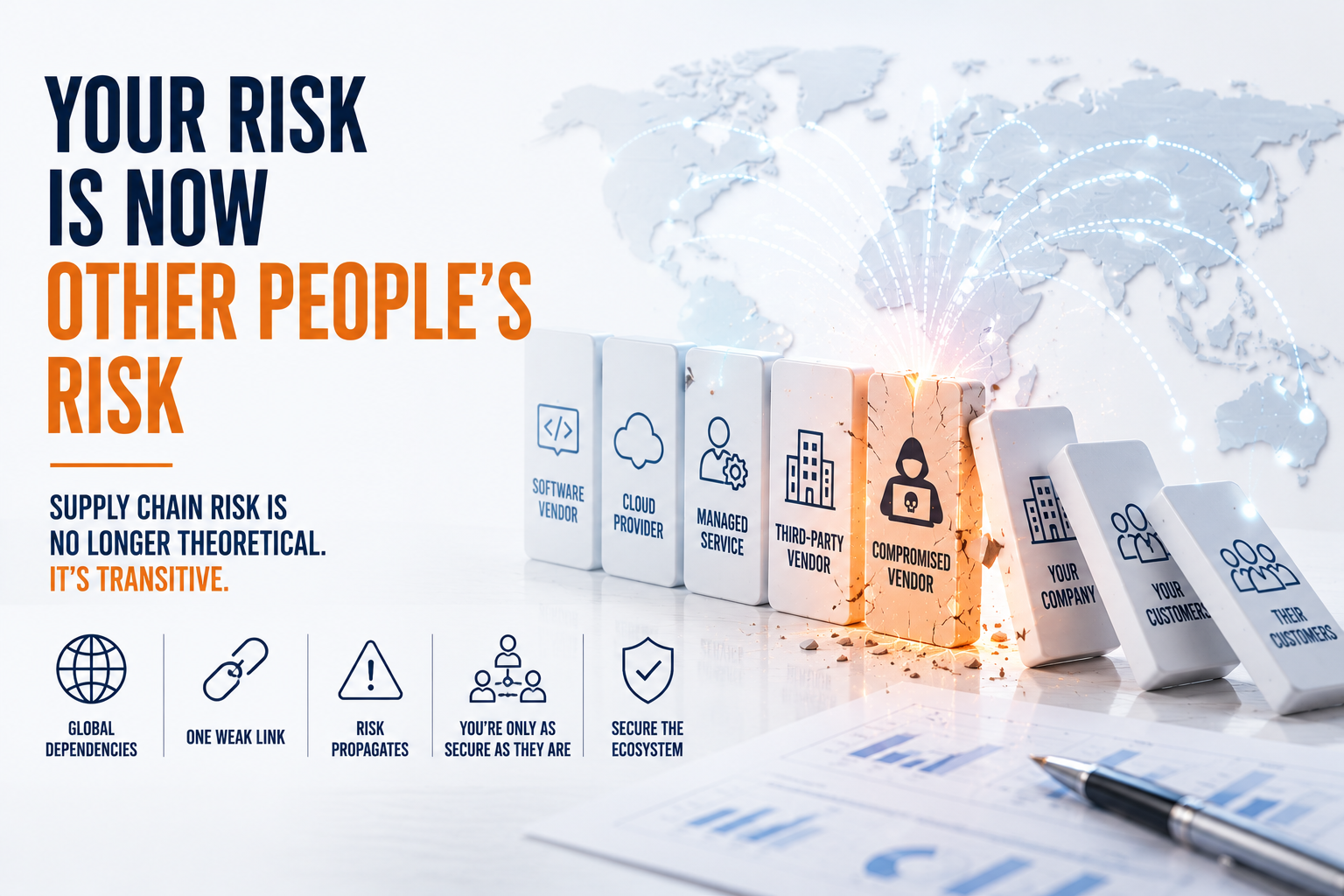
The organization no longer operates as a self-contained system whose risk it can manage by securing its own perimeter. It operates as a node in a dense web of digital dependencies — software vendors, cloud providers, SaaS platforms, managed service providers, suppliers — each of which holds access, data, or a position critical enough that their compromise becomes the organization's compromise. A meaningful and growing share of cyber risk is, quite literally, other people's risk, inherited through dependence.
And the dominant approach to managing it — the annual security questionnaire, the once-a-year attestation, the point-in-time review at onboarding — was inadequate even before these dependencies became so central. It treats a continuous, dynamic risk as a periodic compliance exercise, and the gap between the two is where third-party incidents repeatedly find their way in.
Why This Matters Now
The concentration of digital dependence has reached a point that changes the risk calculus. Organizations now route enormous portions of their operations through a relatively small number of widely-used platforms and providers. This delivers genuine efficiency, but it also creates concentration risk: a compromise of a single widely-depended-upon provider does not affect one organization — it cascades across all of them simultaneously. The shared dependency becomes a shared point of failure.
The dependency also runs deeper than most organizations track. The vendors an organization relies on have their own vendors — the fourth parties — and a compromise several layers down the chain can propagate upward to an organization that never knew the dependency existed. The risk surface is not the list of direct suppliers; it is the entire dependency graph, most of which is invisible from where the organization sits.
Meanwhile, attackers have recognized that compromising a trusted, widely-integrated provider is one of the highest-leverage moves available — a single intrusion that delivers access to many downstream targets at once. Third-party compromise is not an edge case in the threat landscape; it has become one of its central patterns.
CISO2CISO Insight
You can secure your own house perfectly and still be breached through a vendor you onboarded with a questionnaire three years ago and have not thought about since. In a connected enterprise, your risk posture is partly written by organizations you do not control.
Why the Questionnaire Model Fails
The standard apparatus of third-party risk management was built for a different relationship — occasional, arms-length, low-dependency. Applied to deep digital dependence, it breaks in predictable ways.
It is a snapshot of a moving target. A questionnaire captures a vendor's claimed posture at a single moment, usually at onboarding. The vendor's actual security state changes continuously, and the relationship may deepen over years. A point-in-time attestation tells the organization almost nothing about the vendor's risk today.
It measures documentation, not security. Questionnaires assess what a vendor says about its controls. The correlation between a well-completed questionnaire and an actually secure vendor is far weaker than the process implies. A polished attestation and a real breach are entirely compatible.
It stops at the first tier. The questionnaire goes to the direct vendor. It rarely reaches the vendor's vendors, where a significant portion of the inherited risk actually lives. The dependency graph extends beyond what the first-tier review can see.
It is disconnected from consequence. Most third-party risk programs treat all vendors with similar process regardless of how critical they are. The vendor that holds the crown-jewel data and the vendor that supplies office furniture get comparable scrutiny, which means the program's effort is not concentrated where the consequence is greatest.
What Real Third-Party Risk Management Looks Like
A credible approach abandons the pretense that periodic attestation equals risk management and replaces it with something proportionate, continuous and consequence-aware.
Prioritize by dependence and consequence. Not all third parties carry equal risk. The ones that hold critical data, have privileged access, or are operationally indispensable deserve depth of scrutiny that the long tail does not. Concentrating effort where the consequence is greatest is the foundation of a program that works within finite resources.
Move toward continuous insight. For the most critical dependencies, point-in-time review is insufficient. The goal is ongoing awareness of a vendor's risk posture and rapid notice when something changes — moving from an annual snapshot toward continuous monitoring of the relationships that matter most.
Map the dependency, including concentration. Understanding where the organization is concentrated — which single providers, if compromised, would have outsized impact — is essential to managing the risk that efficiency-driven consolidation has created. So is making a reasonable effort to understand critical fourth-party dependencies.
Plan for the compromise, not just the assessment. Because third-party compromise cannot be assessed away, the organization needs to be ready for it: to know its exposure to each critical provider, to detect when a dependency may be compromised, and to respond — contain, substitute, recover — when one is. Resilience to vendor compromise matters as much as the assessment of vendor posture.
Executive Framework
| Dimension | Questionnaire model | Continuous, consequence-aware model |
|---|---|---|
| Timing | Annual / at onboarding | Continuous for critical dependencies |
| What it measures | Claimed controls on paper | Actual posture and changes over time |
| Scope | First-tier vendors | Dependency graph, including concentration |
| Prioritization | Uniform process | Proportionate to dependence and consequence |
| Posture | Assess and file | Assess, monitor, and plan for compromise |
| When a vendor is breached | Discover late | Detect exposure and respond |
What CISOs Should Do Next
- Map your critical dependencies and concentration first — identify the vendors and platforms whose compromise would most damage the organization, including where you are dangerously consolidated.
- Make scrutiny proportionate to consequence, concentrating depth on the dependencies that matter and not spreading the same process uniformly across the long tail.
- Move critical relationships toward continuous insight, replacing the annual snapshot with ongoing awareness of posture and rapid notice of change.
- Extend visibility toward fourth parties for your most critical vendors, recognizing that inherited risk does not stop at the first tier.
- Plan for vendor compromise as a scenario, knowing your exposure to each critical provider and how you would detect, contain and recover if one were breached.
- Bring concentration and third-party risk to the board as enterprise risk, since the exposure now lives substantially outside the organization's own controls.
Board-Level Questions
- If one of our most critical vendors or platforms were compromised, how exposed would we be — and how quickly would we know?
- Where are we dangerously concentrated on a single provider whose compromise would cascade across our operations?
- Is our third-party risk management continuous for the relationships that matter, or a once-a-year questionnaire we file and forget?
- Are we prepared to detect, contain and recover from a third-party compromise — not just to assess vendors beforehand?
Final Takeaway
The boundary of an organization's cyber risk used to be roughly the boundary of the organization itself. That is no longer true, and pretending otherwise is the core weakness of most third-party risk programs. A large and growing share of the risk now lives in the vendors, platforms and suppliers the organization depends on — and in their dependencies, several layers deep and largely unseen. The annual questionnaire, designed for a shallower relationship, manages this inherited risk in name only.
Managing it for real means accepting that a portion of the organization's risk posture is written by others, concentrating scrutiny where dependence and consequence are greatest, moving critical relationships toward continuous insight, and preparing to respond when — not if — a dependency is compromised.
You can no longer fully secure your organization by securing your organization. A growing share of your risk is other people's risk, and managing it requires admitting that, then acting on it.
*To be continued...*