Executive Summary
Every CISO has lived this moment. A new technology is already in production, the standard that would tell you how to secure it is still being written, and the business wants an answer today. AI agents are that moment now.
In February 2026, NIST's Center for AI Standards and Innovation (CAISI) launched the AI Agent Standards Initiative to support secure and interoperable agent technology. NIST said at launch that research, guidelines and further deliverables would follow in the months ahead. Nothing in that body of work is final guidance yet. Several independent reviews of the NIST workstreams reach the same conclusion: no finished control set exists for agents.
The mistake is to treat "not final" as "not actionable." NIST has told the market, through its own documents, which questions it considers important. Those questions are enough to build an interim baseline. This note shows how to map the controls you already operate to NIST's agent workstreams, and how to write interim requirements for agent identity, authorization and monitoring that you will not have to throw away later.
Why This Matters Now
The direction of travel is clear, even if the destination is not. NIST's launch announcement describes an initiative built on industry-led standards, open protocols and research into agent security and identity. A Cloud Security Alliance research note lists an AI Agent Interoperability Profile among planned deliverables for the fourth quarter of 2026, though NIST has not committed to dates in its public announcement.
The inputs are already public. CAISI's Request for Information on AI agent security closed on March 9, 2026. A Cloud Security Alliance research note reports that it drew 932 public comments. NIST's own summary analysis of the responses found broad agreement that agents present novel security threats, that those threats are a barrier to adoption, and that fundamental cybersecurity practices remain relevant but need adaptation for agents.
That last point is the useful one. NIST is not telling the industry to discard what works. It is telling the industry to adapt it. Adaptation is something a security team can start on a Monday morning.
There is also a practical reason not to wait. Law-firm analysis of the initiative notes that NIST frameworks are not binding, yet they frequently shape supervisory expectations, procurement standards and industry practice, particularly in regulated sectors such as financial services. When auditors, regulators and customers eventually ask how you aligned to NIST's agent work, "we waited for the final version" will not be a satisfying answer.
CISO2CISO Insight
A standard that is still in draft is not a reason to wait. It is a free preview of the questions your auditors will ask later.
What NIST Is Actually Building
It helps to separate the pieces, because they are at different stages and are often blurred together in commentary.
The AI Agent Standards Initiative is the umbrella. It sits within CAISI and coordinates industry-led standards, open-source protocols and research into agent security and identity.
The NCCoE identity and authorization project is the most directly usable. On February 5, 2026, NIST's National Cybersecurity Center of Excellence published a concept paper on software and AI agent identity and authorization, with comments due April 2. A Cloud Security Alliance note summarizes its four focus areas as identification, authorization, access delegation and logging. The paper points to existing standards such as OAuth, OpenID Connect, SCIM, SPIFFE and Next Generation Access Control. It is a concept paper proposing a possible project, not a standard.
The COSAiS overlays extend SP 800-53 to AI use cases. NIST's Computer Security Division launched the project in 2025, and per a Cloud Security Alliance research note, it covers five use cases, including single-agent and multi-agent systems. A January 2026 annotated outline covered predictive AI first. As of the reviews we found, from mid-2026 onward, the agent overlays had not been published as drafts. Check the NIST project page before citing any control text to anyone.
The Cyber AI Profile (NIST IR 8596) is a preliminary draft from December 2025 that applies Cybersecurity Framework 2.0 to AI. It is the natural bridge for organizations organized around CSF rather than SP 800-53.
Two cautions. First, do not cite draft control identifiers as settled. Draft text changes. Second, one of the clearest findings in secondary analysis is that the NCCoE paper sets no controls. It gives you the shape of the problem, not an auditable requirement. That is exactly why your interim baseline has to be your own.
Building the Interim Baseline: Three Domains
You do not need to cover everything NIST might eventually publish. You need defensible minimums in the three areas where NIST's early work is most concrete: identity, authorization and monitoring.
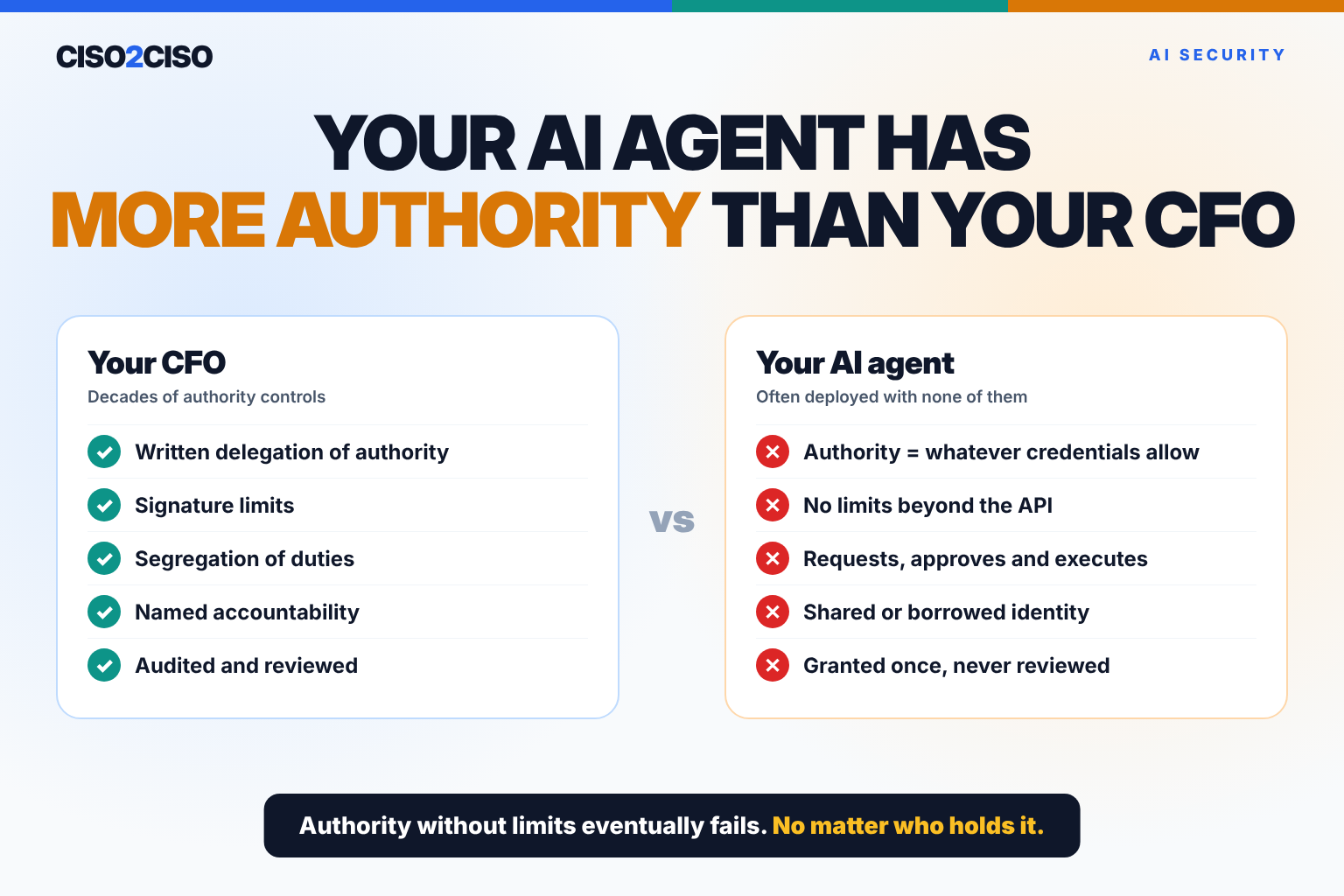
Identity. The NCCoE paper's first focus area is identification. The interim requirement is simple to state and hard to retrofit: every agent has its own identity, a named human sponsor, a documented purpose and an owner for its lifecycle. No agent runs on a shared service account or on a person's credentials. This is the cheapest control to establish at deployment and one of the most expensive to reconstruct after an incident.
Authorization and delegation. The second and third focus areas are authorization and access delegation. The NCCoE paper asks, among other things, whether authorization policies for agents should adapt in real time as context changes. You do not need to answer that to act. Set a written scope for each agent: which systems, which actions, which data. Issue short-lived, task-scoped credentials where your platforms support them. Where an agent acts on behalf of a user, record the delegation and cap it, so the agent does not simply inherit everything the user can do. Define action tiers, and require human approval above them for irreversible or high-value actions.
Monitoring and logging. The fourth focus area is logging. NIST's RFI also asked about monitoring, logging and incident response, and about the ability to undo or roll back unwanted agent actions. Your interim requirement: every agent action is logged with the agent identity, the sponsor, the tool or system called, the input source and the outcome, in a form that lets you reconstruct a sequence of actions. Pair that with a tested way to suspend an agent and revert its changes.
These three domains give you something concrete to put in front of a board: a minimum standard, an owner and a date.
Executive Framework
The table maps each NIST workstream to the control you probably already run and the interim agent requirement that extends it.
| NIST workstream | Control you likely already have | Interim agent requirement |
|---|---|---|
| NCCoE: identification | Workload and non-human identity inventory | Unique identity per agent, named sponsor, no shared or borrowed credentials |
| NCCoE: authorization | Least privilege, role-based access, privileged access management | Written scope per agent; short-lived, task-scoped credentials; human approval above defined action tiers |
| NCCoE: access delegation | Delegated access and on-behalf-of flows | Delegated authority recorded and capped; agents never inherit a user's full rights |
| NCCoE: logging and audit | SIEM and SP 800-53 audit and accountability controls | Per-action logs tying agent, sponsor, tool, input source and outcome; kill switch and rollback tested |
| COSAiS single- and multi-agent overlays | SP 800-53 control baselines and tailoring process | Tag agent systems in your control catalog; document tailoring decisions; set trust boundaries between agents |
| CAISI RFI threat themes | Secure development, input validation, incident response | Treat external content as untrusted; test agents against hijacking scenarios; add agent scenarios to incident playbooks |
What CISOs Should Do Next
- Inventory every agent that can act. Include agents embedded in SaaS products and those built by business teams. Anything that can change a record, call an API or move data belongs on the list.
- Publish a one-page interim agent standard. Cover identity, authorization and monitoring. Label it explicitly as interim, with an owner and a review date, so it is honest about its status and easy to update.
- Map your interim standard to NIST, not the other way around. Use the NCCoE focus areas and your existing SP 800-53 or CSF 2.0 control mapping. When COSAiS or the Cyber AI Profile moves, you will be reconciling differences, not starting over.
- Close the identity gap first. Retire shared service accounts and borrowed human credentials for agents, and assign a human sponsor to each agent. It is the fastest risk reduction available.
- Test the stop button. Run a tabletop where an agent takes a harmful action. Can you identify it, suspend it and reverse its changes? NIST asked the industry about rollback; ask yourself.
- Contribute and watch. Track the NIST project pages and the NCCoE comment summary. If your sector participates in listening sessions or consultations, bring your operational experience, because NIST's process depends on it.
- Build a re-baseline trigger. Decide now that any new NIST draft, final overlay or profile triggers a gap review within a set number of weeks.
Board-Level Questions
- Do we have an interim standard for AI agent identity, authorization and monitoring, and who owns it?
- Can we list every agent that acts in our systems, with a named human accountable for each?
- Which agent actions require human approval today, and who decided the thresholds?
- If an agent acted wrongly this morning, how fast could we stop it and undo the damage?
- When NIST publishes its agent guidance, how quickly can we show what we already meet and where the gaps are?
Final Executive Takeaway
Unfinished standards create a temptation to pause. Agents are not pausing. NIST has already said, through its RFI analysis, that existing security practices remain relevant but need adaptation, and through its NCCoE work it has named the four places to start: identification, authorization, delegation and logging. The organizations that will be best placed when final guidance arrives are not the ones that waited for it. They are the ones that wrote an honest interim baseline, assigned owners, tested their controls and kept the document alive. Build it now, label it interim, and let NIST's final guidance refine it rather than replace it.