What CISOs Are Actually Prioritizing This Year
Executive Summary
One of the persistent dysfunctions of enterprise security leadership is the tendency to treat every risk as a priority and every gap as an urgent concern. The result is a security agenda that is a mile wide and an inch deep — touching everything, making meaningful progress on nothing, and presenting boards with an overwhelming inventory of concerns that provides no basis for governance decisions.
The most effective CISOs in 2026 have made a different choice. They have narrowed their agenda deliberately — selecting a small number of areas where the risk-reduction return on executive attention is highest, accepting that other areas will receive less focus, and building the accountability structures that make priorities stick across an organization that has competing claims on its energy and resources.
This is harder than it sounds. The security landscape presents a genuinely large set of legitimate concerns, and the organizational and regulatory pressure to demonstrate broad coverage is real. The discipline of prioritization — of explicitly choosing some things over others and defending those choices to boards, peers, and regulators — is one of the more demanding leadership capabilities in the CISO role.
Here is what the most effective security leaders are actually prioritizing — and why.
Why This Matters Now
The economic pressure on security investment has increased significantly. The era of near-automatic security budget growth — driven by board anxiety after high-profile breaches and a regulatory environment that was consistently expanding scope — is being replaced by a more demanding standard. CFOs and boards are asking for evidence that security investment is producing measurable risk reduction, not just activity. Security leaders who cannot demonstrate a clear connection between their priorities and business outcomes are finding budget conversations more difficult.
Simultaneously, the attack surface has continued to expand — cloud environments, SaaS applications, AI systems, non-human identities, and supply chain dependencies have all added risk dimensions that did not exist at scale five years ago. The combination of expanded attack surface and increased budget scrutiny makes prioritization more essential, not less. There is genuinely more to do than any security program can fully address, and the organizations that acknowledge this honestly and choose deliberately are better positioned than those that try to cover everything inadequately.
CISO2CISO Insight
The hardest skill in the CISO role is not technical. It is the ability to say "we are not going to focus on that this year" — and then defend that choice with enough analytical rigor that the board, the CFO, and the CEO trust the reasoning.
The Five Areas That Define the 2026 CISO Agenda
AI security as an operating discipline, not a policy exercise. The CISOs who are ahead of the AI security curve have made the transition from policy to operational controls. They have inventoried their AI systems, tiered them by risk, assigned ownership, and built the monitoring and evidence infrastructure that regulators and auditors are beginning to require. The CISOs who are behind this curve are still primarily managing AI through acceptable use policies and shadow AI guidelines — which address a small fraction of the actual risk surface. The gap between these two populations is widening, and the consequences of being on the wrong side of it are becoming more significant.
Identity as the control plane, with non-human identity as the urgent gap. Strong CISOs have accepted that identity is now the primary security control boundary — and that the governance of non-human identities (service accounts, API keys, AI agents, workload identities) is the most urgent gap in their identity programs. The human identity governance infrastructure — provisioning, MFA, access review, privileged access management — is relatively mature in most organizations. The non-human identity governance infrastructure is not. Given that non-human identities now significantly outnumber human identities in most enterprise cloud environments, this gap represents one of the highest-priority risk reduction opportunities available.
Resilience as a demonstrated capability, not a documented plan. The most sophisticated security leaders have shifted from resilience as a planning exercise to resilience as an operational proof. They test their backup restoration processes and document the results. They run incident response exercises that simulate realistic adversary scenarios and use the findings to drive capability improvement. They establish and track recovery time objectives against tested performance, not assumed performance. They brief boards on resilience in terms of what has been proven, not what has been planned. This shift — from planning to proving — is the most consequential change in how the best security programs operate.
Exposure reduction over control expansion. A significant proportion of enterprise security investment goes toward adding new controls, tools, and capabilities. The most effective CISOs in 2026 are making a different investment philosophy: reducing the attack surface rather than adding defense layers. This means eliminating unnecessary internet exposure, rightsizing privileged access, decommissioning legacy systems that create attack paths without delivering proportionate business value, and reducing third-party connectivity to the minimum necessary. Exposure reduction produces risk reduction that is durable and measurable — not dependent on controls operating correctly under adversary pressure.
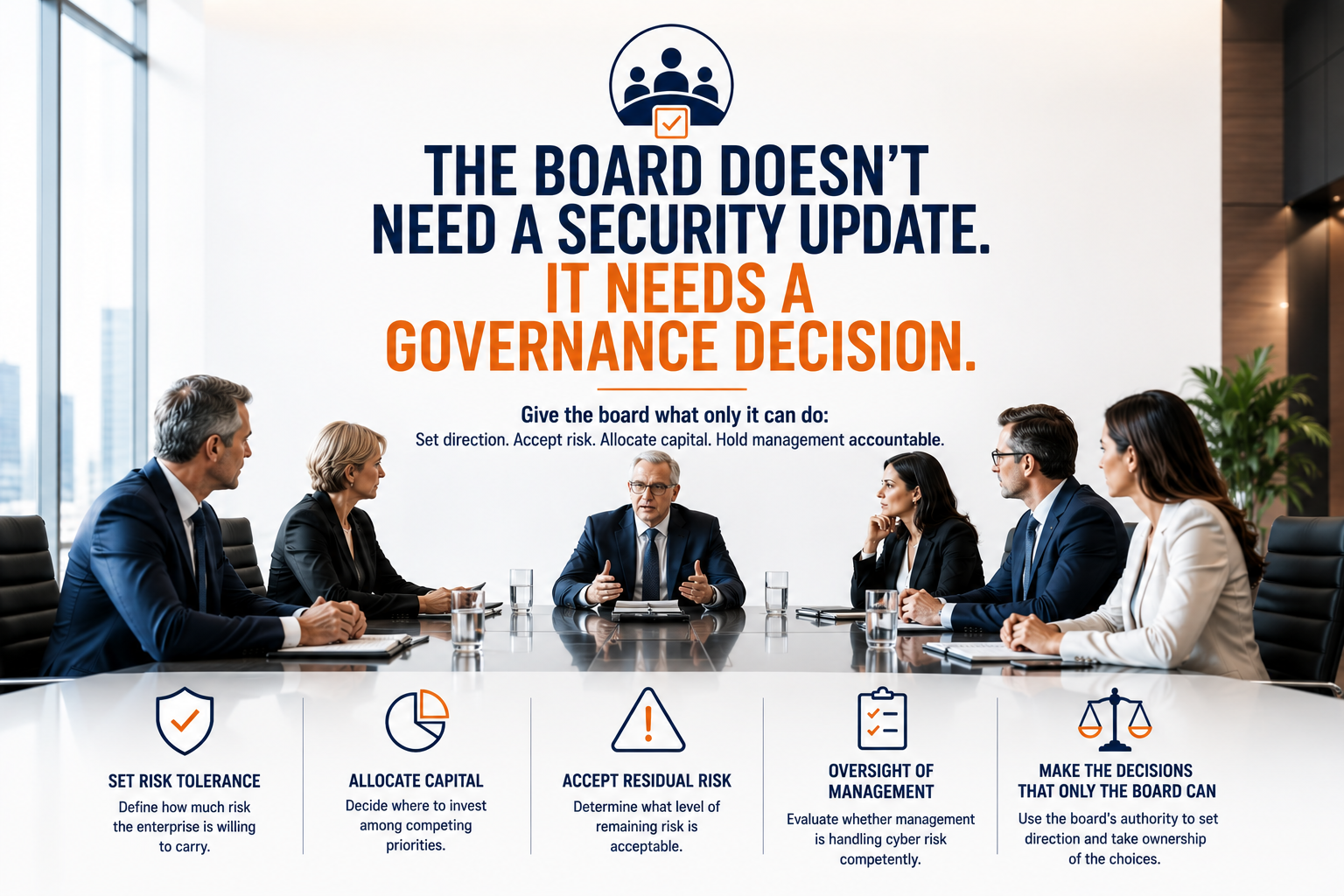
Board communication as a leadership capability, continuously developed. The best security leaders treat board communication as a core professional competency that requires deliberate development — not a presentation to be prepared the week before a meeting. They invest time in understanding how their specific board thinks about risk, what governance decisions they are trying to make, and how security information can be framed in ways that enable those decisions. They brief individual board members between meetings. They seek feedback on the quality and utility of their communication. They adapt their approach based on what they learn. The quality of the CISO-board relationship is one of the strongest predictors of both security program effectiveness and CISO tenure.
Executive Framework
| Priority area | What mature looks like | What catching-up looks like |
|---|---|---|
| AI security | Operational controls with evidence architecture | Acceptable use policy and shadow AI guidelines |
| Identity governance | Non-human identity inventory and governance | Human identity programs with no NHI coverage |
| Resilience | Tested and documented recovery capability | Documented plans, untested assumptions |
| Exposure reduction | Deliberate attack surface reduction program | Control layering without surface reduction |
| Board communication | Scenario-based, decision-oriented, quantified | Activity reporting with dashboard attachments |
What CISOs Should Do Next
- Conduct a priority audit: assess your current security program's allocation of executive attention and investment across these five areas — and be honest about where you are behind.
- Define what "mature" looks like for each priority in your specific organizational context — not generic industry benchmarks, but specific capabilities that would materially change your risk posture.
- Build a prioritized roadmap that sequences investment and attention based on risk-reduction return — explicitly acknowledging what will receive less focus and why.
- Establish the measurement architecture that will let you demonstrate progress: if you cannot measure it, you cannot demonstrate it to a board that is asking for evidence.
- Communicate your priorities explicitly to the board — not just the security program details, but the strategic choice to focus on these areas over others and the reasoning behind it.
- Review and adjust annually: the priority landscape changes as the threat environment evolves and as the organization's risk profile shifts, and a priority that was right two years ago may not be right today.
Board-Level Questions
- Has our CISO articulated a clear prioritization of security investment based on risk-reduction return — and does that prioritization reflect explicit choices about what receives less focus?
- Are we investing in demonstrated resilience or documented plans — and how do we know the difference?
- What is the current state of our non-human identity governance, and does it reflect the same standards we apply to privileged human access?
- Can our CISO demonstrate — not describe — that our highest-priority security investments are producing measurable risk reduction?
Final Executive Takeaway
The CISO agenda in 2026 is not defined by comprehensive coverage of every security domain. It is defined by the quality of choices — which risks deserve the most executive attention, which investments produce the highest risk-reduction return, and which capabilities need to be built or improved most urgently.
The security leaders who are making the most impact are not the ones with the longest security program inventory. They are the ones who have narrowed their agenda to what matters most, built the accountability structures that make priorities stick, and developed the communication capability to translate those priorities into board-level governance decisions.
The test of a security agenda is not whether it covers everything. It is whether the things it prioritizes actually make the organization meaningfully safer — and whether everyone in the organization, including the board, understands which things those are.