Executive Summary
Picture the call. An agent that reconciles supplier payments has started sending records to an address nobody recognizes, or has begun changing customer data in bulk. It is not clearly "hacked." It is simply doing things nobody authorized, at machine speed, and every minute adds to the damage.
Now ask who in your organization can stop it. Who is allowed to switch it off without asking the business owner for permission? Which credentials does it hold, and will revoking them break ten other workloads? Who tells legal? Who decides whether the finance process runs manually for a week?
For most organizations, those answers do not exist yet. Traditional incident response was built around compromised hosts, accounts and networks. An agent incident is different: the actor is software that holds delegated authority, may be acting on instructions it picked up from a document or web page, and can keep going while you investigate. The response is less about isolating a machine and more about pulling autonomy to zero, quickly and in a way the business can live with.
This note turns that into a runbook a CISO can rehearse with incident response, legal and business owners before the first real case.
Why This Matters Now
Agent incidents are no longer hypothetical. A April 2026 survey of 418 IT and security professionals by the Cloud Security Alliance, commissioned by Token Security, found that 65% of organizations had experienced at least one AI agent-related security incident in the past 12 months. The same report found that 82% had discovered previously unknown agents operating without governance oversight. You cannot contain an agent you did not know existed.
The gap is sharper at the point of containment. A Salt Security report, State of Agentic AI and API Security 2H 2026, based on more than 380 security and technology professionals, found that 49.8% confirmed or suspected an agent had taken an unintended, unexpected or unauthorized action in the past year. Among them, more than half reported an unauthorized external API call or transaction, and over 40% reported data being changed or deleted. Yet only 17.5% said they could automatically halt an agent behaving unexpectedly in a live environment; most relied on manual intervention or shutting down the whole application.
Visibility is the second weak point. In the same Salt Security research, just 12.5% could reliably follow an agent's activity from the original instruction through connected tools to the result, and more than 60% said reconstructing the previous day's agent activity would take hours or days of manual investigation.
The standards community has reached the same conclusion. The OWASP Top 10 for Agentic Applications, published in December 2025, calls for rapid mechanisms such as kill switches and credential revocation to disable rogue agents, and treats strong observability as non-negotiable. The control is recognized. The rehearsed procedure around it is what is missing.
CISO2CISO Insight
Watching an agent is not a control. Being able to stop it — and having agreed in advance who may — is.
Most agent governance effort goes into the front end: inventories, permission reviews, guardrails. Those matter. But they all assume prevention works. The CSA research itself shows organizations improving lifecycle practices at the front end while decommissioning lags: only 21% reported formal decommissioning processes. Incident response is the other end of the lifecycle, and it is the part nobody has practiced.
The hard part is not technical. It is authority. A kill switch that needs three approvals is not a kill switch. A kill switch that anyone can pull without consequences will be pulled during a false alarm, and then quietly disabled. The CISO's job is to settle, in calm conditions, who can stop what, under which triggers, and who absorbs the business cost.
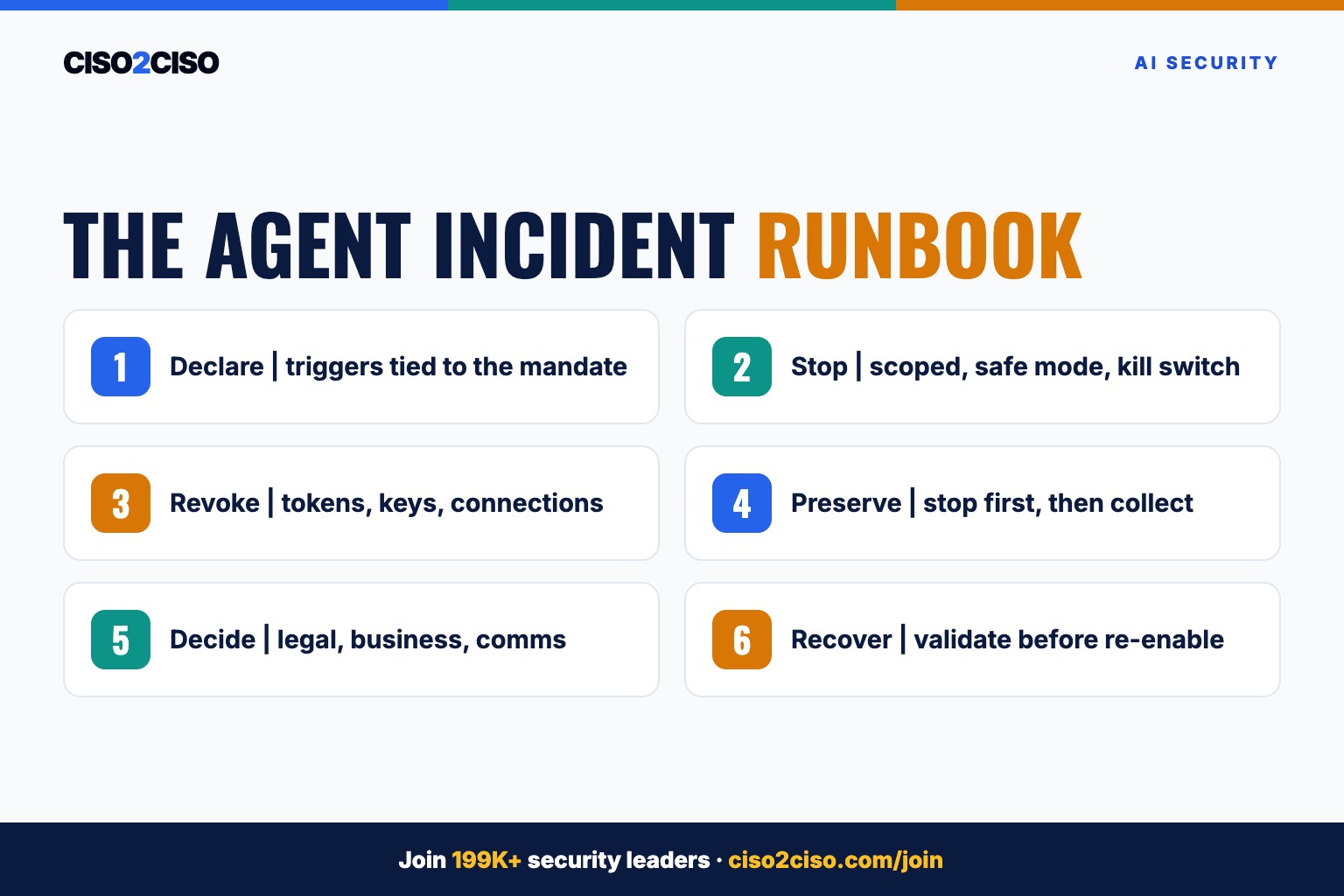
The Runbook: Six Steps to Rehearse
1. Declare. Define what triggers the runbook. Do not limit it to compromise. The trigger is any action outside the agent's mandate: an unexpected tool call, a transaction above its limit, data leaving to an unapproved destination, or behavior that changes sharply from its baseline. This requires a written mandate for each agent, otherwise "outside mandate" has no meaning. Name the on-call role that can declare, and make that authority explicit.
2. Stop. Pre-agree the ladder of containment options and who can use each. At the bottom is a scoped step: disable one tool, one connector or one session. Above it is safe mode, where the agent can analyze and recommend but cannot execute. At the top is a full kill switch. Guidance from practitioners consistently favors starting with the least destructive effective action, but with a clear exception: where the agent holds transaction authority or is actively exfiltrating data, go straight to the full stop. Pre-authorize the on-call engineer for the lower rungs and give the incident lead authority for the top.
3. Revoke. Stopping the agent process is not enough. The agent's access must die as well, including tokens already issued, delegated user credentials, API keys and connections to tools. Confirm that no queued work is still executing under old permissions. This is where earlier design decisions show up. If the agent runs under a unique identity, revocation is a single clean action. If it shares a service account or borrows a human's identity, revoking access hits other workloads or a real employee, and the responder hesitates. Hesitation is exactly what a runbook is meant to remove.
4. Contain the chain. Agents rarely act alone. They call tools, hand tasks to other agents and write to shared memory. Map what the agent touched: downstream agents that consumed its output, records it changed, messages it sent, and any poisoned data it may have stored for later. Containment that ignores the chain only relocates the problem.
5. Preserve and reconstruct. Capture prompts, tool calls, configuration, memory and logs, but do not let evidence collection delay the stop. The order is stop, then preserve, then investigate. Your ability to do this quickly depends on logging decisions made months earlier. If reconstructing yesterday's activity takes days, as many respondents in the Salt Security research reported, your decision-making during the incident will be blind.
6. Decide, communicate, recover. This is where legal and business owners earn their seat. Legal needs to determine whether personal data or regulated records were touched and which notification clocks have started. The business owner decides how the process runs manually while the agent is down, and which actions need to be reversed. Communications needs a holding statement. Before the agent is re-enabled, someone with authority must validate the cause, the fix and the revised limits. Where the agent is retired rather than restored, decommission it properly, with credentials removed.
Rehearse Three Scenarios, Not One
A single generic tabletop will not surface the real friction. Use three short scenarios that stress different parts of the runbook:
- The silent leak. An agent starts sending sensitive data to an external destination after reading a manipulated document. Tests the stop decision, egress control and legal notification.
- The wrong action at scale. An agent updates or deletes records in a business system. Tests business-owner authority, reversal and manual fallback.
- The borrowed identity. An agent running under a shared account misbehaves. Tests whether revocation is even possible without collateral damage.
Run each with incident response, legal, the business owner of the agent, communications and the platform team that holds the kill switch. Time the first decision. Record who hesitated and why. Those hesitations are your backlog.
Executive Framework
| Phase | Decision to pre-agree | Who must be in the room |
|---|---|---|
| Declare | Triggers tied to each agent's written mandate; who may declare | Security operations, agent business owner |
| Stop | Containment ladder: scoped, safe mode, full kill switch; who may use each | Incident lead, platform engineering |
| Revoke | Which identities, tokens and connections die first; how to avoid collateral damage | Identity team, platform engineering |
| Preserve | Minimum evidence set and retention; stop before collect | Forensics, legal |
| Decide | Notification obligations, manual fallback, reversal of actions | Legal, business owner, communications |
| Recover | Criteria to re-enable, retire or redesign the agent | CISO, business owner, risk |
What CISOs Should Do Next
- Inventory what you would need to stop. List every agent with action authority, its identity, its credentials, its tools and its named business owner, including agents embedded in SaaS and built outside IT.
- Build the kill switch before you scale the agent. Ensure each production agent has a tested way to disable its tools and revoke its access that does not depend on the agent's own cooperation, and that on-call staff can reach it.
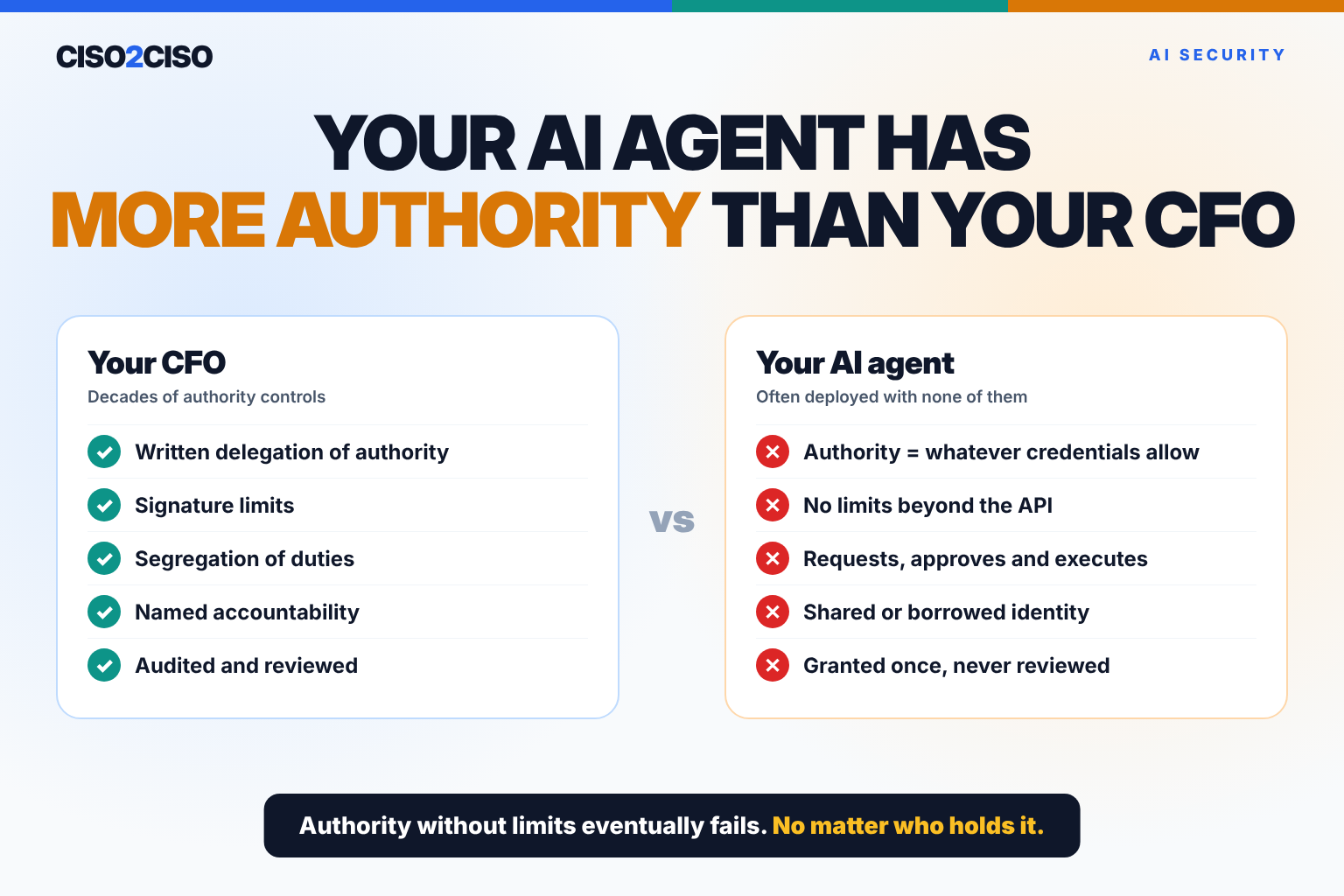
- Give every agent its own identity. Retire shared accounts and borrowed human credentials for agent use so revocation is surgical and safe.
- Write the mandate and the triggers. A short document per agent stating what it may do and what counts as outside mandate, approved by the business owner.
- Pre-authorize the ladder. Decide in writing who may use scoped containment, safe mode and full shutdown, so nobody waits for permission at the worst moment.
- Fix the logging gap. Make sure you can reconstruct an agent's instructions, tool calls and results quickly, because response speed depends on it.
- Rehearse with legal and the business. Run the three scenarios within the next quarter, measure time to first decision, and report the findings to the risk committee.
Board-Level Questions
- If an agent acts outside its mandate tonight, who is authorized to stop it, and how long would it take?
- For our highest-authority agents, can we revoke access without disrupting other systems or employees?
- Have we rehearsed an agent incident with legal and the business owner, or only with the security team?
- Could we reconstruct what an agent did yesterday, on whose instruction, within the hour?
- Who owns the business cost of stopping an agent, and have they agreed to it in advance?
Final Executive Takeaway
The industry has spent two years learning how to give agents access. The next test is how fast an organization can take it back. The surveys cited here suggest that many organizations can see agent activity but cannot automatically stop it, and that many have never practiced the decision. That is a governance gap, not a tooling gap. Decide who can pull the plug, make revocation clean by giving each agent its own identity, keep the evidence you will need, and bring legal and business owners into the rehearsal. The first real agent incident should not be the first time anyone in the room has asked who is in charge.