Your Board Wants Threat Intelligence Too — Just Not the Kind You're Producing
Executive Summary
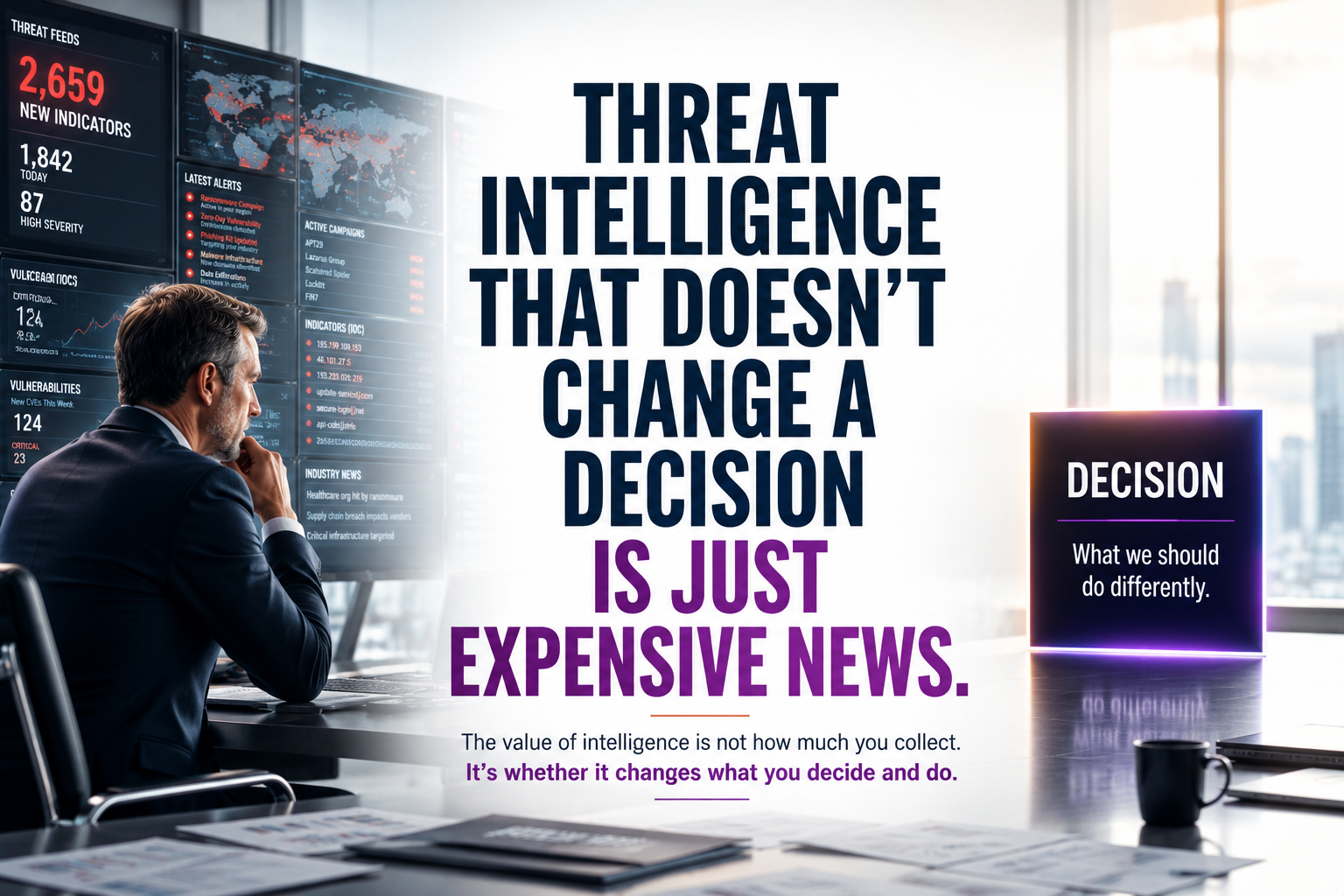
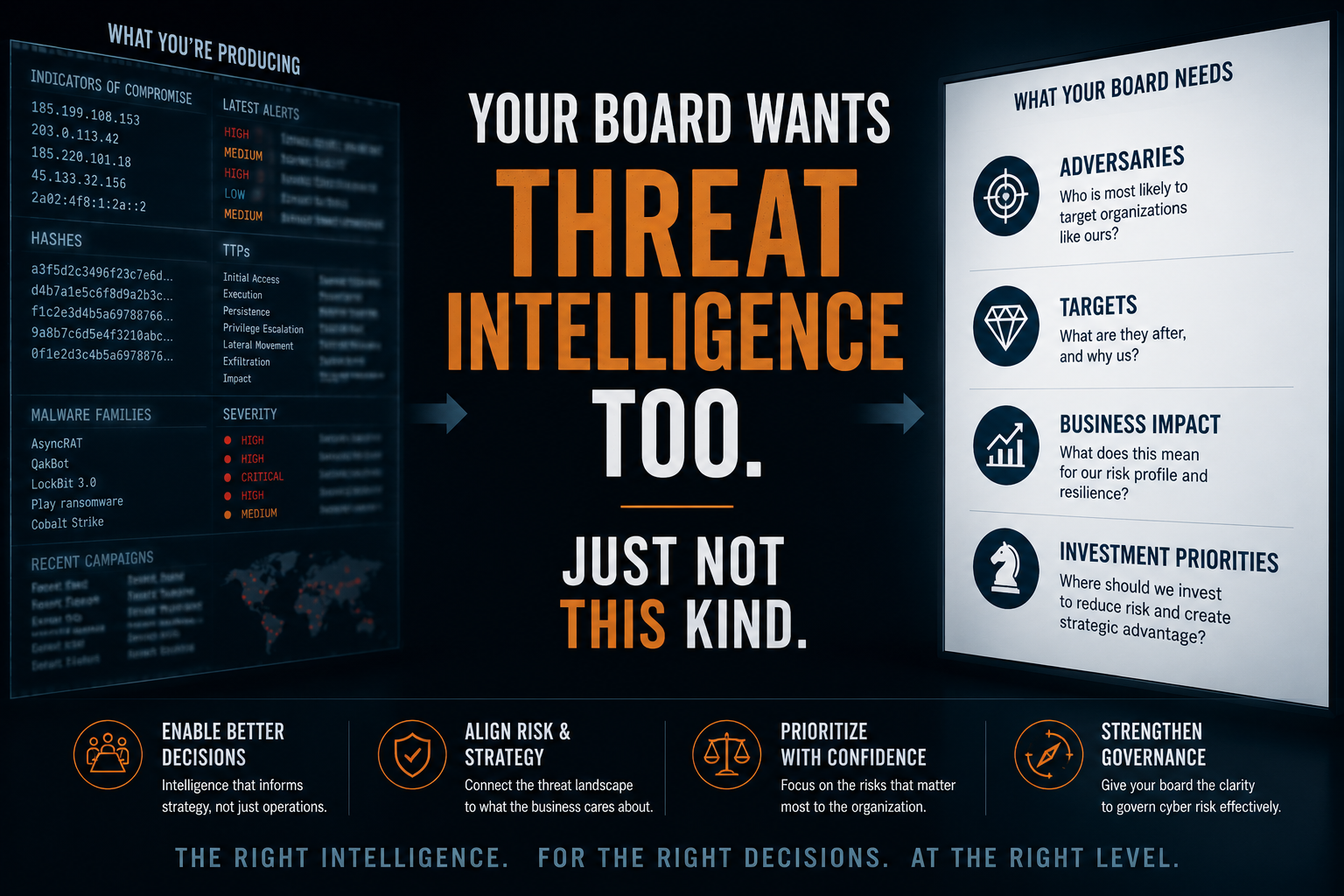
Threat intelligence, as most organizations practice it, is aimed downward and inward — at the security operations center and the technical teams that defend the environment day to day. It deals in indicators of compromise, adversary techniques, vulnerability advisories and campaign details. This tactical and operational intelligence is valuable and necessary, and it is what most threat intelligence programs are built to produce.
But there is another audience with genuine intelligence needs that those programs almost never serve: the executives and the board. Leaders making decisions about strategy, investment, risk appetite and resilience need to understand the threat landscape too — not the indicators and the techniques, but the shape of the risk: what kinds of adversaries are likely to target an organization like theirs, what they are after, how the threat is evolving, and what it means for the decisions leadership actually has to make.
This is strategic threat intelligence, and it is a distinct discipline. It is not tactical intelligence with the jargon removed. It answers different questions, for a different audience, in service of different decisions. Most organizations that have invested heavily in operational threat intelligence have never built the capability to produce the strategic kind — and so their leaders govern cyber risk with a picture of the threat that is either absent or borrowed from headlines.
Why This Matters Now
Boards are being asked to govern cyber risk more actively than ever, and good governance requires understanding the threat, not just the controls. A board that does not understand what kinds of adversaries plausibly target the organization, what those adversaries want, and how the landscape is shifting is governing in a vacuum — approving or declining security investments without a grounded sense of the risk they address. The absence of strategic threat intelligence shows up as a board that cannot calibrate, that swings between complacency and overreaction depending on the latest news.
At the same time, the threat landscape has become genuinely strategic in its implications. The targeting of supply chains, the industrialization of certain attack types, the geopolitical dimension of some threats, the evolving motivations of different adversary classes — these have consequences for business strategy, for where an organization invests, for how it thinks about resilience and concentration. These are leadership questions, and they require intelligence pitched at the leadership level to answer well.
CISO2CISO Insight
Your SOC needs to know which indicator to block. Your board needs to know which kind of adversary is coming for an organization like yours, what they want, and what that means for where you invest. These are different questions — and the second one almost never gets answered.
What Makes Strategic Intelligence Different
Strategic threat intelligence is not a simplified version of operational intelligence. It is a different product, built to inform different decisions, and understanding the differences is essential to producing it well.
It is about the landscape, not the indicator. Operational intelligence asks "what is this threat and how do we detect it?" Strategic intelligence asks "what does the threat environment look like for an organization like ours, and where is it heading?" The unit of analysis is the landscape and its trajectory, not the individual artifact.
It connects to business decisions. Strategic intelligence earns its place by informing the decisions leaders make — about risk appetite, investment priorities, resilience, and where the organization is most exposed given who is likely to target it. If it does not connect to a leadership decision, it is not strategic intelligence; it is a briefing no one needed.
It is contextual to the organization. Generic threat-landscape commentary is of limited value. Strategic intelligence is most useful when it is specific: what adversaries are relevant to this organization's sector, profile, geography and assets, and what their interest implies. The relevance filter is what turns landscape information into intelligence.
It is communicated for executives. The product has to be intelligible and useful to a non-technical leadership audience — framed in terms of business consequence and decision relevance, not adversary tooling. This is a communication discipline as much as an analytical one, and it is where many technically excellent intelligence functions fall short.
Building the Capability
Producing strategic threat intelligence requires deliberately building something most programs do not have, rather than expecting it to emerge from the operational function.
It starts with understanding what leadership actually needs to decide — the same requirements-driven discipline that good intelligence always rests on, applied to the executive audience. It requires analytical capacity oriented toward synthesis and trajectory rather than indicators and detection — the ability to look across the landscape and assess what it means, not just what it contains. It depends on contextualizing relentlessly to the organization, filtering the vast threat landscape down to what is relevant to this specific enterprise. And it demands communication built for executives, translating threat reality into decision-relevant terms without dumbing it down into vagueness.
Crucially, this capability complements rather than competes with operational intelligence. The two serve different audiences and different decisions, and a mature program produces both — feeding the SOC the tactical intelligence it needs to defend, and feeding leadership the strategic intelligence it needs to govern.
Executive Framework
| Dimension | Operational threat intel | Strategic threat intel |
|---|---|---|
| Audience | SOC and technical teams | Executives and the board |
| Unit of analysis | Indicators, techniques, campaigns | Landscape, trajectory, adversary classes |
| Question answered | What is this and how do we detect it? | What is coming for us, and what does it mean? |
| Decisions informed | Detection, response, defense | Strategy, investment, risk appetite, resilience |
| Relevance filter | Our environment and detections | Our sector, profile, geography, assets |
| Communication | Technical | Decision-relevant, executive |
What CISOs Should Do Next
- Recognize strategic threat intelligence as a distinct product, not as operational intelligence with the jargon stripped out — they answer different questions for different audiences.
- Define what leadership needs to decide, and build the intelligence requirements for the executive audience the same way you would for any other.
- Develop analytical capacity for synthesis and trajectory, oriented toward what the landscape means rather than what indicators it contains.
- Contextualize relentlessly to your organization, filtering the broad threat landscape down to the adversaries and trends genuinely relevant to your sector, profile and assets.
- Communicate it for executives, framing the threat in terms of business consequence and the decisions it informs, without retreating into vagueness.
- Produce both kinds of intelligence, serving the SOC's operational needs and leadership's strategic needs as complementary outputs of one program.
Board-Level Questions
- Do we, as a board, actually understand the threat landscape relevant to our organization — who is likely to target us, what they want, and how it is evolving?
- Is our threat intelligence informing the strategic decisions we make about risk appetite, investment and resilience — or only the technical defenses below us?
- Is the threat intelligence we receive contextual to our specific organization, or generic landscape commentary?
- Are we governing cyber risk with a grounded picture of the threat, or calibrating to the latest headline?
Final Executive Takeaway
The maturation of threat intelligence in most organizations has been almost entirely in one direction — deeper, faster, more comprehensive operational intelligence for the teams that defend the environment. That investment is justified and valuable. But it has left a conspicuous gap at the top, where the people governing cyber risk receive little or no intelligence pitched to their actual decisions. The board is asked to govern the threat without being given a usable picture of it.
Closing that gap means building strategic threat intelligence as a deliberate, distinct capability: landscape-oriented, decision-relevant, contextual to the organization, and communicated for executives. It does not replace the operational function; it completes the program by serving the audience the operational function was never built for.
Your board wants threat intelligence — the kind that tells it what is coming for an organization like yours and what to do about it. The fact that you are producing a different kind, for a different audience, is exactly why it feels like the board still does not understand the threat.
*To be continued...*