Threat Intelligence That Doesn't Change a Decision Is Just Expensive News
Executive Summary
Walk into the average enterprise security function and you will find an impressive volume of threat intelligence flowing in. Commercial feeds, vendor reports, industry sharing groups, open-source indicators, government advisories — a steady stream of information about adversaries, campaigns, vulnerabilities and indicators of compromise. The organization is, by any measure, well supplied with intelligence.
And then ask a harder question: in the last quarter, what specific decision did that intelligence change? Which detection was built because of it? Which control was reprioritized? Which executive choice was informed by it? For a great many organizations, the honest answer is uncomfortably thin. The intelligence arrived, was logged, perhaps summarized in a report few people read, and changed almost nothing about what the organization actually did.
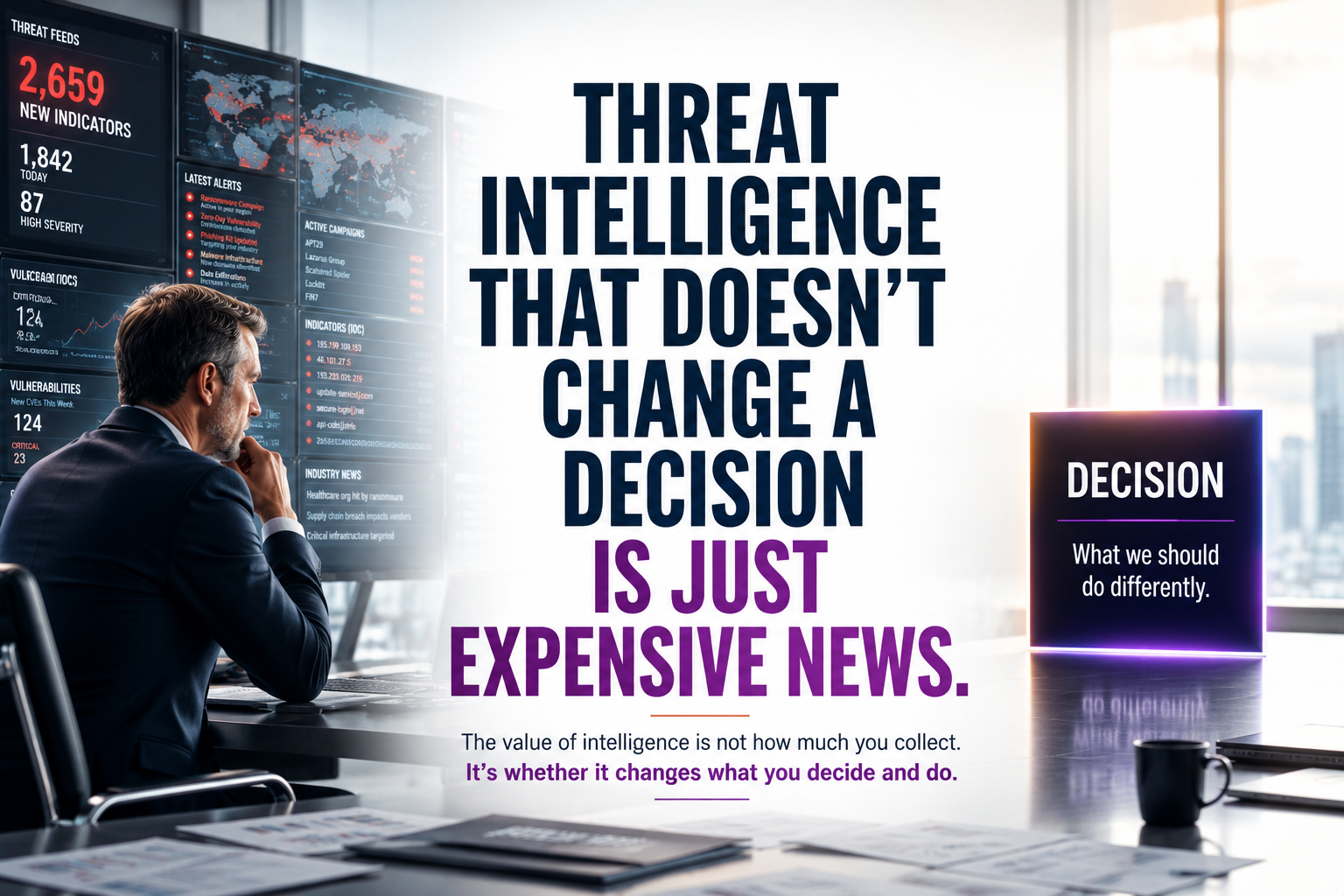
This is the central failure of threat intelligence as it is commonly practiced. It is consumed as content rather than used as input to decisions. And intelligence that does not change a decision — no matter how accurate, how timely, or how expensive — is not providing value. It is just news.
Why This Matters Now
The volume problem has become acute. The quantity of threat information available now vastly exceeds any organization's capacity to read it, let alone act on it. The instinct to subscribe to more feeds and ingest more indicators has produced security functions that are drowning in information while remaining starved of insight relevant to their specific environment.
At the same time, the cost of acting on the wrong intelligence has risen. Attack progressions have compressed — the window between an adversary gaining access and causing significant damage has narrowed considerably. An organization that cannot quickly distinguish the intelligence relevant to its actual environment from the background noise will spend its limited response capacity in the wrong places, and arrive late where it matters.
The organizations that get value from threat intelligence are not the ones consuming the most. They are the ones who have built a tight loop between intelligence and decision — who treat every piece of intelligence as obligated to answer the question "so what should we do differently?"
CISO2CISO Insight
The measure of a threat intelligence program is not how much it knows. It is how often what it knows changes what the organization does. By that measure, most programs are libraries — full of information, empty of consequence.
Why Most Threat Intelligence Goes Nowhere
The disconnect between intelligence and action is not an accident. It is the predictable result of several structural problems.
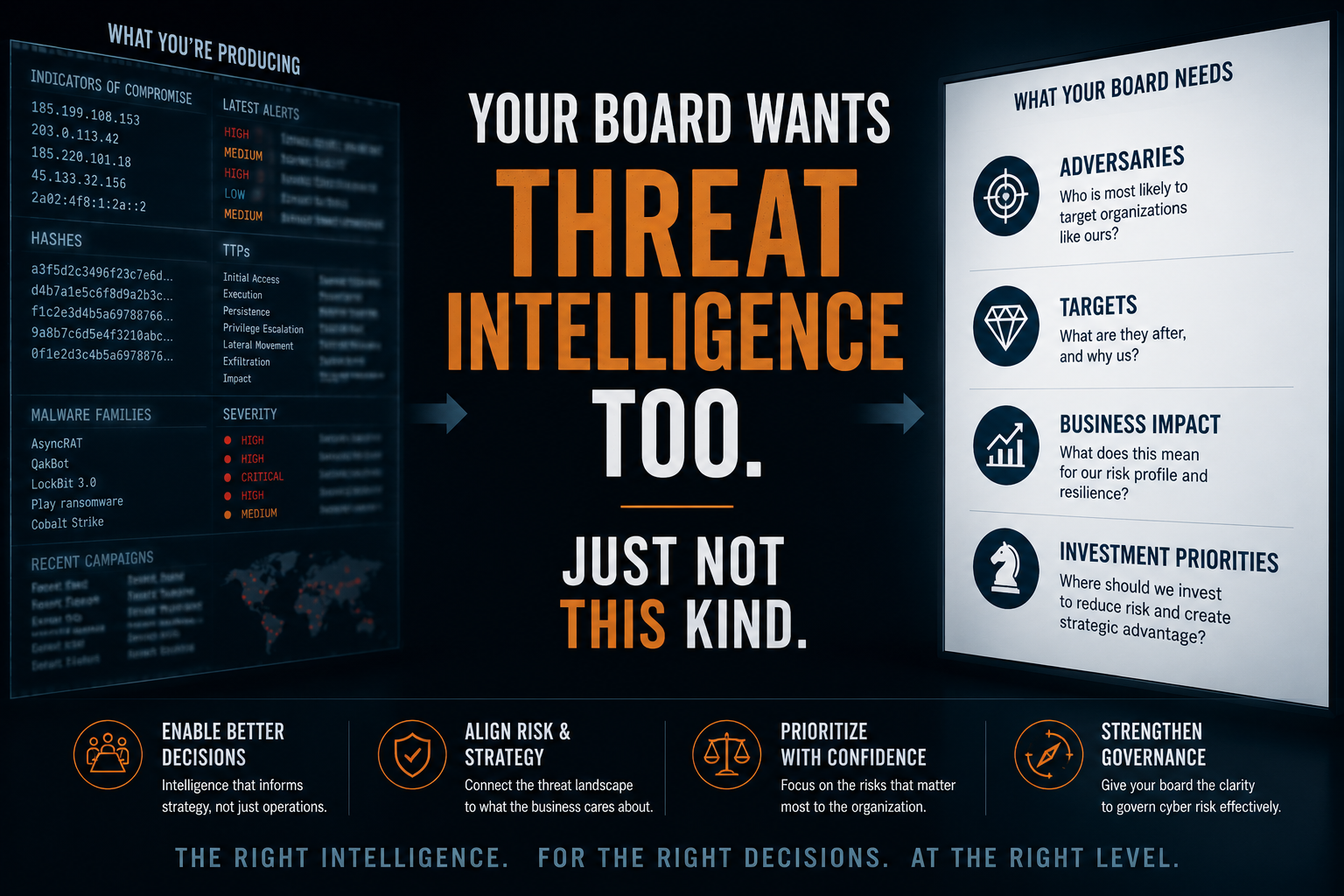
It is not tied to the organization's actual environment. A report about a threat actor targeting an industry, or exploiting a technology the organization does not use, is interesting but inert. Intelligence becomes actionable only when it is mapped against what the organization actually has, runs and cares about. Without that mapping, every piece of intelligence carries equal weight — which means none of it drives prioritization.
It is not connected to a decision owner. Intelligence that arrives without a clear path to someone empowered to act on it dissipates. If a piece of intelligence implies a detection should be built, a control reprioritized, or a risk escalated, but no one owns that translation, the intelligence dies in the inbox.
It conflates feeds with intelligence. A feed of indicators is data. Intelligence is the analysis that turns data into an assessment of what is relevant, what it means for this organization, and what should be done about it. Many programs have invested heavily in feeds and almost not at all in the analytical capacity to convert them — and then wonder why volume has not produced value.
It is not prioritized against the crown jewels. Intelligence that is not filtered through the question "does this threaten what matters most to us?" produces a flat landscape in which a threat to a trivial asset and a threat to a critical one look the same. The most valuable intelligence is the intelligence that bears on the organization's most consequential exposures.
From Collection to Consequence
The fix is to invert the program. Instead of starting with what intelligence is available and pushing it into the organization, start with the decisions the organization needs to make and pull the intelligence that informs them.
This means defining, in advance, what the organization actually needs to know to make better choices: which assets and capabilities matter most, which threats are plausible against them, and what intelligence would change a decision about how to defend them. Intelligence is then collected, prioritized and analyzed against those requirements — and every output is expected to terminate in an action: a new detection, a reprioritized control, an escalated risk, an informed executive decision. Intelligence that does not connect to one of those outcomes is, by definition, not worth the resources spent collecting it.
The most mature programs close the loop explicitly. Intelligence informs detection engineering, which produces telemetry, which feeds back into intelligence. It informs risk prioritization, which directs defensive investment, which changes the organization's exposure. The intelligence function is not a publisher of reports. It is an engine that continuously sharpens what the organization detects, defends and decides.
Executive Framework
| Dimension | Intelligence as news | Intelligence as decision input |
|---|---|---|
| Starting point | What feeds are available | What decisions we need to inform |
| Relevance filter | None — collect broadly | Mapped to our assets and crown jewels |
| Output | Reports and indicators | Detections, reprioritizations, decisions |
| Ownership | Dissipates in the inbox | Routed to an owner empowered to act |
| Success measure | Volume collected | Decisions and detections changed |
| Feeds vs. analysis | Heavy on feeds | Invested in analytical conversion |
What CISOs Should Do Next
- Define your intelligence requirements before expanding collection — what does the organization actually need to know to make better defensive and executive decisions?
- Map intelligence against your real environment and crown jewels, so that relevance, not volume, drives what gets attention.
- Require every intelligence output to terminate in a proposed action — a detection, a reprioritization, an escalation, a decision — and route it to an owner empowered to act.
- Invest in analytical capacity, not just feeds: the scarce resource is the ability to convert data into an assessment of what it means for you, not the data itself.
- Close the loop with detection engineering, so that intelligence continuously sharpens what you can see and detection continuously informs what intelligence to seek.
- Measure the program by consequence — decisions and detections changed — and be willing to cut collection that never produces any.
Board-Level Questions
- Is our threat intelligence investment changing what we actually do — detections built, controls reprioritized, decisions informed — or is it producing reports we do not act on?
- Is our intelligence prioritized against the assets and capabilities that matter most to our business?
- Do we have the analytical capability to turn raw threat data into decisions, or have we mostly bought feeds?
- When intelligence indicates a relevant threat, is there a clear, fast path to acting on it?
Final Executive Takeaway
Threat intelligence has a seductive quality: it always feels valuable to know more about the adversary. That feeling has led many organizations to equate the quantity of intelligence they collect with the value they derive from it — and the two have almost nothing to do with each other. The organization that ingests a hundred feeds and changes nothing is worse off than the one that ingests a handful and continuously sharpens its detections, priorities and decisions, because the first has spent resources to produce the illusion of intelligence-led security.
The discipline that separates the two is relentless attention to consequence. Every piece of intelligence is obligated to answer one question: what should we do differently because of this? When the answer is nothing — too often, the honest answer — the intelligence was never intelligence at all.
Intelligence that doesn't change a decision is just expensive news. The job of a threat intelligence program is not to know more. It is to make the organization decide and defend better — and if it isn't doing that, the volume is not the solution. It's the problem.
*To be continued...*