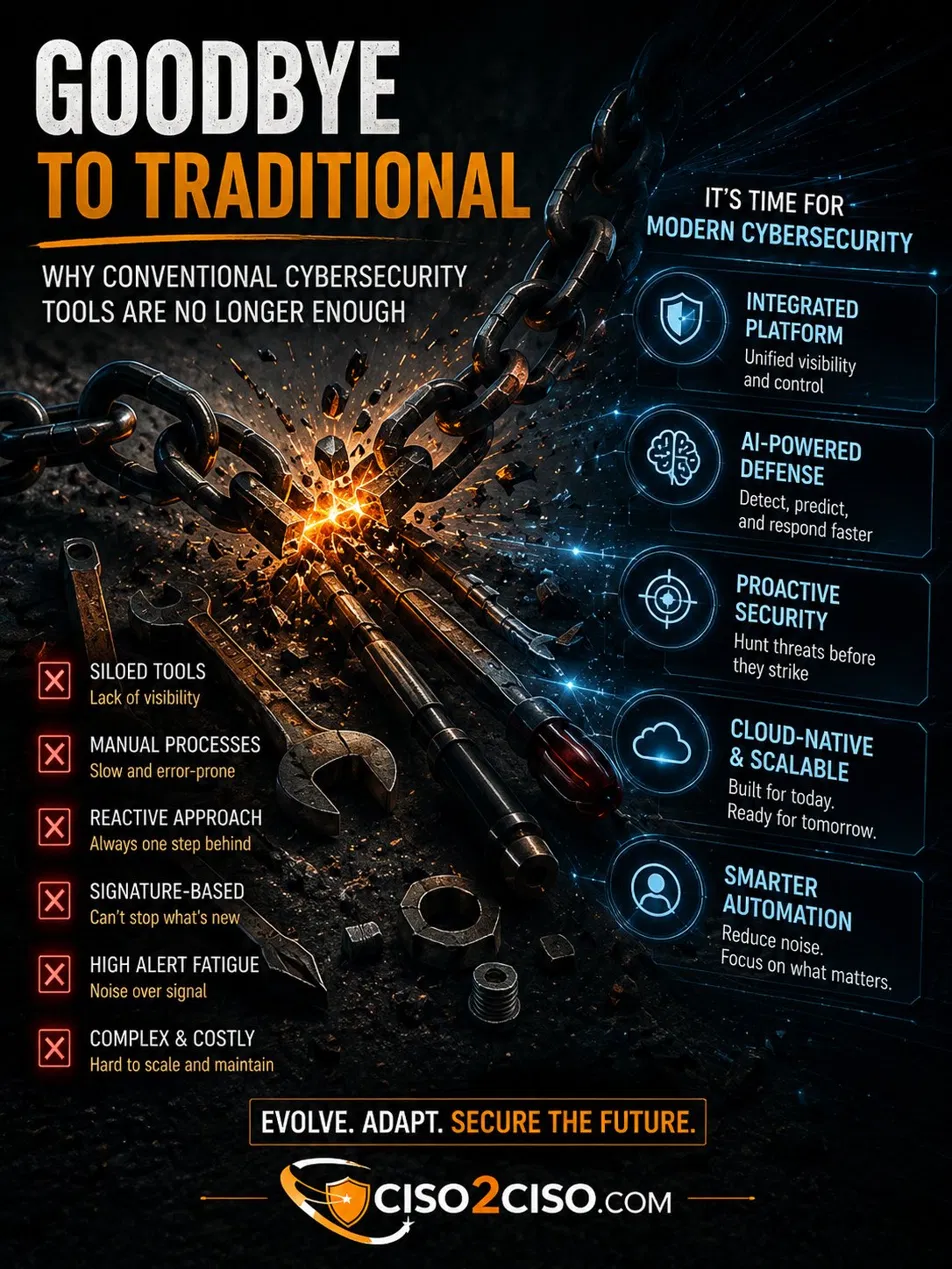
Goodbye to Traditional: Why Conventional Cybersecurity Tools Are No Longer Sufficient
The Widening Gap
In a world where technological innovation advances at an accelerating pace, cybersecurity has become a priority for organizations of every size and sector. But as the digital threat landscape grows in sophistication and complexity, a structural reality is becoming impossible to ignore: the tools and approaches that defined cybersecurity for the first two decades of the discipline no longer provide adequate protection against current and future challenges.
This is not an argument for abandoning what has been built. It is an argument for understanding what the current threat environment actually requires — and for building the capability gap between conventional approaches and adversarial reality.
The security challenges we face today share surface-level similarities with those of previous decades. But the tactics, tools and operational sophistication of modern threat actors have evolved dramatically. Our defense strategies must evolve in response.
How the Threat Landscape Has Changed
The evolution of cyber threats over the past decade has been fundamental, not incremental. What changed is not just the scale or frequency of attacks — it is the nature of them.
From opportunistic to targeted. Early malware was largely opportunistic — it spread to whatever systems it could reach. Modern threat actors, including ransomware groups and nation-state actors, conduct reconnaissance on their targets before attacking. They understand the organization's architecture, identify the most critical assets, and time their deployments for maximum operational pressure.
From noisy to silent. Signature-based detection was built for malware that announced itself — through known file hashes, network indicators and behavioral patterns that matched existing threat intelligence. Modern attackers use living-off-the-land techniques, leveraging legitimate system tools and administrative processes to move laterally without triggering signature-based alerts.
From perimeter-focused to identity-focused. The perimeter security model assumed that what was inside the network was trusted. Modern attackers target identity — credential theft, privilege escalation and the abuse of legitimate accounts — because identity is the new attack surface that perimeter controls were never designed to address.
From single incidents to sustained campaigns. The dwell time of sophisticated attackers — the period between initial compromise and detection — is measured in weeks or months. Tools designed to detect and block individual malicious events are structurally unable to detect the slow, deliberate progression of an advanced intrusion campaign.
The Limitations of Conventional Tools
Traditional cybersecurity tools were built for a different threat model. Understanding their limitations is not a criticism of the people who built and deployed them — it is a prerequisite for building what is needed now.
Signature-based detection identifies threats by matching observed activity against a database of known malicious patterns. It is effective against known, catalogued threats. It is ineffective against novel malware, fileless attacks, and living-off-the-land techniques. The time between a new attack technique emerging in the wild and a signature being developed, deployed and updated across the installed base creates a structural detection gap that sophisticated attackers exploit consistently.
Static rule-based SIEM generates alerts when observed events match predefined conditions. It requires security teams to anticipate every attack pattern in advance and write a rule for it. In environments that generate millions of events per day, the signal-to-noise ratio in static rule-based systems becomes unmanageable. Alert fatigue — the operational condition where analysts cannot meaningfully process the volume of alerts generated — is not a personnel problem. It is an architectural one.
Perimeter firewalls control traffic crossing the network boundary. They are largely irrelevant to attacks that have already achieved initial access, to insider threats, to cloud-native environments without a traditional perimeter, or to the lateral movement of attackers already inside the network.
Periodic vulnerability scanning provides a point-in-time view of known vulnerabilities. It does not provide continuous visibility, does not account for vulnerabilities introduced between scan cycles, and does not prioritize based on active exploitation in the wild.
The Need for a Holistic Approach
Modern cybersecurity requires a fundamentally different architecture — one built around four capabilities that conventional tools were not designed to provide:
Unprecedented network visibility. In a world where threats can originate anywhere at any time, complete visibility of network traffic is an invaluable asset. The ability to monitor and analyze network traffic comprehensively — including encrypted traffic, east-west traffic between internal systems, and cloud workload communications — enables detection of anomalous activity before it becomes a major incident.
Advanced endpoint protection. With the proliferation of connected devices and the normalization of remote work, endpoints have become the primary entry point for cyberattacks. Modern endpoint protection goes far beyond malware detection — it includes behavioral analysis, exploit prevention, automated investigation and response, and integration with identity and network controls.
Microsegmentation. Dividing the network into smaller, secure segments limits the impact of a compromise and restricts lateral movement. When an attacker cannot move freely from a compromised endpoint to critical infrastructure, the blast radius of any incident is fundamentally constrained.
Security for services and containers. With widespread adoption of container architectures and migration to hybrid and multi-cloud environments, securing the services and applications that run in those environments is a critical element of modern security posture. Container security, cloud workload protection and API security are not optional extensions of the security program — they are core requirements.
The Transition That Is Required
The organizations that are managing this transition well have recognized that it is not primarily a technology problem. It is an architectural and strategic one.
The question is not which specific products to replace. The question is what the security architecture is trying to achieve: continuous visibility, behavioral detection, identity-aware access controls, tested response capability and the ability to contain and recover from inevitable compromises.
Technology follows architecture. Architecture follows strategy. And strategy must follow the actual threat environment — not the threat environment of five years ago.
| Conventional Approach | Modern Requirement |
|---|---|
| Perimeter firewall | Zero Trust network access |
| Signature-based AV | Behavioral EDR / XDR |
| Static SIEM rules | AI-assisted anomaly detection |
| Periodic vulnerability scans | Continuous exposure management |
| Annual compliance audits | Continuous security posture assessment |
| Documented IR plan | Tested, exercised IR capability |
Board-Level Questions
- Is our current security architecture designed for the threat environment of today — or the threat environment of when it was originally deployed?
- Do we have continuous, real-time visibility into what is happening in our network, endpoints and cloud environments — or does our visibility depend on periodic scans and manual reviews?
- Have we tested our detection and response capabilities against the attack techniques being used against organizations like ours?
- Is our security investment allocation driven by the actual risk we face — or by compliance requirements and what we have always done?
Final Takeaway
The future of cybersecurity does not reside in the mere adoption of advanced technologies. It resides in the capacity to adapt and evolve in response to emerging threats — to build an architecture that assumes compromise will occur and is designed to detect, contain and recover rapidly when it does.
The organizations that make this transition — from perimeter-focused, compliance-driven, reactively-managed security to continuous, behavioral, resilience-designed programs — will be significantly better positioned as the threat environment continues to evolve.
The tools that protected us in the past are not sufficient for the threats we face today. The architecture that protects us today must be designed for the threats we will face tomorrow.
*To be continued...*