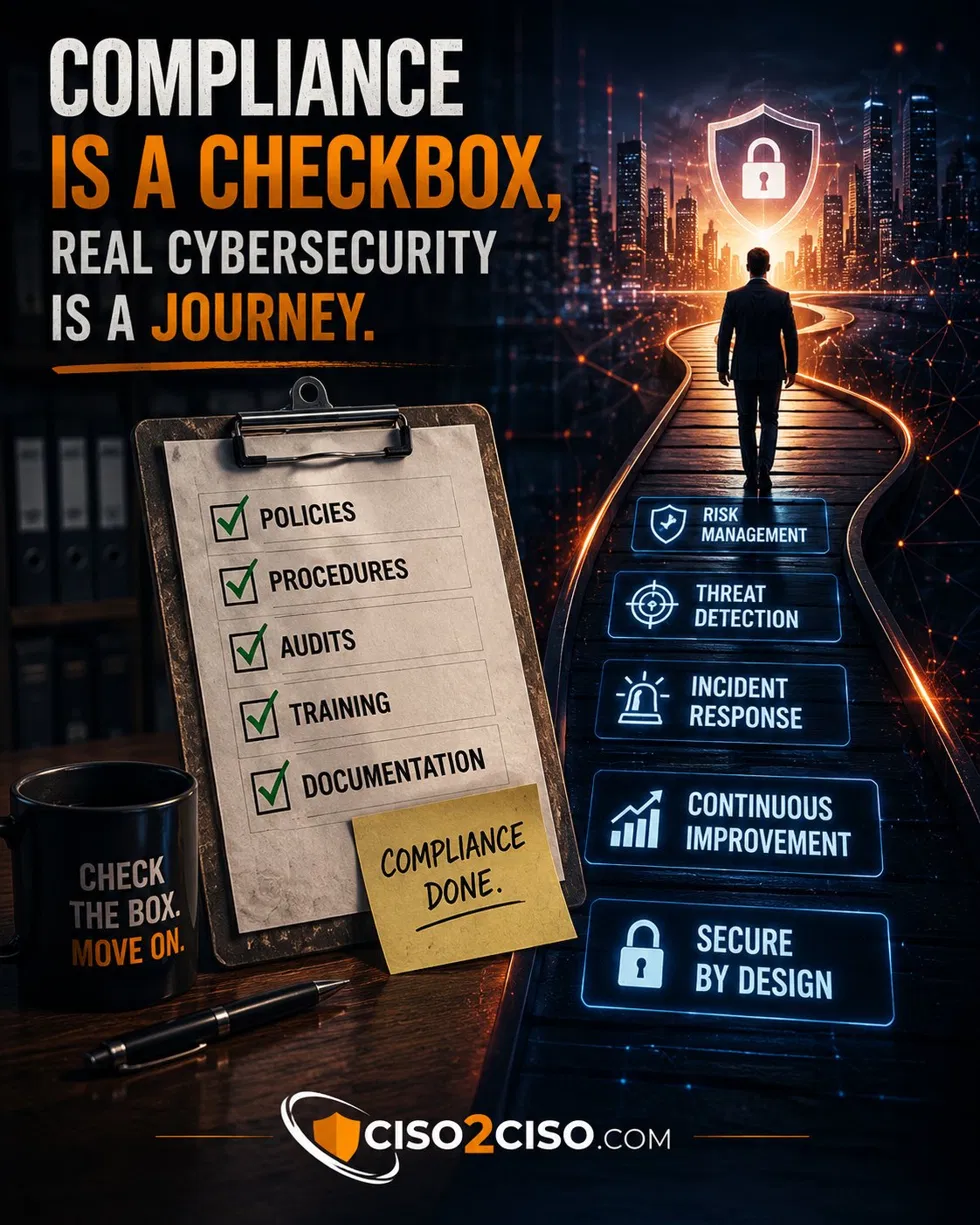
Compliance Is a Checkbox. Real Cybersecurity Is a Journey.
The Misconception That Puts Organizations at Risk
In the modern enterprise, cybersecurity has become a topic of maximum relevance across every industry and every size of organization. But despite its prominence, one of the most persistent and dangerous misconceptions remains widely held: that achieving compliance equates to comprehensive security.
It does not.
Compliance is foundational. It is not all-encompassing. And the organizations that confuse the two — treating a passed audit as evidence of adequate protection — are consistently the ones most surprised when an incident occurs.
Being compliant with PCI, SOX or GDPR will not protect you from ransomware, a data breach, or a denial of service attack. It may reduce risk by a marginal percentage. But without implementing real cybersecurity controls and processes on operational, automated tools — beyond passing audits and satisfying regulators — organizations will be affected by attackers. It is a matter of when, not if.
What Compliance Actually Is
Compliance is an organization's documented demonstration that it meets a defined set of industry regulations and standards. It involves security protocols, risk assessments, guideline adherence and data protection commitments.
Within those parameters, compliance serves a real and important purpose. It establishes a baseline. It creates accountability structures. It ensures that certain fundamental controls are in place and documented. It satisfies regulatory and contractual obligations that carry genuine legal and financial consequences.
But compliance is inherently static. It describes a point-in-time assessment of whether defined criteria are met. The threat landscape evolves continuously. Compliance frameworks update on a cycle measured in years. The gap between what a compliance framework requires and what a sophisticated attacker can exploit is not a minor inefficiency — it is a structural vulnerability in compliance-centric security thinking.
Why Compliance Fails to Address Real Security
Compliance frameworks are backward-looking. They codify what the security community determined was important at the time the standard was written. By the time a framework is published, adopted, and audited against, the threat landscape has moved. Ransomware groups, nation-state actors and criminal organizations operate on timescales measured in weeks, not audit cycles.
Compliance is binary. Security is continuous. A system is either compliant or it is not. But security is a spectrum — and the difference between an organization that passes an audit and one that is genuinely resilient against current threats can be enormous. Compliance says nothing about whether the controls work under real attack conditions, whether detection capabilities are operational, or whether incident response has been tested.
Compliance does not require operational effectiveness. A firewall that is configured and documented but not monitored satisfies most compliance frameworks. A security awareness training program that employees complete annually and immediately forget satisfies most compliance frameworks. A backup system that has never been tested for recovery time satisfies most compliance frameworks. Compliance measures the existence of controls. Security requires that they work.
Compliance creates false confidence. The organizations most at risk from compliance-security confusion are not those that ignore compliance — they are those that treat compliance as the endpoint of their security program. When leadership receives a clean audit report, the natural conclusion is that the organization is protected. When an incident then occurs, the shock is compounded by the sense of betrayal: we passed the audit. How did this happen?
The Controls That Compliance Does Not Require
Real cybersecurity requires operational capabilities that most compliance frameworks do not specifically mandate — or mandate only in general terms that leave significant gaps:
Threat detection with operational coverage. Compliance frameworks typically require a SIEM or log management system. They do not require that detection rules are tuned, that alerts are actioned within a meaningful timeframe, or that the security team can actually identify the attack techniques being used against the organization.
Tested incident response. Compliance requires an incident response plan. It does not require that the plan has been tested against realistic scenarios, that recovery time has been measured, or that the organization can actually execute the plan under the pressure of a real incident.
Real-time vulnerability management. Compliance requires vulnerability scanning on a periodic basis. It does not require a continuous exposure management program that prioritizes vulnerabilities based on exploitability, asset criticality and active threat intelligence.
Identity and access controls that work under adversarial conditions. Compliance requires access controls and periodic access reviews. It does not require that privileged access is monitored in real time, that credential theft would be detected, or that lateral movement using compromised credentials would trigger an alert.
Reframing the Relationship Between Compliance and Security
The answer is not to abandon compliance. It is to understand its proper role.
Compliance is the floor — the minimum baseline that establishes fundamental hygiene and satisfies external obligations. A good security program meets compliance requirements as a byproduct of doing security well, not as the goal in itself.
Security is the journey above that floor. It requires continuous improvement, operational effectiveness, threat-informed decision making, tested capabilities and a culture that treats security as a business function rather than a checkbox exercise.
The question every CISO should be able to answer is not "are we compliant?" It is "if an attacker with the capabilities of the groups targeting our industry targeted us today, what would happen? How would we detect them? How quickly could we contain them? How would we recover?"
Compliance frameworks cannot answer those questions. Only operational security programs can.
Board-Level Questions
- Does our security program measure compliance checkboxes or operational security outcomes?
- When did we last test our incident response capability against a realistic scenario — not a tabletop exercise, but an actual simulation of the attack techniques being used against organizations like ours?
- Do we have visibility into what is actually happening in our environment in real time — or do we only know about security events after the fact through log reviews?
- Is our security investment driven by what frameworks require or by what the actual threat landscape demands?
Final Takeaway
The organizations that treat compliance as the destination of their security program will continue to be surprised by incidents that their controls — technically compliant — failed to prevent or detect.
The organizations that treat compliance as the starting point — and build operational security capability above and beyond what frameworks require — are the ones that actually reduce risk.
Remember: compliance is a checkbox. Cybersecurity is a journey.