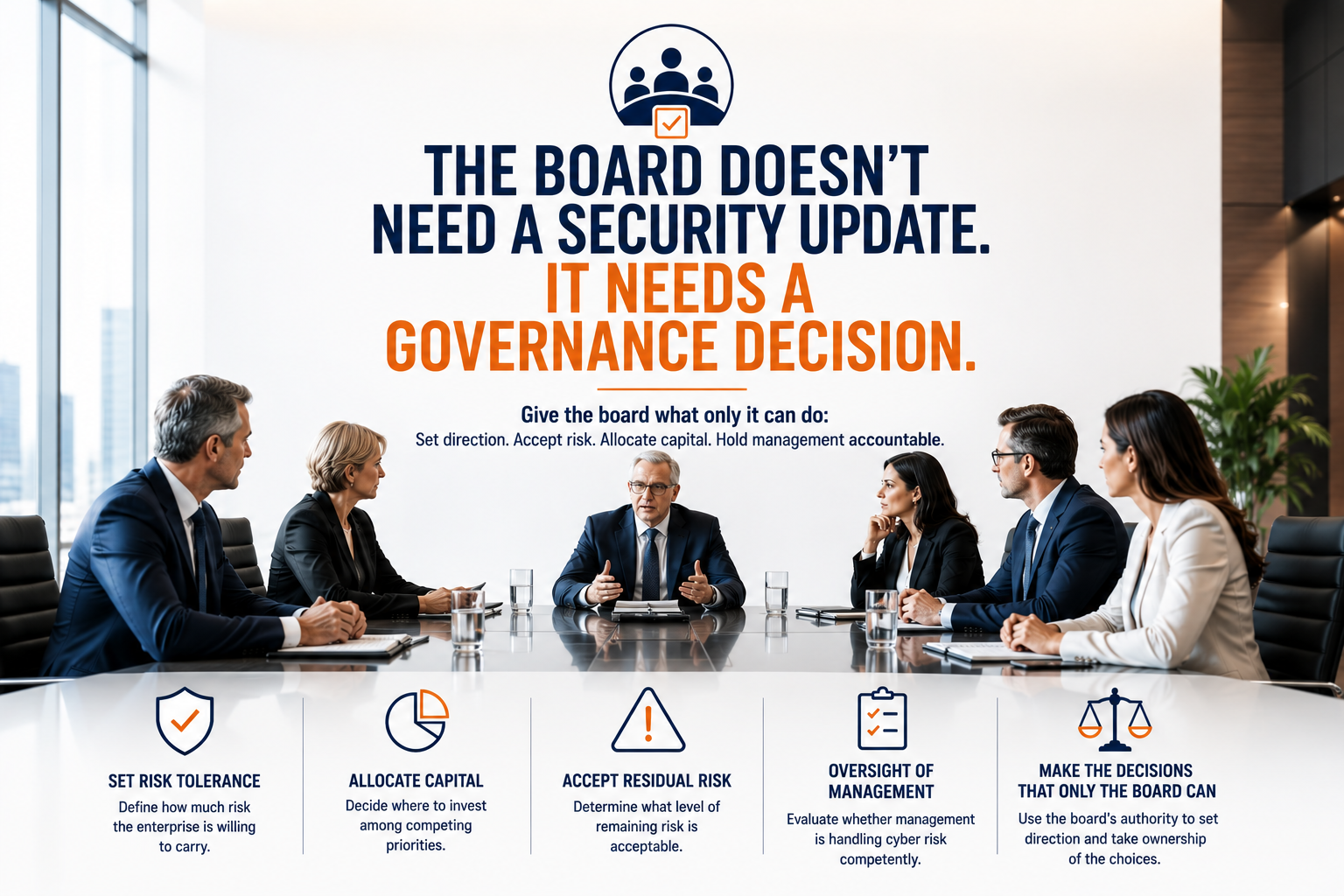

Executive Summary
Cyber rarely loses board time in one dramatic moment. It loses it a little at a time. The meeting runs long on a strategy item, a regulatory matter or a transaction, and the security update is shortened, moved to the end or deferred to next quarter with a promise of a fuller session. Nobody decided that cyber does not matter. The agenda simply behaved the way crowded agendas do.
The pattern underneath is consistent. Most items that win board time arrive as a request: approve this, fund that, choose between these options. The typical security update arrives as information: here is what happened, here is how we are doing. Information can be shortened without anyone noticing a loss. A decision that is pending cannot be skipped without someone owning the delay.
That is the lever. If you want a durable place on the agenda, stop asking for time and start asking for decisions, in a fixed slot, in a fixed format, every cycle. This note sets out a practical way to do that and to convert the recurring security update into a short list of specific requests the board can approve, decline or defer on the record.
Why This Matters Now
Board agendas are getting more crowded, not less. BDO's 2026 Board Survey, published on October 19, 2026 and based on more than 200 US public company directors surveyed in June 2026, found that 36% of directors expect balancing competing priorities on the agenda to be among their boards' most significant challenges over the next 12 months. The same survey found that 42% of directors see board effectiveness, including evaluation, refreshment and education, as an area likely to be deprioritized under competing demands. When agendas compress, whatever lacks a forcing function gets squeezed.
Directors also do not consistently rank cyber at the top of that competition. The Corporate Board Member What Directors Think 2026 report found that only 28% of directors view cybersecurity as a top organizational risk and just 12% say strengthening cybersecurity and data privacy defenses is a priority for 2026, even though technology and cyber risk were cited most often as the most underestimated risks of the year. The same report found that 53% of directors say they do not often receive real-time data between meetings.
The time cyber does receive is thin. Gartner analysts speaking at the Gartner Security and Risk Management Summit 2026 reminded CISOs that, if lucky, they will get only five to 10 minutes to present to the board. Separate research published as the Cybersecurity Board Reporting 2026 study, which interviewed 78 directors in 13 countries and 35 security executives, reported that the average board spends one hour a year on the topic and that directors give the cyber reporting they receive a Net Promoter Score of minus 53. The same study found that 85% of executives say they provide benchmarks while only 30% of directors say they receive them.
Meanwhile, other topics are earning dedicated time. The National Association of Corporate Directors reported in its survey data, as summarized in February 2026, that more than 62% of directors now set aside agenda time for full-board AI discussions. AI has a slot. Cyber, which sits underneath it, often still has a guest appearance.
The expectation is already on paper. The NACD and Internet Security Alliance 2026 Director's Handbook on Cyber-Risk Oversight, released in April 2026, describes cybersecurity as a consistent agenda item with a formalized cadence at committee and full-board level, and recommends regular, non-crisis communication channels between the board and the CISO. Directors are being told to give cyber a standing place. The CISO's job is to make that place worth keeping.
CISO2CISO Insight
A standing agenda slot is not won by asking for more time. It is kept by arriving every cycle with a decision only the board can make.
Most CISOs respond to a shrinking slot by compressing the update: fewer slides, a tighter dashboard, a sharper headline. That helps readability but does not change the nature of the request. A tighter update is still an update, and updates are the easiest thing on any agenda to postpone.
Consider how other items hold their place. The capital allocation item has a number to approve. The audit item has an opinion to receive and a finding to resolve. The compensation item has a recommendation to ratify. Each has a verb. "Approve", "ratify", "accept", "direct". A security item whose verb is "note" has already told the board it can be moved.
The second half of the insight is about the CISO's own discipline. Many security updates contain no decision because management has not yet decided what it needs from the board. The decision-request format forces that work upstream. If you cannot name the decision, you may not have a board matter. You may have an operational matter that belongs in a written pre-read, and saying so is a credibility gain, not a loss.
The Fixed Slot
The slot has three properties, and each one matters.
Fixed position. Agree a recurring place in the agenda, for example the first item after the CEO report in the risk or audit committee, with the full board receiving the output at defined intervals. A slot that floats with the schedule is the first thing displaced. NACD's handbook points the same direction when it calls for a formalized cadence rather than ad hoc presence.
Fixed length. Ask for a modest, protected block, such as 15 minutes, and commit to using it. Given Gartner's point that five to 10 minutes is often all a CISO gets, a fixed 15 minutes with a pre-read is a realistic ask. Spend three minutes on what changed, and the remainder on the decision.
Fixed owner and sponsor. The committee chair should own the slot with the CISO, not merely tolerate it. Agree with the chair, before the cycle begins, which decision requests will be tabled. Chairs control time, and they will protect a slot that makes their meeting more decisive.
The Decision Request
Each cycle, the CISO tables one to three decision requests on a single page. Every request has the same six lines.
- Decision needed: one sentence in the form of a verb and an object. Approve a risk acceptance. Fund a remediation. Set a recovery objective for a critical service. Direct management to retire a legacy system.
- Why now: what changed in the business, the threat picture or the regulatory position, and what deadline applies.
- Options: two or three, including doing nothing, each with cost and residual exposure in business terms.
- Recommendation: the CISO's position and the reasoning, so directors are challenging a view rather than building one from scratch.
- Cost of deferral: what the exposure looks like if the board postpones, stated as an operational or financial consequence, not a technical one.
- Owner and date: the named executive accountable for delivery and the date the board will see the result.
Then close the loop. At the next slot, the first item is the decision log: what was decided last time, what was delivered, and what changed. Minutes that record the decision and the owner are the board's own record of oversight, and for listed companies that supports the disclosure of how the board oversees cyber risk that SEC rules require in annual reports.
What Qualifies as a Decision
Not every security topic deserves board time. A useful screen is to ask whether the matter requires something only the board or its committee can give. Four categories usually qualify.
- Risk acceptance. Residual risk above management's authority, where someone must formally accept it or direct more work.
- Funding and trade-offs. Investment that competes with growth or margin, where the board needs to see what is being bought and what is being traded away.
- Appetite and thresholds. Tolerances such as maximum acceptable downtime for a critical service or conditions under which an incident is escalated to directors.
- Mandates. Direction to the CEO and executive team on cross-functional matters that security cannot resolve alone, such as supplier requirements, retirement of end-of-life systems or ownership of AI risk.
Everything else, including status metrics, incident statistics and project progress, moves to a short written pre-read. A stable, minimum set of metrics held consistent across cycles gives directors the trend, which is why Gartner analysts suggest borrowing the structure of familiar financial reporting. Metrics support the decision; they are not the agenda item.
Executive Framework
| Element | What it contains | Why it protects the slot |
|---|---|---|
| Fixed slot | Recurring position, protected length, chair as co-owner | Removes the monthly negotiation over whether cyber is on the agenda |
| Pre-read | Stable metrics and status, delivered in advance | Frees live time for discussion and keeps trend data visible |
| Decision request | One page, one to three requests, six standard lines | Gives directors a verb to act on and makes deferral a visible choice |
| Decision screen | Risk acceptance, funding, appetite, mandates | Keeps operational matters out and credibility in |
| Decision log | Prior decisions, owners, dates and outcomes | Turns each slot into a continuation, not a restart |
| Off-cycle channel | Short written note to the chair when a decision cannot wait | Prevents urgent matters from forcing their way onto a crowded agenda |
What CISOs Should Do Next
- Audit the last four board cycles. For each time cyber appeared, record how long it had, whether a decision was requested, and whether one was taken. That gives you the baseline and the argument.
- Agree the slot with the chair before you design the slides. Propose a fixed position, a fixed 15 minutes and a pre-read, and ask the chair to co-own it.
- Build the one-page decision request template. Use the same six lines every cycle so directors learn the format and compare requests over time.
- Convert your top three recurring updates into requests. Take each standing topic, such as third-party exposure, resilience testing or legacy systems, and write the decision that would change its trajectory.
- Move everything else to a stable pre-read. Hold a minimum set of metrics constant across cycles so the trend is the story, and stop presenting them live.
- Open each session with the decision log. Report what was decided, what was delivered and what changed before asking for anything new.
- Agree an escalation route with the chair. Define what triggers a request outside the cycle, so that urgent matters never have to compete for scarce agenda time.
Board-Level Questions
- Where does cybersecurity sit on our agenda, and is that position fixed or does it move depending on what else is scheduled?
- When did the board last take a recorded decision on cyber risk, rather than receiving an update?
- Which decisions on our current cyber risk list are waiting for the board or committee, and what is the cost of each additional cycle of delay?
- Do directors receive a stable set of cyber metrics in advance, so meeting time is spent on choices rather than on reading?
- Can we show, from minutes, that the board directed cyber risk decisions and followed up on the outcome?
Final Executive Takeaway
Cyber does not lose board time because directors disagree about its importance. It loses time because it competes as information against items that arrive as decisions, and information is the easiest thing to cut. The answer is structural, not rhetorical. Take a fixed slot, protect it with a pre-read, and fill it with one to three specific requests that only the board can resolve. Record what is decided, report what happened, and open the next cycle from there. Do that consistently and the standing place on the agenda stops being a favour the CISO asks for. It becomes the mechanism through which the board does the oversight it has already said it owes.